Sunday, December 29, 2013

3rd Quarter 5th Grade Common Core Math Outline

I'm ready to share my outline for math for 3rd quarter. These plans show the standards we will learn each week, the review standards I will focus on on Fridays, and the materials that I have to work with so far. Some of the weeks may seem a little slim, but I'm still working on planning out the specifics of those. I also plan to do a Week-By-Week "Peek at My Week" for math where I will outline the gist of my daily plans. Hopefully, this will help me plan better and you can enjoy the specifics. Did you already read about my math routine?                                                              
These plans are in a PDF with clickable links. Click on the image to go to the PDF. Poke around and see what you find. I have linked a few freebies that go straight to google doc files, so you might find something useful and free.

Modeling Multiplication of Fractions

It sure feels like I have been writing about fractions like CRAZY~CRAZY, but we spend almost all of 2nd quarter and part of 3rd quarter learning fraction concepts. Are you looking for a way to launch your unit on multiplying fractions (read-elicit some prior knowledge and a reality check on where students are in their fraction understanding?) I created these task cards to do just that with my students. I wanted to focus on representing situations/word problems with models and equations. I also incorporated the opposite--representing models and creating word problems. It was interesting to see my students try to color the fraction models to represent the word problems.

Did I mention that these cards grew from the fact that I was pretty sure that many of my high-achieving students could solve the equations for multiplying fractions, but I was not sure that they truly understood what they were doing or why you would multiply a fraction by a fraction or a fraction by a whole number. With these cards, students were exposed to examples, had to represent what it meant on a picture, and had to create their own situations/word problems.

I included 16 task cards each for multiplying fractions times a whole number and fractions times a fraction. 8 of the cards in each set focus on modeling a word problem and 8 of the cards focus on writing a word problem and equation to represent a model.
 Multiplying Fractions with Models Task Cards 5NF
 Multiplying Fractions by Fractions and Fractions by Whole Number Task Cards
The student answer sheets for these task cards include all parts students are to complete (IE-models, equations, written word problems, etc).
I also made a version of the task cards that are one to a page so that you can show them on the smart board. This is actually how I used the problems to launch the lesson (students had their recording sheets and I displayed the cards on the board so that we could "math talk" about what we were thinking and share our representations.) After day 1, students worked on the task cards independently. These task cards fit 4th and 5th grade Common Core standards for fractions.
Have you checked out my other recent math posts? Here's a run-down: 
Fractions Fractions Fractions  (differentiation strategies and subtracting fractions with regrouping)
Division with Fractional Parts (Multistep and CHALLENGING!)

You can check out all of my fractions products HERE @ TPT

Oh yeah, I also made an "Everything Fractions" pinterest board, if you want to follow along. I've already pinned some goodies, especially websites for integrating technology in math, but I will keep pinning every time I see a great fraction idea.

I'm cooking up one more idea for an interactive fraction lesson that I hope I can make work...

Thanks for stopping by!


Saturday, December 28, 2013

Math Routine: Algebraic Thinking Day

I love to integrate algebraic thinking throughout the year, rather than as a separate unit. Over the years, I have come to love a number of materials. Today I'm going to share websites and a new set of task card that I purchased for Algebraic Thinking Thursdays. You can check out an outline of my math schedule if you want more info.

Math Playground houses my favorite online games for Algebraic Thinking, and since we just went 1-1, this will be a perfect way to use the laptops in math. I'll be sure to have discussions where students share some of the strategies they have developed (as well as push them to verbalize their strategies with me one on one as they are working).
1) Algebra Puzzle
http://www.mathplayground.com/algebra_puzzle.html
 2) Algebraic Reasoning
http://www.mathplayground.com/algebraic_reasoning.html
 3) Calculator Chaos
http://www.mathplayground.com/calculator_chaos.html
 4) Weigh the Wangdoodles
http://www.mathplayground.com/wangdoodles.html
I have a set of really cool Algebraic Thinking worksheets. These sets of activities are special because each problem builds and gets more challenging as students move through them. In addition, students are successful when they are able to carry previously learned strategies and concepts with them to future puzzles. (Unfortunately, I can't find an example of these anywhere online, so I will have to share them in another Algebra post when I return to school and can get some pictures!)

I love this game called "24." Students must use all 4 numbers and any operations (make an equation basically) to get a result of 24. In poking around on the net today, I found out there are multiple versions of this game--providing for challenge at many grade levels.

I also bought Order of Operations Task Cards from Chilimath. I thought the cards were great because they have three different sets that require students to find answers in different ways:           1) simplifying an expressions, 2) multiple choice where students simplify the expression then pick a multiple choice answer, then 3) students have three choices of expressions and choose the one that gives the listed result (I like this one because potentially students have to solve three problems to get the answer to the task card and problems of this type often show up on state tests).

I hope you found a resource that you can incorporate into your math time. Did you know that if you use blogger or a google site for your classroom, you can straight copy my links and pictures above and paste it into your site? I'm going to do this to share the algebra links with students. Easy peasy!

Saturday, December 21, 2013

Math Routine: Exit Slips and Data Tracking

To catch up on previous math posts, check out My Math Schedule/Routine and Departmentalizing 3rd Quarter.

Once my team made the decision to departmentalize and I became "the" math teacher for my grade level, I knew that I had to step it up. I relish in the opportunity to do an even better job teaching math and in the fact that all energy I put into teaching math next quarter will benefit not just one class of students, but an entire grade level. I also love the fact that this opportunity means that I don't have to plan for science or writing. While I'm focusing lots of my attention on math, I don't have to worry that another subject area is not getting planned. I felt stingy stealing math because I know we all love to teach math, but my team so graciously let me take it. So, I made a few promises to them and myself:

* I will differentiate math for students to the highest level of my abilities
* I will do a better job of tracking data
* We will implement assessments more regularly (I've only given 2 math tests this year!)
* I will further analyze our state test samples and align parts of my instruction with the way questions are presented
* I will not only focus on students who need extra challenge, but implement a structure that allows for remediation and extra support for those who need it (see yesterday's post)

With these goals in mind, I needed some new materials. I made two fantastic purchases from TPT, including One Stop Teacher Shop's Spiral Math Homework and Math Mojo's Math Exit Slips.

I'll talk about homework in another post, but today, I'm going to focus on Exit Slips and Data Tracking.
http://www.teacherspayteachers.com/Product/Math-Exit-Slips-5th-Grade-Common-Core-All-Standards-Mega-Bundle-937921
Math Mojo's Math Exit Slips contain 5 to 10 problems for each of the 5th Grade common core math standards. (She has also created exit slips for 3rd and 4th grade). When I saw these at such a good price, I new it was exactly what I needed for a quick morning work assignment for all grade levels. (Now, these were created as "exit slips" but I am using them as review/entry slips.)

On our workday, I got right at "getting ahead." I copied the exit slips for Numbers and Operations in Base 10 with two sets to a page to save on paper. Then I cut all the sets, paper clipped them,
and organized them into bags by concept.
Since the slips are so well organized by standard (and a dependable 5-10 practice problems for each concept), I also knew that I wanted students to be aware of their performance in each area and track their data. I created "Bar Graphs for Tracking Student Success" to go along with the exit slips.
http://www.teacherspayteachers.com/Product/5th-Grade-CC-Math-Bar-Graphs-for-Tracking-Student-Success-1026674
I got carried away with my designs and ended up making 5 options. With Math Mojo's blessing, I uploaded this data tracking system to TPT.
 
How do I plan to use the exit slips?

1) Students receive 5 exit slips on Friday or Monday to glue into their math journals to prepare for the upcoming week. Students glue 2 exit slips on each page, leaving 1/2 of the page available to show their work or write a written response. (If you print the exit slips 4 to a page instead of 8 to a page like I did, students should have enough space to complete the problems on the slip).
2) Students complete one slip each morning for morning work and get it checked by the classroom teacher.
3) Since I am starting with exit slips mid-year, I will give students a mix of standards each week to allow for review and practice of previously taught concepts.
4) On data day, students color in their data bar graphs to show how they did on the week’s problems.

How do students fill out the bar graphs? Here's one possibility:
I'm so excited to use these math exit slips, and I think it will be exactly what my students need, no matter where they are on the continuum. (I have students who need review/remediation and then I have students who simply need to gain control of their accuracy with computations.) Next up, I will talk about my plans for "Algebraic Thinking Day."

Friday, December 20, 2013

My Math Schedule/Routine

I'm chiseling out my vision of next quarter. Did you hear that I get to teach math for all three classes? As promised, I'm going to be spending the next few weeks posting about my plans. First up, an outline of my routines/schedule for math block:

I like to think of my math block as broken into at least two sections. (Maybe it's from doing a few quarters of station-type math instruction, but it seems to work well to plan for 25 minute blocks. This helps to make sure instruction is varied and that whole group, small group, and independent work can happen throughout the day and the week).

To begin planning, I laid out the quarter with our "Focus Standards" (new material) and "Review Standards" for each week. For the first part of the week, we will focus on our "Focus Standards" (catchy, I know :). I will provide students with typical math lessons, explorations, and problem solving, as well as have them practice independently through task cards.

Wait! That's not all! Task card time will also be differentiated--I'll take all of the independent materials I plan to use for a given concept and "level" the resources. I'll decide which resources my more advanced students can skip and which resources some of my students will probably not complete. Basically, I will have a continuum of task cards and activities and I will place students where it makes sense for them to begin on this continuum. For students, it should feel like they are working in "stations" because each task will be placed in a different area of the classroom.

Why go ahead and plan for review throughout the quarter? I know that I have a lot of kiddos who either did not master skills earlier in the year or that need to spend time making sure those skills are maintained. With that in mind, I wanted review (and intervention) to be an integral part of our week and 3rd quarter. I am going to quiz on the review standards that I have designated for that week and then students who do not demonstrate mastery will work in the "review standards" station on Fridays. Friday is a great day for me to differentiate for these learners because my AIG teacher will take the AIG students for a 30 minute lesson. For the other half of Friday time, students will work with me to get extra reinforcement on the new math concepts we focused on during the week. Of course, students will be split into two or three groups during this time to provide for more small group time. (The third group may consist of students who don't need to work in the review standards station but also do not go to AIG. In this case, they will use an online program like Mobymax to work on individualized concepts).

In future posts, I'll delve deeper into what other things on my schedule mean, including Math Exit Slips, tracking data, Algebraic materials and website suggestions, differentiating homework, and maybe even the map of my quarter. Hope you enjoy hearing about math! I sure love thinking about it!

Wednesday, December 18, 2013

Departmentalizing 3rd Quarter! Math~Math~Math!!!!!

My team has been strongly considering departmentalizing for next year. We had pretty much convinced ourselves that we wanted to go for it in 2014-15, then I got to thinking....why not try it out 3rd quarter? We are a 5th grade team and we could use this as an opportunity to see if we like switching our students and we can prepare our students for middle school at the same time. I know many schools in our area departmentalize already, but with the great state of NC tying test scores to teacher evaluations (I don't really care about that part), every teacher has to have data (IE-be teaching in a tested subject). What this means for some schools is that kids get extra tests so that the teacher who teaches social studies has a test (over testing kids, I care about that part!).

To be honest, planning for science is the bane of my existence and I think life would be better if I didn't have to worry about it. It's also been a tough year to be a teacher and I've left many a math lesson this quarter saying, "If I could just teach math all day..." So, I am so excited about this opportunity to focus on a few things to teach well-rather than spreading myself thin and knowing that I could always be teaching a few subjects better on any given day.

How's this going to work? I am teaching math to all three classes, one teacher will teach science, and one will teach writing. Then, our social studies will be integrated into reader's workshop, and each teacher will teach reading for our homeroom class. I know everyone loves to see schedules, so ours will be something like this:

8-9               Block 1:Science
9-10             Block 2: Writer's Workshop
10-11           Block 3: Math
11-11:25      Lunch
11:25-11:55 Independent Reading/Writing Conference groups/Class meetings, etc
11:55-12:40 Specials
12:45-1:45   Reader's Workshop
1:45-2:20     Pack Up/Recess/Dismissal

One of the kinks we worked out was the transition time from homeroom to the first block. We decided that the kids would actually switch at 8:10. This gives us time to take attendance, take in any money being turned in, forms for the office, etc. Students will receive a morning work assignment  or something to get them prepared for their first block from that teacher. So, my math students will get a question to complete and my students will get something from the science teacher. The schedule also worked out nicely because students see us for a few minutes in the morning, transition to their two other blocks, then come back to their homeroom teacher for the rest of the day.

Here's the letter we sent to parents:


I've been outlining math for 3rd quarter (and even had to make some new purchases!) Stay tuned as I share about my plans for teaching math next quarter!

Sunday, December 15, 2013

Snowman Personalities~End of 9 Weeks Sanity!

Friday was our last day!!!! Now we have three weeks of intercession and I am looking forward to planning time, reading at my luxury, working out (well maybe not looking forward to it....but...), and general time to myself!

How did we make it through Friday with all of the excitement of the holiday season and our looming intercession? Well, I held out my Snowman Personalities project until the afternoon. Earlier in the week, students completed their word research (looking for definitions, synonyms, antonyms, etc).

On Friday, students got their Snowman Character Profile and the snowman drawing template.
Here are two good examples of the work students did.

 
With more time, students can create stories about their character, but with us running out of time at the end of the quarter, finishing reading, writing, and math assessments, I was happy to have the time for them to explore their word, analyze their character using the questionnaire, and design a snowman.

I served hot cocoa, candy canes, and sugar cookies as part of our Snowman treats; it was a great way to wrap up the quarter and spend the afternoon. Creativity, sugar, and entertained students...who could ask for more?


Sunday, December 1, 2013

Cyber Monday and Tuesday~SAVE 28% on TPT and FLASH Fractions FREEBIE!

http://www.teacherspayteachers.com/Store/Tarheelstate-Teacher
Cute clip art from Ink n Little Things 
Time for a sitewide TPT sale! These only happen a few times a year! You can grab everything in my store for 28% off by using the code CYBER!

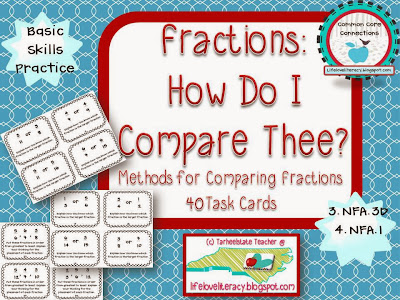
I just uploaded a new Fractions Skills product~Methods for Comparing and Ordering Fractions. This is a freebie through the CYBER Monday/Tuesday sale, so grab it now! It goes up to 2.25 on Wednesday!
http://www.teacherspayteachers.com/Product/Methods-for-Comparing-and-Ordering-Fractions-Task-Cards-3NFA3D-4NFA1-1003661

http://www.teacherspayteachers.com/Product/Methods-for-Comparing-and-Ordering-Fractions-Task-Cards-3NFA3D-4NFA1-1003661

Wednesday, November 27, 2013

Fractions, Fractions, Fractions! ~Differentiation at its Best!


Hi All,
This post is going to be about FRACTIONS! And, DIFFERENTIATION (don't you love it when it just works out?) We have been working on adding and subtracting fractions with unlike denominators in my class. I started with Jennifer Findley's Winter Themed Fraction Centers, specifically I used the snow globes addition and subtraction of fractions task cards. (These were simple problems with unlike denominators that were easy to make common, no word problems, just equations, so a good first step for practice).

Once students understand finding common denominators, I always move to subtracting fractions with unlike denominators where you must "borrow" or "regroup." I decided to make my own problems for this concept, breaking the different types of borrowing problems down instead of using my old worksheets that had everything all mixed up.

I came up with three types of problems:
* Whole Number Start
* Mixed Numbers with Like Denominators (provides a scaffolding/easier set of problems for students who have difficulty moving to multi-step problems; they can get the hang of borrowing without having to worry about finding like denominators, then move on to putting it all together with the next set of task cards).
* Mixed Numbers with Unlike Denominators

For whole number start, I taught students to use the "add up to start" strategy:
I hoped to develop some mental math skills, and students loved it because they found this method to be simple to understand.

Now, did I mention that part of this post was about "differentiation at its best?" Well, this set of task cards (and a few others that I have) allowed me to differentiate for the different needs in my classroom. I copied each of the three sets on different colored card stock. (The three types of subtraction problems come with 16 questions, with two of the sets having 8 equations and 8 word problems).

Most of my students were able to complete all of the "whole number start" problems on the day I introduced it. (I am not always concerned that students finish all of a set of task cards, but that they get enough practice, so often, a handful of students don't end up finishing them.)

On the following day, I explained to students how to borrow 1 whole and convert it to the fractional parts that they needed in order to be able to subtract. I then explained that I had two sets of cards (one with like denominators and one with unlike) and allowed them to choose where to start. I also told them that if they weren't sure which would be best for them to start on, just ask me! (I held my breath hoping that students who needed to start on the easier problems--like denominators--would choose to do so...and they did!) Students who started with the like denominator problems (orange cards) moved on to the unlike denominators (green cards) later in the week.
Once students completed the green set of cards, they worked on my Candy Shop Task Cards (a mix of adding and subtracting fractions with unlike denominators, including problems where students have to borrow.)
http://www.teacherspayteachers.com/Product/Add-Sub-Fractions-w-Unlike-Denominators-Word-Problems-Candy-Shop-5NFA1-5NFA2-464987

 Subtracting Fractions with Unlike denominators task cards word problems

 Adding Subtracting Fractions Unlike Denominators Task Cards Word Problems Models
This is our second year teaching the Common Core State Standards, and I believe that I am finally getting my resources for math stocked so that I can better differentiate for my kiddos. I have a group of about 7 students that always need reinforcement of a lesson and move a lot slower than the rest of my class. Most of the rest of my students are "gifted" and just catch on to math concepts very quickly. What to do, what to do with all of these different levels of math students? Often, I introduce something quickly and allow my gifted students to ask questions as they are working, instead of trying to hit all of the ways they might see the problem. I have also developed the strategy of explaining a common question that pops up to one or two students and then asking them to teach others when they come to me with questions. It works out pretty well for us!

My group that moves a little slower gets a reteaching lesson, perhaps explained in a different way, and some extra practice with me before they head to working on task cards. They worked at the kidney table this week and I sat with  them for the most part. This group also benefits from immediate reinforcement, so I am sure to check their work regularly during task card work. (This also helps me catch them before they make a pattern of mistakes too many times.)

You know what else helped my differentiation the past two weeks? I was able to fit TWO large carpets in my room! I have one in front of my reader's workshop white board and one in front of my smartboard. I also have a kidney table, so I was able to send students to different carpets to work on the different levels of task cards. When students finished one set and got their answers checked, they are able to move on to the next carpet and set of questions. It worked like a well-oiled machine!

Next, we move on to multiplying and dividing fractions, so I have to assess what materials I already have for this and get to work on anything new that I need. You can check out all of my fractions products HERE as I reorganized and labeled some of my TPT store this week!

After a successful week of differentiation in math, I feel like "Genius teacher"~said with sarcasm! Will I ever perfect this machine? Sometimes I find myself relearning lessons that I thought I learned years ago (with 8.5 years under my belt); sometimes I find it hard to carry what I thought I learned from one group of students to another group, but then they show me that they need the same basic structure!
PS~When differentiating with a number of different task cards, worksheets, or problem sets, PREPARED ANSWER KEYS are a MUST for my sanity! All of my task card sets come with answer keys and I fully appreciate it when I buy a product that has provided a key!!! (Often, I let my students check themselves...they don't cheat and help themselves confirm answers!)

LinkWithin

Related Posts Plugin for WordPress, Blogger...