Showing posts with label reading life. Show all posts

Sunday, July 14, 2013

Peek at My Week~Back to School Tomorrow!!

It's finally time! 
Here's a peek at my upcoming week! 

 
Farley’s Currently for the Classroom for JULY (I plan to use Currently every month this year! These will be great assignments to post in the hallway and I think Kiddos will love to see what was happening for them month to month.
  
If you've been reading my blog for a while, you know that I have fallen in love with morning meeting. Last year, I tried to squeeze it in from 8-8:15, but this year, I want to give it more time on the schedule, so I have blocked off 8-8:25. I have also begun working on a "Year's Worth of Morning Meeting Themes and Ideas" so that teachers can have a morning meeting resource ready for the whole year. This is going to take a little while to complete, but what you see above are the themes I am introducing this week. Basically, I want to have a quote, key words w/ definitions, read alouds, and videos/modern songs to match each morning meeting theme. In the future, we will focus on one theme for a week, however, I plan to introduce 5 important "beginning of the year" themes this week and spiral back to them in following weeks. I hope to get to belonging, kindness, perseverance, and legacy during this week's morning meetings.

Here's a peak at my morning meeting bulletin/display boards. I love the clothespins because I can just take down an old theme and put a new one up. (I also plan to have a display board in the room of past themes so that they stay on our minds). By the end of the week, we will definitely have identified a few classroom goals.
In addition to focusing on a theme per week, students will also have "Morning Meeting" journals this year. This will hold their reflections on the quotes we talk about and reflections on their personal goal setting. Who knows what else will end up in these notebooks--I'm sure we will have some classroom issues that need to be solved, so our brainstorms will also go in these notebooks. Basically, morning meeting is a therapeutic time to focus on being better human beings. I CAN'T WAIT to start our mornings like this! This week I will introduce each theme with a read aloud:
Launching Reader's Workshop Plans:
The goals for reader's workshop are simple this week. We won't have a ton of time to launch the full workshop with independent reading, but we will:
-learn about ourselves as readers (and share that with the teacher)
-discuss how to have our best reading life ever
-learn how to use our classroom library by understanding how it is organized
-set up our book bins with books that we are interested in reading
-set up our reader's workshop journals
-identify a book that is an "old favorite" and a book that we abandoned or struggled to read last year (won't this assignment give you sooo much info about your readers?) These books will be important in two future lessons I plan to do
-leave school with a "just right" book
-learn to set ambitious goals for our daily reading lives

Monday: Quick review of what it means for a book to be "just right;" explore classroom library and discuss how it is organized (maybe split class in half to work with two small groups and then come together to discuss these topics)
Tuesday: Read Alouds Aunt Chip; "I read Because sheet"; discuss ideal reading space and encourage students to create this space at home tonight
Wednesday: Aunt Chip; T-Chart: Reading is the best for me when/I don't enjoy reading when
Thursday: That Book Woman- How to Choose a Just Right book, finding books we love
Friday: Richard Wright and the Library Card (reading is a gift; people in the past have had to fight hard to receive this gift)


After lunch, we have a 20 minute block before we go to specials. I plan to do the following "fun" read alouds during this time.
When the kids return from specials, we are going to spend a lot of time on our first chapter book read aloud: Wonder by RJ Palacio. And, then we are going to organize all of our notebooks and materials.
Math and Writing will be my two subject areas that take a little while to get started. At some point, we will cover/decorate our writers notebooks and do at least a few journals/lists of writing ideas/etc. In math, I will definitely do some multiplication facts games to see who needs to study more and perhaps we will do something with our Common Core Math Mathematical practices, which we call norms.

It is a BUSY week for sure!! Are you exhausted yet? If you are still on break, lucky ducks! Although, I am pretty excited to get back into the swing of things and to enjoy this first week of school excitement!

Saturday, July 13, 2013

"Penciling in" a ^Worthwhile Writing Life

Back to School with students on MONDAY!!! :) I recently created a set of journal prompts and quotation posters for my "Building a Reading Life" minilessons. As I was getting ready for our upcoming year this week, I decided that I also wanted the same type of journal prompts and quotations for writer's workshop to help me get to know my students as writers. So, here it is!

***As I was making " 'Penciling in' a Worthwhile Writing Life," I decided that "chart parts" or anchor chart labels would be really useful, so this set includes four different designs of chart parts and I am going back today to revise my reading set to also include chart parts.***

From the teacher's note in "Penciling in" a ^Worthwhile Writing Life: "You might be wondering how you can inspire your students to believe they are writers this year, and in turn, help them become invested in improving their writing abilities. First, I want to remind you that for some of us, writing can be difficult depending on what our worries are. (Who's going to read this? What will they think about it? Am I spelling this right? Does it sound good? What will someone think of me if I actually write this down? Does this only make sense to me?--any of these questions might make a young writer freeze up before getting out their wonderful ideas.)

We can help students by teaching them that writing is a gift. Writing has something to offer me in my own life. Just like running (where I receive a positive way to deal with my stress, create more work-life balance, and reap health benefits), WORTHWHILE writing provides positive benefits. Not to mention, looking back on something we have written is a gift to our future selves. (This is the LOVE of writing perspective that we can express to our students). As a safe love of writing grows, other aspects will surely grow too--grammar, spelling, neatness, etc.—”

  
Chart Parts/Anchor Chart Title Pages/Bulletin Board:

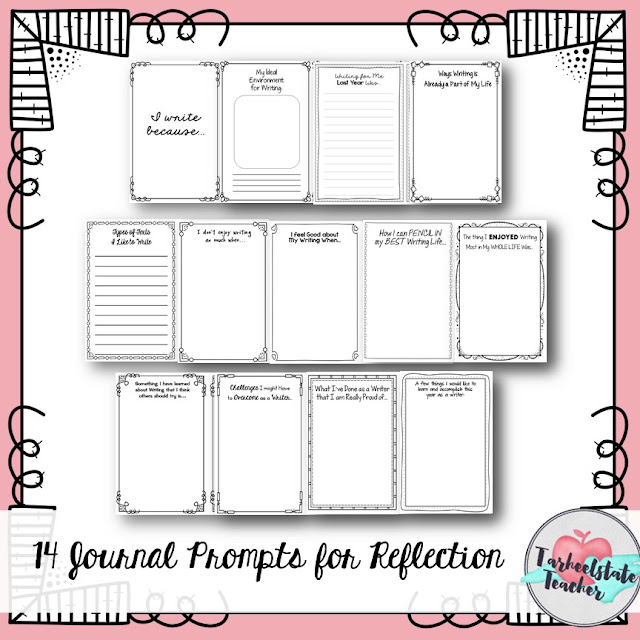
14 Journal Prompts:


15 Quotation Posters about Being a Writer:


Putting together this set of quotes was so rewarding to me. It made me start thinking about the idea of "what writing gives us" because lets face it, I am a writer. I love to write to share things on my blog and I also do some pretty creative writing sometimes when I am putting together parent letters. I have to write emails, sometimes I have to revise and consider how to reword things to get the results that I want, and I also grab my writer's notebook often to write with my students. I can think of many positive benefits that being able to write with enjoyment gives me.

So, I aim to help my students see that writing is a gift to them too--like being able to talk, taste food, have a heart do the beating for us, lungs that breathe in fresh air, to hear the sounds of music or laughter, to feel the warmth of a handshake, writing is one of our human abilities that we are lucky to have!

My Building a Reading Life set has already received great feedback! 
I am so excited about these two new creations because it relieves the stress of my minilessons for the first few weeks of school. As I get to know my students, I can pick and choose which journal prompts and quotations would be most beneficial for them to reflect on and discuss. I can't wait to get to know my readers and writers this week and inspire them to BUILD and PENCIL IN worthwhile "life love literacy" lives. :) I think the reasoning behind my blog name has finally come to fruition...haha, 2 years later! 
 

You can now get my "Building a Reading Life" and "Penciling in a Writing Life" sets in a bundle! 

Need more ideas for Back to School Writer's Workshop? 

Happy Weekend! 

Sunday, July 7, 2013

Top 10 (or more!) Back to School Read Alouds: Love of Reading


What read alouds are your MUST READS during the first few weeks of school? In the next few weeks, I am going to share groups of read alouds that I use for various purposes at the beginning of the year.

One of the main focuses of my read alouds for the first few weeks of school is a "love of reading." Here are some of my favorite read alouds to use to provide students with a variety of perspectives on having a great reading life and developing (or continuing) an appreciation for and love of reading:


Aunt Chip and the Triple Creek Dam Affair, Patricia Polacco
(All time favorite for Reading Life!) What happens to a town when a tv tower comes along? Books become furniture, props, pot-hole fillers. Can Aunt Chip, the town's old librarian bring Triple Creek back to life with a love of story, books, and the printed word? 

Thank You, Mr. Falker, Patricia Polacco
I'm sure you are familiar with this one, but Patricia Polacco was a struggling reader herself. Mr. Faulker was a teacher who made a difference in her reading life.

The Bee Tree, Patricia Polacco
When Mary-Ellen gets tired of reading, grandfather shows her how to follow the bees to a tree with honey. "Just like we ran after the bees to find their tree, so you must also chase these things adventure, knowledge, and wisdom through the pages of a book!"

•More than Anything Else, Marie Bradby
During Emancipation, Booker T Washington pursues learning to read. This reminds me of one of my favorite reading quotes, "Once you learn to read, you will forever be free!" (Frederick Douglass)

•That Book Woman, Heather Henson
That Book Woman makes her rounds throughout Appalachia and turns the most uninterested child into a reader.

The Wretched Stone, Chris Van Allsburg
The Wretched Stone entrances everyone when it is found. The men on this ship turn into monkeys and have a hard time thinking and remembering anything after watching the wretched stone for hours. (This is great for making inferences and discussing figurative vs literal--the wretched stone is a figurative television. Re-read the book after figuring this out to show students all the things Chris Van Allsburg says about the "wretched" television.)

Richard Wright and the Library Card, William Miller
What if you didn't have the right to get a library card? What if a love of reading was something you had to pursue with perseverance and at the risk of being caught? Our students don't know how blessed they are to have parents and teachers who try to instill in them a love of reading and who help them pursue reading, no matter their struggles. (set in the 1920's segregated south, Richard eventually learns to read and becomes a writer.)

The Librarian of Basra, Jeanette Winter  and Alia’s Mission: Saving the Books of Iraq, Mark Alan Stamaty
When Alia, a librarian and lover of books, is caught in the war zone of Iraq, her love of reading transcends her fear of danger. She saves 30,000 books from being destroyed. These two books tell the same story, but Alia's Mission is more of a graphic novel.

•The Wednesday Surprise, Eve Bunting
This book has a twist. The granddaughter and grandmother read together every week. Throughout the book, you may be thinking the granddaughter is learning to read, but at the end you find out she has been teaching the grandmother how to read. Great for discussing illiteracy.

•Amber on the Mountain, Tony Johnston
Another story set in Appalachia. Anna comes along and teaches Amber how to read.

•The Library, Sarah Stewart
Elizabeth is a true bibliophile, so much so that her house is overflowing with books. Eventually, she has to figure out what to do with all of her books. This is a quick read in poetic form. Easy to squeeze in at some point during my back to school week!

• Please Bury Me in the Library, J Patrick Lewis (poetry)
Mix up your love of reading discussions and read alouds with a little poetry. Some of my favorites from this book are "Are You a Book Person?" and  "Please Bury Me in the Library."

This past week, I worked on polishing a "Reading Life" packet to help me with my first few weeks back to school. I created 15 reflection templates (in 1/2 page form) and 16 quotations about reading (these are in poster form and in a form that you can print for students to put into a reader response). This set of journal sheets and quotations are meant to initiate discussions and minilessons about a love of reading and to lead your students in carving out time for the best reading life they have ever had. I also like to participate in this reflection and share my own "reading life" goals with students (like trying to read more for myself, trying to read a book that one of them has recommended to me, etc.) IF YOU HAVE PURCHASED THIS PRODUCT, IT RECEIVED A BEAUTIFUL REVISION 6/26/2016, so please go re-download in your tpt account!

I made sheets of the quotations so that I can copy them and give them to students to analyze, to help us have discussions, and most importantly, to help me learn more about their reading lives so that I will have some ideas about how to help them have the best reading life ever!

I created 15 1/2 sheets to go into the "reading life" section of their journals. I will not use all of these at the beginning of the year, but I thought that the ones I do not use early in the year would be great for "boosters" when we need to revisit our reading life conversation (for example, when we return from our first break or as "New Year's" reflections for reading.
Last year, I called my Reading Life unit "Coaching Your Own Reading Life." I decided to divide students' reader response notebooks into four sections (these are included in my reading life product):

What is the purpose of each section?

My Reading Life holds beginning of the year “Reading Life” journal prompts, responses to quotes, and can contain responses to the end of classroom read alouds. We use an “I remember” structure to celebrate and respond to a book when we finish it.

Coach’s Huddle: a place to put handouts from the teacher, record notes from mini-lessons,etc.

Practice Time!: In this section, students respond to the classroom read aloud; it is used as a space for active engagement during mini-lessons and for students to practice a concept with teacher support.

Game Time: When students respond to their own reading (or book club books,) it’s GAME TIME. This is when students take what they have learned about reading and apply it with their own responses.

Students started to run out of pages in their marble notebooks this year. Some students glued another marble notebook to their first, so this year, I am just going to have everyone glue two together from the beginning of the year. How exciting! (Maybe I will tell you more about how much I LOOOOOOVED reader response this year~we instituted a 10 minute write right after minilesson and it did WONDERS!)

I hope you LOVE LOVE LOVE reading as much as I do. And, I especially love to turn my struggling, apathetic readers into READERS for life. I hope I am ready for whatever challenges my students have in store for me this year...only 7 more days until the first day of school! :)


Tuesday, June 18, 2013

New Series: 1-1...with Class-Getting Started in Reader's Workshop!

In a few weeks, I will be a 5th grade teacher with a 1-1 classroom. Wow! That sounds like a lot of responsibility and a lot of change. But, I am SOOOOOOOOO ready for it. Well, ready, but not exactly prepared I guess. As I was planning over spring break, I couldn't help but think how this or that lesson or unit would be so much better (or different) if I had easy access to laptops in my classroom. (We have a computer lab and a few classroom computers, but the ability to differentiate is just not the same as it will be with EVERY child having access to a computer within seconds.)

So, I'm going to start blogging about my journey through the 1-1 classroom initiative. Sometimes I will talk about how I see things changing (like how reader's workshop will look in my 1-1 classroom), while other times I will highlight a website or resource that I have found. (For example, in upcoming posts, I will share and evaluate websites that I will consider foundations in my 1-1 classroom.)

FIRST UP....Online Conferring Notes and Student Reading Logs

In my 1-1 Reader's Workshop, my students will complete their reading logs in a google spreadsheet and I will log my conferences with them on a separate tab in the same document. In the above pic, I will use the list of reading areas (highlighted in mint) to note the student's main reading goal(s). Moving these documents to an online format will be fantastic for collaboration (the AIG teacher comes in to confer with some of my students) and for sharing conversations around books with parents. My student reading logs tend to drop after first quarter, and I'm fine with that as long as I know students are reading, but with an online spreadsheet, students will be required to either complete it at night or in the morning before the bell rings.

Benefits of an online conferring form and student reading log:
* Increase collaboration and documentation of AIG/inclusion teachers' work with students
* Given that students have completed their reading log, you can take a quick scan of what they have read before starting the conference (make observations like range of reading choices, progress through books, how much time is being set aside for reading at home, and compare pgs the child is able to read at home with their school stamina)
* Students now have access to your confering notes and ideas that you expect them to continue thinking about (this also means that you have to make sure you write all of your comments in a kid-friendly, positive tone)
* The document can easily be shared with parents so that they stay in the loop
* How about upping the ante on your informal record keeping--you have documentation for report cards
* You have access to your "conferring binder" everywhere that you have internet access WITHOUT having to carry around a chunky binder (WIN-WIN-awesome!)
****I can already envision myself adding a tab for documentation of a student's progress towards a specific goal (I use CAFE-ish goal setting in my reader's workshop). How easy to chart some fluency or words per minute progress in one of these files :) ****

If you like this google spreadsheet, you can go to file, make a copy, and have it for your own students. When the year begins next year, I will share the spreadsheet with students, teach them how to make a copy, and then have them include their first name in the title. I also have a classroom laptop, so when we confer, I will be typing notes instead of handwriting.

If you kind of know your way around google docs, here's how I plan to organize these files. I will have a "Reading Conferences" folder in my google drive that I share with the AIG teacher and any other staff members who work with my students in reading. Next, I will place the spreadsheet that I have already made in the "Reading Conferences" folder. Then, I will copy the spreadsheet and add student names until I have made a spreadsheet doc for all students. Last, I will share each individual spreadsheet with the student it belongs to (they have google drive accounts!).

Is your school 1-1 yet? What are you thinking about? How did your implementation go? What "must have" sites have you found? 
 

Saturday, June 15, 2013

Favorite Classroom Read Alouds

 
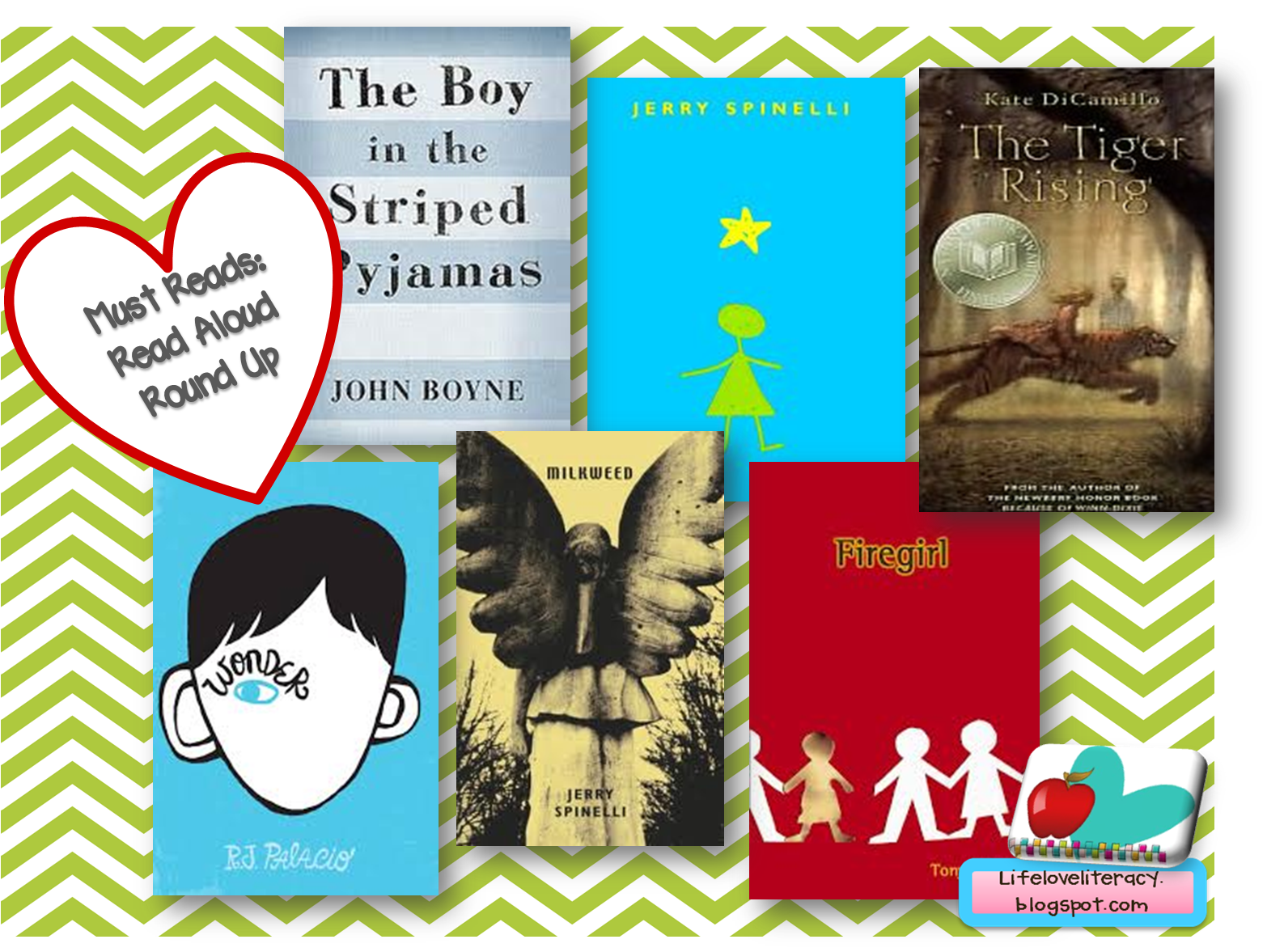
1. Wonder by RJ Palacio: Wonder is so "hot of the presses" new. It's the first summer read that I finished (in just a few days and I am a SLOW reader). I am so excited to share this book with students as my first read aloud this year. Auggie was born with a craniofacial disorder. He was born with droopy eyes, a cleft pallet, and missing part of his jaw. He is used to people looking at him and quickly changing their gaze or looking down. His parents chose to homeschool him until 5th grade. The book chronicles his 5th grade year in a middle school setting. As you would predict, he experiences bullies, fake friendships, and hurt feelings, but he also experiences true friendship, triumph, and finally--acceptance. I had to fight off the urge to sob the entire time I was reading this book. I truly think it's a wonderful way to start the year, bring together a group of students, and teach compassion. I also feel that this book challenges every reader (young and old) to see through how superficially we live our lives and to challenge how critical we are of our own looks. I can't say enough amazing things about this book (but I can promise you will hear more about it as I use it with my students!) Other key highlights:

* The inspiration for the name of the book, Natalie Merchant's "Wonder" is icing on the cake and will provide opportunities for text-text connections. ("I must be one of the wonders, God's own creation!")
* The story is told by a number of characters, mostly chronological, but sometimes overlapping the previous teller's section (opportunity for multiple-perspectives)
* A number of mantras are shared throughout the book through Auggie's English teacher
* RJ Palacio quotes a song at the beginning of each characters' section
* Many references to pop culture--Elephant Man, Star Wars, the Ugly Duckling, Beauty and the Beast (just to name a few)


2-3. Boy in the Striped Pajamas by John Boyne AND Milkweed by Jerry Spinelli: I must confess that these two were not read alouds this year, but book club books. However, through my minilessons on themes, symbolism, re-reading to catch things you might have missed originally, etc. I pulled excerpts of each of these books into my lessons. And, students were so into discussing their books and making connections during minilessons that I felt like every student got a good sense of the books no matter what they were reading individually. This year was the first time I read The Boy in the Striped Pajamas and Milkweed myself, and after sharing the experience with my 5th graders, and knowing that we referred to and repeated lines from these books ALL the YEAR LONG, these books top my FAVORITE books of ALL time list. The symbolism of angels throughout Milkweed is so strong that I now believe in "everyday" angels. The Holocaust is a sensitive topic for 5th graders, but we got so much out of the unit last year that we plan to do this unit again. I created a parent letter to inform them of our plans to learn about the Holocaust. (You can download it for free and change to fit your needs.) For more about my Holocaust lessons...
 
4. Stargirl by Jerry Spinelli: Stargirl almost always makes itself into my year as a book club, but this year,  I used it as a read aloud to target the theme of "conformity."  I hope you are already familiar with Stargirl, but basically Mica Area High School is the "hotbed of conformity." Everyone, even the unpopular kids, seems to follow along with Hilary Kimball and Wayne Parr. Until, Stargirl, a homeschooled, unique, march-to-the-beat-of-her-own-drum, girl comes along. Leo, the narrator, eventually falls in love with Stargirl, but soon realizes that he is being ostracized because of his friendship with her. The critical conflict in the book is the choice Leo feels he must make between being accepted by his peers and continuing a friendship with Stargirl. Regret, "being caught between a rock and a hard place," and accepting others for their uniqueness (rather than expecting them to conform) are huge themes in Stargirl.

5. Firegirl by Tony Abbott: I have used Firegirl as a read aloud once and in a book club this year. If you want a read aloud that gets at some of the same themes as Stargirl and Wonder but that is a shorter, less complex read, Firegirl is the one for you. Jessica comes to Tom's school mid year because she is receiving burn treatments at a local hospital. Jessica was badly burned when a gas tank exploded while her mom was pumping gas. As you can imagine, the environment in the classroom totally changes when Jessica joins the class. Although she is not able to come to class all of the time because of her medical treatments, when she does, no one speaks to her or wants to touch her. Mid-book, Tom begins a friendship with Jessica when his teacher asks him to drop off some of her school work at her house. When Jessica returns to her regular home, Tom has major regrets about not reaching out to Jessica and befriending her sooner. This book again gives you the opportunity to teach compassion and regrets, but also lends itself to discussing with students how to be a leader rather than a bystander.


5. The Tiger Rising by Kate DiCamillo: The Tiger Rising is CAPTIVATING for students, but I love it because it has so much to teach us about dealing with our demons. The amazon.com description does not do this book justice, "Walking through the misty Florida woods one morning, twelve-year-old Rob Horton is stunned to encounter a tiger—a real-life, very large tiger—pacing back and forth in a cage. What’s more, on the same extraordinary day, he meets Sistine Bailey, a girl who shows her feelings as readily as Rob hides his. As they learn to trust each other, and ultimately, to be friends, Rob and Sistine prove that some things—like memories, and heartache, and tigers—can’t be locked up forever." During my reading aloud of this novel, I taught students to walk in the characters' shoes, have compassion, and deal with their own "suitcase" of emotions. I seriously felt like I was teaching guidance lessons at the same time that I was teaching reading skills. To me, the tiger is the LEAST of importance in this book, but it keeps the kids wanting more and is a symbol of Rob and Sistine's own imprisonment by their emotions. Sistine's father is out of the picture and Rob's mother has recently died. Rob's father moved them to another town to get away from the pain, never talks about his mother, and has a hard time showing love towards Rob. Rob stuffs his feelings inside a metaphorical suitcase. On the otherhand, Sistine is always ready to let her feelings explode and often lets them out by beating on the bullies at the school. If you have not read this book, you MUST put it on your "to read" list. It took me all of an hour to finish and I did not want to put it down!!!!

From the looks of this list, it's safe to say that I like to choose read alouds that help teach my students how to treat one another with tolerance and compassion, how to face life, and how to become better people. I think each of these read alouds stick with students forever.

Hop on over to Mr. Hughes blog, Created by Mr. Hughes to check out this growing list of suggested read alouds. Although I suggested read alouds for 5th grade, the linky list ranges from 3rd through 8th and is divided by grade level. If you are a blogger, you can link up too!

Happy reading!


Green Chevron Background in first picture by

Monday, October 15, 2012

Minilesson Magic: Coaching Our Reading Life

As promised, this Monday's Minilesson Magic focuses on my lessons for "Coaching Your Own Reading Life." To get this unit (and really our year) in reading started,  I talked to students about how a coach anticipates the challenges their team will have during a game and designs strategies to overcome those challenges. As readers, we can anticipate challenges that we might face in a book, and we can use many strategies that we already know to overcome those challenges. I wanted this unit to challenge my students to PUSH themselves as readers and to rely on themselves for the challenges they encounter.

My first lesson focused on how to use the book jacket to anticipate and predict the challenges we might face. I used The Seekers: the Quest Begins by Erin Hunter.I typed up the description from the book jacket on half sheets for students to place behind "Practice Time" in their reader response notebooks.
From this book summary, we could see that the number of characters was going to be a challenge and the different character names could be challenging if we didn't have a strategy for helping ourselves remember them. Another challenge is that it appears 3 different stories are actually going on in the book--three different settings, three different families, three different problems.

For each of these problems, we can decide on a strategy to use to help us overcome it. (It is assumed/understood that students are choosing just right books, but this lesson asks them to "up the ante." Rather than quickly deciding that a book is too challenging, students identify strategies that can help them persevere through the book.) Our strategy for keeping up with character names was to create a list of characters. In this case, we needed to keep them grouped by families. We then decided to create a chart of the three sets of characters, three settings, and the three sets of problems they are facing. We organized this so that we could keep up with each storyline. Keep in mind, this book did not turn into a read-aloud, but the book jacket information was perfect for the minilesson. (I also had a student in the class reading the book--and these strategies were perfect for helping that child be successful).


I also taught how to preview well enough that we figure out the structure of a book. I used The Seekers again. As we flipped through the book, we noticed that each chapter had a title of one of the character's names. We figured out that the story would flip back and forth between the characters. If we had not figured this out from the beginning, we might have been confused for a while, but since we were prepared for that before we started to read, we would probably be pretty successful. We could look back at our character/setting/problem chart each time we start a new chapter to help us remember what's going on with that character.

I used Schooled by Gordon Korman as another anchor text for analyzing the text structure. Basically, this story is also told by MANY characters in the book, so students need to be ready to read each chapter through that character's voice.

This may seem like an obvious thing, but I have a number of students who are great at reading words but struggle with comprehension. I have found that identifying the way an author has structured the book is one of their biggest pitfalls.  These students usually do not spend enough time previewing and specifically trying to figure out how the book is going to go before they start to read.

If you are teaching students to "coach" themselves in the lower grades, strategies like IPICK or the "3 finger check" for choosing just right books, identifying the genre and thinking about how stories like that usually go, previewing to predict what the book is going to be about, and keeping up with character names would also be appropriate. Teaching students how to use story structure to their advantage would also fit into this unit. Really, you can modify "Coaching Your Reading Life" to target any strategies you find students are not using independently that you think they should be. 

Have a happy week creating literate lives!


Friday, October 5, 2012

Reader Response Set Up: Coaching Our Own Reading Lives

Today I want to share snapshots of my reader response journals. This year, I set them up with sections for the first time and am loving the sections I used. I have to admit, I was super-scared to create sections--how do you know how many pages to leave for each--and what if the kids run out of space---arrrghhh. I just decided to GO FOR IT!!!
 
Last year in 4th grade, my students and I spent a large portion of our 1st 9 weeks talking about "Building a Reading Life."
Students' reading lives are solid, so for their 5th grade unit, I had to come up with a unit that would ask them to step it up a notch. I decided to teach them how to "Coach" their own reading lives. I used the reader's statement, "Readers take charge of our reading lives by realizing we can be our own coaches. Like a coach, we can predict the challenges a book might present us and use strategies to overcome them." Today I wanted to focus on how I set up my reader response notebooks, but if you want to hear more about my minilessons for "Coaching Your Own Reading Life," tune in to Monday's Minilesson Magic this week  and I will tell more.
Based on the theme of "Coaching Your Own Reading Life," I thought about the sections I wanted to have in my notebooks. I thought it was important to have a place that was about the reading life (especially for beginning of the year reflections), a place for information from minilesssons that can be used again and again--handouts, reader statements, etc, a place for students to practice what we are learning in the minilesson and responses to our read alouds, and a place for work they do with their own book. I really wanted to keep the sports/coaching theme going, so I decided to break the reader's response into the following sections:  
To make the sections cutesy (and to mark them), I had a parent make circles, stars, and hearts out of scrapbook paper. I typed up the titles for each section and had students glue them on the pages listed above. Numbering the notebook was quite an ordeal. We did it in chunks of 20 and I had students partner up to check each other's numbering to catch each other's mistakes. After a partner had checked the 20, they could move on to numbering the next 20. Another thing I learned is that marble notebooks aren't standardized. I thought they all would have 100 sheets, but apparently the more decorative notebooks short on notebook pages :( I will be specifying this on next year's supply list now that I know!
I got many of my ideas for what to have students do in the "Reading Life" section from Julie Ballew's Website. Sadly, we didn't get to many of these great ideas, but we did complete the "I read because..." brainstorm.
We also reflected with a list of "Reading is the Best for Me When..." characteristics.
I would have spent the time to do more of the activities if  I felt my students were still "building" their reading life (which really means buying into how great reading is and making sure that we are committed to it in our lives), but since I had already spent a quarter the year before building the reading life, they already loved to read and were ready for more--and I was surely ready to get into teaching them how to be their own coach.  Saving space at the beginning of the notebook is also great for reflecting at the end of our units. For example, when we finish our historical fiction unit, I can have the students reflect on what they learned about reading historical fiction or I could make it more creative and have them make a list of tips for another student who is about to read historical fiction, etc.
 
I hope you enjoyed a look at my reader response notebooks. Hopefully I will get to let you peak inside more during Monday's Minilesson Magic! Do you use reader response notebooks? Do you set up your notebooks with different sections?

PS-I am SUPER excited to see that I have 100 followers on my blog! I just broke that 100 mark last night. Thank you so much for following and I hope you are able to pick up ideas. Feel free to comment on my blog at anytime. You can even tell us about posts you have written on the same topic. I would love to hear from you!

LinkWithin

Related Posts Plugin for WordPress, Blogger...