Showing posts with label theme. Show all posts

Friday, February 20, 2015

~~Morning Meeting Made Easy~Set 2 Ready!~~

Finally!!!! My second set of Morning Meeting Made Easy themes is complete! This makes me super happy because I have had the draft in the works for MONTHS and it's been one of those projects that has been hanging over my head a little.

If this is the first you are hearing about my Morning Meeting Made Easy sets, let me tell you more! Last year, I decided to try a theme-based morning meeting and loved it! I created a list of themes for personal development, came up with related vocabulary words, and found quotes to match the themes. I created posters for each theme so that I could display our community themes all year for us to refer back to. I also used key read alouds to initiate my discussions with students about the theme. From this idea grew "Morning Meeting Made Easy." Not only does the set include posters for each theme, but you get student journal pages and teacher overviews that suggest read alouds, possible activities, and videos or songs that connect to the theme. This product is seriously READY to USE instantly, except for grabbing the picturebooks!


My first set of Morning Meeting Made Easy includes the following themes:
You can check out my detailed post about teaching through the theme of belonging earlier this year. (It includes my daily plans! At that time, I had not yet completed my student journal pages, but you have them ready to go AND my belonging set is offered as a FREEBIE download on TPT and TN!) Best of all, you can also use this as a mini-literacy unit on theme. It is SO ready to go and the discussions are SO rich. {Belonging has to be my most favorite theme to teach through} :]

You may also purchase themes as individual downloads, but I highly recommend going for the whole set (they are cheaper as a set, of course, and I believe that using many of the related themes helps spiral back to previous conversations and helps build your students' understanding of theme even more--leading to growth in your classroom community.)
Compassion Theme 
Conflict Theme
Perseverance Theme
Kindness Theme
Compromise Theme
Happiness Theme
Achievement Theme
Individualism Theme
Integrity Theme

Here's a closer look at my Kindness student journal pages. (All included in the kindness download or the MMME Set # 1.)

Happy Friday! We have been out with three snow days in a row and have a two-hour delay for Friday. Gotta love being a "Tarheelstate Teacher!"

Sunday, September 21, 2014

Belonging Theme Lessons in Action~Morning Meeting Made Easy


My goal at the beginning of the year is to introduce the classroom community themes that I plan to focus on throughout the year. Then, I plan to spend at least a week exploring each theme in more depth with my students. This week, we focused on belonging. {My students use a marble notebook for Community Meeting. I used the coverpage image to create stickers on labels for them to place on the front of their notebook). 

I have a quick 15 minutes each morning before my students go to special area classes. As I think about morning meeting for the week, I know that I will have some quick days and on other days, we will have a longer block of morning meeting that continues after students return from special area classes. Morning meeting can take as little or as much time as you have, but I think it is nice to have the flexibility in my schedule to have some days that are quick and some that are longer where I can push for deeper thinking  and discussion. You will see this alternating change of pace in my week's outline below.


I had already read aloud Big Al by Andrew Clements during the first week of school. We watched how Big Al, the ugliest fish in the sea, tried many things in order to fit in. When a fisherman's net captures many of the fish, Big Al saves the day and gains a sense of belonging. Finally, he has the most friends of all the fish in the sea.
On Monday, I quickly shared our focus theme for the week, shared the related quote, and went over key words. I post the theme, quotations, and vocabulary on our "community themes" bulletin board and give students a copy in a journal page format. Then, students complete the self-assessment and goal setting pages. (I print these as 1/2 pgs for students to glue into their marble notebooks).
Tuesday/Wednesday: After introducing the theme to students, I spend time building the theme with as many examples as possible through read alouds. I read aloud Babushka Baba Yaga by Patricia Polacco on Tuesday and Wednesday. If I had pushed it a little, I could have finished the book in one day and read Somebody Loves You Mr. Hatch by Eileen Spinelli. However, the beauty of my morning meeting is that I can spiral back to these themes again and again, adding new texts to push students to add to and enhance our understanding of the theme with another author's take on it. (For example, when we do return to Somebody Loves You, Mr. Hatch, I think that we could learn that sometimes a person's isolation keeps them from having a sense of belonging, but if they could or would step outside of their shell and take a risk, others are more than happy to welcome them with open arms.) You can see what we learned from the other stories in the chart we made on Friday.

Thursday: We watched The Lost Thing and discussed how what we saw in the video related to our belonging theme. (There is SOOOOO much to talk about in this video. I could do an entire week of lessons just on it, but I mostly stayed focused on the idea of belonging in this lesson, knowing that I would be able to go back to it and use it later in other lessons. For example, why is "the lost thing" a lost thing--who says he is 'lost'? Is it really lost? Do we have to find others like us (or assimilate) to gain a sense of belonging? What does "the lost thing" symbolize? etc. This is a rich video for "close reading" lessons! It is also sending a message about individuality in a society of sameness, so I plan to use the video again during our Individualism theme.)
Friday: We have met many characters this year that have tried to gain a sense of belonging (especially this week with it being our theme focus), so it was time to start comparing our story lines and identifying generalizations. Students worked to fill out this simple chart and then we created a class chart on the smartboard. This was one of our longer morning meeting lessons this week. We could call this stage "synthesizing" :).
Drawing Conclusions and Going Deeper: Since completing our chart took a little while, we are going finish up our belonging theme on Monday by reviewing the information we put into the chart and drawing conclusions about belonging as a theme and a desire. I have lots of questions for my students, but here is what I hope they notice:
-In stories, sometimes characters "save the day" and gain a sense of belonging from that act. Is this realistic for a student who does not fit in or seem to belong?
-Does changing yourself to fit in with others seem to work? (Is this "fix" long-lasting? Is this fix of not being ones "true self" sustainable?)
-Is it possible to accept others for who they are, give them a sense of belonging and love, without expecting them to change to fit our idea of "normal" or what's popular/cool?

I love having "The Lost Thing" as an example in the mix of our analysis because how he gained a sense of belonging is much different from how the Baba Yaga and Big Al gained a sense of belonging. (Basically, the narrator finds a place where other things look like the "lost thing" and drops him off there. Instead of the "lost thing" actually being accepted into mainstream society, he goes to live with others of his kind.)

If you want to pick up my "Belonging Freebie," it's in my teacherspayteachers store. Morning Meeting Set 1 and Set 2 are now available.

This week (and probably next), our theme will be Achievement because it's mid-way through the quarter and time to set some goals. I'll post about those lessons soon!

PS: I am working on Pinterest boards for each of my morning meeting themes. If you decide to start implementing theme-based morning meeting lessons, you can follow my boards to have all of the video resources in one place. I will also be adding other goodies I find that may not be linked in my Morning Meeting Made Easy product.
Follow Tammy's board Belonging (Classroom Community) on Pinterest.


Sunday, September 7, 2014

~Morning Meeting Made Easy! Set 1 Ready~

It's finally finished! My Morning Meeting Made Easy set is ready to go for your classroom community meetings!

First, let me say, I call my morning meeting by a few different names: morning meeting, classroom meeting, and community meeting. Having our classroom meeting in the mornings doesn't always fit into our schedules, right?

Last year, I decided to try a theme-based morning meeting and loved it! I created a list of themes for personal development, came up with related vocabulary words, and found quotes to match the themes. I created posters for each theme so that I could display our community themes all year for us to refer back to. I also used key read alouds to initiate my discussions with students about the theme. From this idea grew "Morning Meeting Made Easy." Not only does the set include the posters for each theme, but I created student journal pages and teacher overviews that suggest read alouds, possible activities, and videos or songs that connect to the theme. This product is seriously READY to GO, except for grabbing the picturebooks! I'm so excited to have this set completed because Morning Meeting will be so much easier for me to plan for this year!

My morning meeting may be a little different than what you are used to seeing (google morning meeting and you may find calendar lessons, name games, get-to-know you activities, and morning messages). I have found morning meeting to be more typical of a lower-grades classroom, but I wanted my morning meetings to focus less on getting to know each other and more on getting to know ourselves and more about humanity. How do humans treat each other, why do we act the way we do, and what can we do to act more like how we believe we should? I also use classroom meetings to problem solve any classroom issues that have popped up.

My first morning meeting set focuses on belonging, kindness, compassion, conflict, and perseverance. I think all of these themes are important to discuss at the beginning of the year!
The shift in how I use and plan for my mornings meetings actually aligns perfectly with what I have done in past years with personal goal setting. For each theme, students have a journal page where they self-reflect and set a personal goal for improving in that theme. At the end of the week, students return to their goal to reflect on how they have improved or how their thinking has changed. (Students should have lots of ideas and opportunities to make improvements on the goal because you have continued the conversation all week!) Through our classroom meetings, I encourage personal improvement, character development, and community building.
Each theme's journal pages include a cover page with the theme, quotations, and key vocabulary, a self-assessment/reflection page, a 3 questions and illustration page that helps students analyze the theme and think of real life examples, and a quotation and video reflection sheet. Other goodies include sheets for making connections between read alouds and quotations, word brainstorms, and beginning middle, and end sheets. You will surely see many ways to extend the lessons and journal pages for your students. These journal pages are meant to support your instruction and classroom discussions.
To have a quick reference for teaching through each theme, I put together teacher overviews. Instead of having to search for read alouds, videos, and related songs to use, you have a quick list to get you started and can add to this with books you are already familiar with.
In my next post, I share a day-by-day possible teaching sequence. Two sets of Morning Meeting themes are now available. If you want to check out the theme sets up close, you can download my belonging set freebie!

Tuesday, October 15, 2013

Social Studies through FREEDOM and OPPRESSION

Are you capitalizing on every opportunity to teach your students about theme? Could conceptual lenses raise the level of the work your students do in social studies and help you meet some of your literacy goals? What is the purpose of a conceptual lens?

A CONCEPTUAL LENS NARROWS THE SCOPE AND PROVIDES DEEPER FOCUSES FOR CURRICULUM. It provides a reciprocal relationship between CONTENT learning and CONCEPTUAL levels of thinking. Conceptual lenses provide direction for the kinds of thinking that will be accomplished during a unit of study.

I got super-excited this year as I began teaching THEMES through my social studies instruction. Teaching through a conceptual lens has been the biggest shift in my social studies instruction this year and I believe it has made a huge difference. As students think about historical events through different lenses, they are learning to recognize patterns and make connections that transfer beyond social studies and that specific time period. In addition, this helps me FOCUS the materials I choose to use during the unit. 

One of the beauties of a theme or lens is that these "big ideas" can also be found as important themes in literature. Therefore, by teaching through a focused lens in social studies, you are providing students with opportunities to access literacy concepts and skills across the curriculum.

To begin my instruction with conceptual lenses, I decided that US History (and surely every other history) boils down to FREEDOM and OPPRESSION, and within that, a struggle for power. I decided that freedom and oppression would be my overarching themes for social studies this year.
These posters are currently hanging on a bulletin board in my classroom to remind students of these themes. 

Here's a basic outline of how I launched our yearlong theme and goal for social studies --thinking through FREEDOM and OPPRESSION:
 
Another option would be to use a book like Encounter by Jane Yolen and chart examples of freedom and oppression from both the point of view of the Spaniards and the natives.

I decided to think through the larger chunks of US History and come up with themes that are threaded through those time periods that could be used as conceptual lenses. Here's a peak at some of the other themes/conceptual lenses I came up with: 


Not only did I make these theme definitions for bulletin boards or to pull up on smartboards, I also created student journal definition pages. These are 4 to a page, so you can easily copy them and have students glue them into their notebooks. We put our freedom/oppression definitions on the first page so that we could continue to look back and reflect on how our current study relates to freedom and oppression.

I got so excited about conceptual lenses that I decided to also make fold-ables to go with the themes. 


(My conceptual lenses include: freedom, power, oppression, change, causes, effects, compromise, propaganda, conflict, perceptions, relationships, assimilation, revolution, independence, government, democracy, ideals, beliefs, advancement, division, discord, movement, equality, injustice, influence, prosperity, crisis, being responsible, wants, needs, educated decision, innovation, interconnectedness, globalization) You can find both of these products on TPT


Sunday, June 16, 2013

Fabulous Feedback Linky

I'm linking up with Christina at Bainbridge Class for her Fabulous Feedback on the 2nd Friday's of the month. (I know, it isn't Friday! :) In this post, I get to share two great feedback comments I received on two different products. We TPT'ers especially love thoughtful feedback and as you will see below, good feedback doesn't always have to say that our product was perfect to make us smile. I especially like feedback that is more than "great," "thanks," and " :)" and I always try to provide at least one specific sentence when I leave feedback for products I purchase. 

1st up...
I love this feedback and really appreciate that mccaigwright took the time to leave a comment that was so specific. I am so glad that my Classroom Timeline has helped her pull together historical topics and concepts for her students. I love how she mentions exactly what my goal for my timeline products is--to anchor what happened and when--to begin to understand the order of important historical events in US History. I also made a flub when I created the student sheets for the timeline overview and left out the Revolutionary Era. Today, I worked on updating this product AND came up with another version of the student overview sheets.
I love this new option so much, it might be exactly the revision I need this year for my students' US History Timeline binder projects.

Here's what our finished timeline looked like this year:
 Next up...
Now, I said that I often appreciate feedback that does not say my product is perfect (when presented in a helpful, respectful way, of course :)). I totally agree with barb19's feedback that it would be nice if all of my "Theme Bulletin Board Labels" included a definition/description, although I was thinking about myself when I designed this and only thought I needed to define the words that might be new to my students. Given this great feedback, I decided to update this product with two sets of the labels--one clean, no definitions, and the other with all theme words having a definition below.

As part of my participation in the Fabulous Feedback Linky, mccaigwright and barb19 get a FREE product from my store when you see this post (no deadline!:). Just comment below or shoot me an email of what you would like at lifeloveliteracy@gmail.com.

Happy summer relaxation!


Credits: Backgrounds from Zip-a-dee-doo-dah-Designs

Saturday, June 15, 2013

Favorite Classroom Read Alouds

 
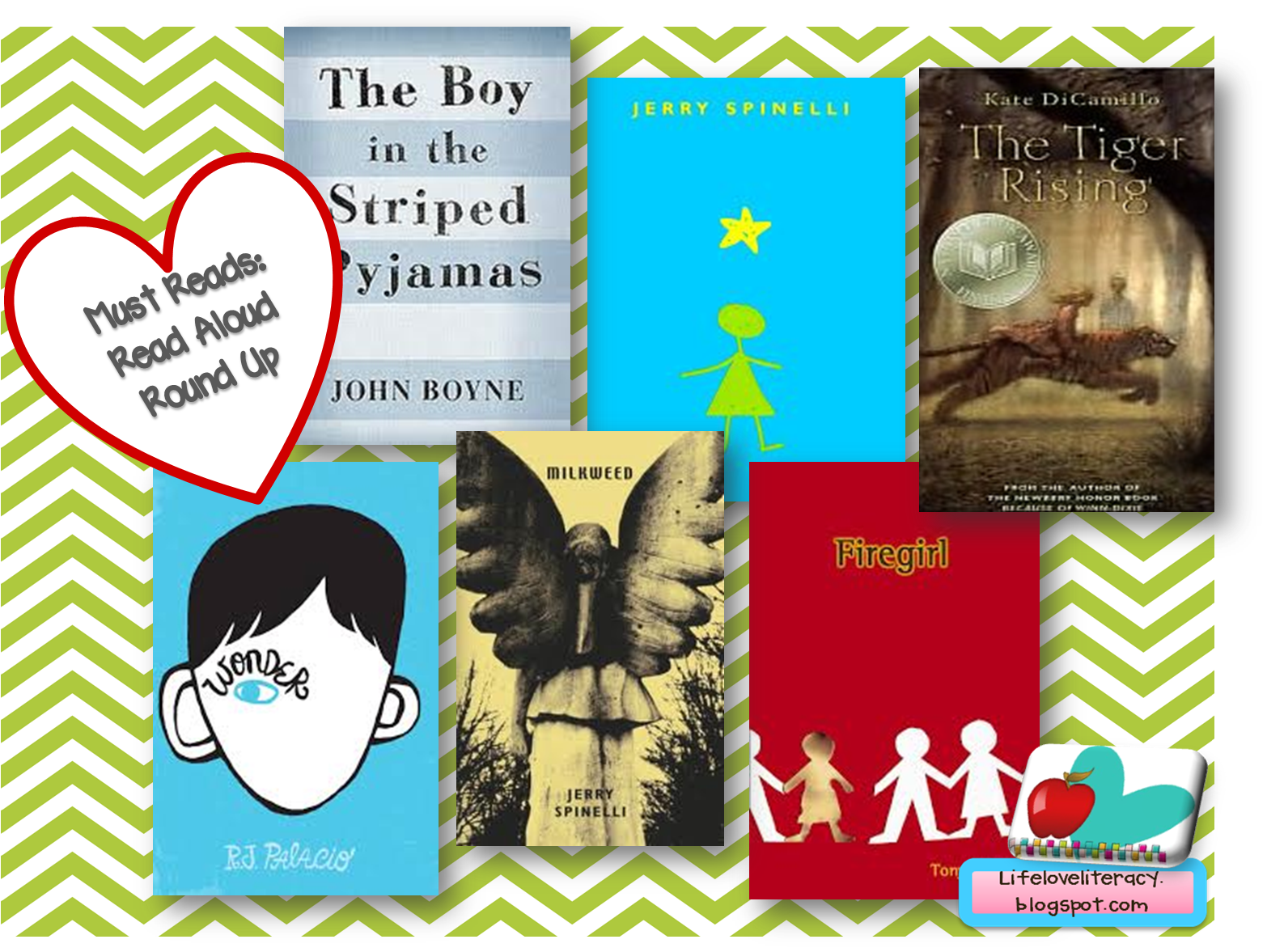
1. Wonder by RJ Palacio: Wonder is so "hot of the presses" new. It's the first summer read that I finished (in just a few days and I am a SLOW reader). I am so excited to share this book with students as my first read aloud this year. Auggie was born with a craniofacial disorder. He was born with droopy eyes, a cleft pallet, and missing part of his jaw. He is used to people looking at him and quickly changing their gaze or looking down. His parents chose to homeschool him until 5th grade. The book chronicles his 5th grade year in a middle school setting. As you would predict, he experiences bullies, fake friendships, and hurt feelings, but he also experiences true friendship, triumph, and finally--acceptance. I had to fight off the urge to sob the entire time I was reading this book. I truly think it's a wonderful way to start the year, bring together a group of students, and teach compassion. I also feel that this book challenges every reader (young and old) to see through how superficially we live our lives and to challenge how critical we are of our own looks. I can't say enough amazing things about this book (but I can promise you will hear more about it as I use it with my students!) Other key highlights:

* The inspiration for the name of the book, Natalie Merchant's "Wonder" is icing on the cake and will provide opportunities for text-text connections. ("I must be one of the wonders, God's own creation!")
* The story is told by a number of characters, mostly chronological, but sometimes overlapping the previous teller's section (opportunity for multiple-perspectives)
* A number of mantras are shared throughout the book through Auggie's English teacher
* RJ Palacio quotes a song at the beginning of each characters' section
* Many references to pop culture--Elephant Man, Star Wars, the Ugly Duckling, Beauty and the Beast (just to name a few)


2-3. Boy in the Striped Pajamas by John Boyne AND Milkweed by Jerry Spinelli: I must confess that these two were not read alouds this year, but book club books. However, through my minilessons on themes, symbolism, re-reading to catch things you might have missed originally, etc. I pulled excerpts of each of these books into my lessons. And, students were so into discussing their books and making connections during minilessons that I felt like every student got a good sense of the books no matter what they were reading individually. This year was the first time I read The Boy in the Striped Pajamas and Milkweed myself, and after sharing the experience with my 5th graders, and knowing that we referred to and repeated lines from these books ALL the YEAR LONG, these books top my FAVORITE books of ALL time list. The symbolism of angels throughout Milkweed is so strong that I now believe in "everyday" angels. The Holocaust is a sensitive topic for 5th graders, but we got so much out of the unit last year that we plan to do this unit again. I created a parent letter to inform them of our plans to learn about the Holocaust. (You can download it for free and change to fit your needs.) For more about my Holocaust lessons...
 
4. Stargirl by Jerry Spinelli: Stargirl almost always makes itself into my year as a book club, but this year,  I used it as a read aloud to target the theme of "conformity."  I hope you are already familiar with Stargirl, but basically Mica Area High School is the "hotbed of conformity." Everyone, even the unpopular kids, seems to follow along with Hilary Kimball and Wayne Parr. Until, Stargirl, a homeschooled, unique, march-to-the-beat-of-her-own-drum, girl comes along. Leo, the narrator, eventually falls in love with Stargirl, but soon realizes that he is being ostracized because of his friendship with her. The critical conflict in the book is the choice Leo feels he must make between being accepted by his peers and continuing a friendship with Stargirl. Regret, "being caught between a rock and a hard place," and accepting others for their uniqueness (rather than expecting them to conform) are huge themes in Stargirl.

5. Firegirl by Tony Abbott: I have used Firegirl as a read aloud once and in a book club this year. If you want a read aloud that gets at some of the same themes as Stargirl and Wonder but that is a shorter, less complex read, Firegirl is the one for you. Jessica comes to Tom's school mid year because she is receiving burn treatments at a local hospital. Jessica was badly burned when a gas tank exploded while her mom was pumping gas. As you can imagine, the environment in the classroom totally changes when Jessica joins the class. Although she is not able to come to class all of the time because of her medical treatments, when she does, no one speaks to her or wants to touch her. Mid-book, Tom begins a friendship with Jessica when his teacher asks him to drop off some of her school work at her house. When Jessica returns to her regular home, Tom has major regrets about not reaching out to Jessica and befriending her sooner. This book again gives you the opportunity to teach compassion and regrets, but also lends itself to discussing with students how to be a leader rather than a bystander.


5. The Tiger Rising by Kate DiCamillo: The Tiger Rising is CAPTIVATING for students, but I love it because it has so much to teach us about dealing with our demons. The amazon.com description does not do this book justice, "Walking through the misty Florida woods one morning, twelve-year-old Rob Horton is stunned to encounter a tiger—a real-life, very large tiger—pacing back and forth in a cage. What’s more, on the same extraordinary day, he meets Sistine Bailey, a girl who shows her feelings as readily as Rob hides his. As they learn to trust each other, and ultimately, to be friends, Rob and Sistine prove that some things—like memories, and heartache, and tigers—can’t be locked up forever." During my reading aloud of this novel, I taught students to walk in the characters' shoes, have compassion, and deal with their own "suitcase" of emotions. I seriously felt like I was teaching guidance lessons at the same time that I was teaching reading skills. To me, the tiger is the LEAST of importance in this book, but it keeps the kids wanting more and is a symbol of Rob and Sistine's own imprisonment by their emotions. Sistine's father is out of the picture and Rob's mother has recently died. Rob's father moved them to another town to get away from the pain, never talks about his mother, and has a hard time showing love towards Rob. Rob stuffs his feelings inside a metaphorical suitcase. On the otherhand, Sistine is always ready to let her feelings explode and often lets them out by beating on the bullies at the school. If you have not read this book, you MUST put it on your "to read" list. It took me all of an hour to finish and I did not want to put it down!!!!

From the looks of this list, it's safe to say that I like to choose read alouds that help teach my students how to treat one another with tolerance and compassion, how to face life, and how to become better people. I think each of these read alouds stick with students forever.

Hop on over to Mr. Hughes blog, Created by Mr. Hughes to check out this growing list of suggested read alouds. Although I suggested read alouds for 5th grade, the linky list ranges from 3rd through 8th and is divided by grade level. If you are a blogger, you can link up too!

Happy reading!


Green Chevron Background in first picture by

Monday, September 24, 2012

Monday's Minilesson Magic: Thinking about Theme Strategy

Drumroll please...Today I am announcing my new weekly blog post topic: Monday's Minilesson Magic!!!!! I really want to dedicate myself to posting about something each week and I think minilessons will be such a useful topic for other teachers, for me to document what I am doing and reflect on how it went, and to push me to seek out new ideas---I hope you think so too and will plan to tune in every Monday to catch the newest Minilesson Magic focus and grab some ideas.

I have been horrible at my weekly poetry post (uh-hem, please forgive me!). I can't seem to get the writing/idea/creative teacher muse inspired on my Love of Language Post so I thought trying something more general might work better: MINILESSONS :) I teach those everyday right? So, surely I can work up some magic once a week to come up with good ideas to share with you for Monday's Minilesson Magic.

I thought for my first post, I would focus on a new strategy I used this year for thinking about theme. I am always, always, always trying to push students' thinking about reading and trying to give them ways to push themselves that are tangible. I came up with the "It's About..." strategy. When I say "It's about" now my students know what I'm talking about.

I first introduced the "It's About" strategy in our first reading unit that I call "Coaching Your Own Reading Life." For this unit, I chose Pictures of Hollis Woods by Patricia Reilly Giff as our main read aloud. Before this lesson, I brainstormed my own ideas for "It's About" and chose to model for students the ideas I came up with instead of letting them share their own. I wanted to ensure that they understood what I meant by "It's About" and I explained that I wanted us to get at what the book is really about. I wouldn't say "It's about a girl named Hollis Woods who is a foster child that always runs away from the families she is assigned to." This is a summary statement, and I want to get at what the book is REALLY about. (During this discussion, I never mentioned that I was talking about THEME because I wanted our thinking to be unlimited. I introduced these students to theme last year and did not want us to only be thinking about themes the way we had before.) This strategy also gets at author's message, what the author might be noticing in the world and trying to make a statement about, and lessons we could learn. Here's what I came up with:
As I continued this lesson, I told students "I keep having to stop myself from explaining why I think it's about this or that." I think holding myself back from discussing why I put it on the poster made students really eager to think about why that would be on the list. My next step in the lesson was to ask students to choose one of the it's about from my poster, list it on the top of their next clean Reader Response page, and start explain why they think it's about that idea. Of course, we closed the lesson by sharing some of our writing.

How did we take this brainstorm to the next level? In the next lesson, we discussed how we could use this to push our thinking and I modeled for students how I could plan for my written response by thinking about the examples and evidence from the text that make us think "It's About..." The "It's about" that stood out to me the most that I really wanted students to write and think about was "It's about Wishes and Wants." I modeled how we could list this idea at the top of our page and list the reasons/examples from the book that make us think it's about that. I also told them that my list could include some of my own thinking, like "Every child wants/needs a family." I told them this is my thought because this is what I know and think is true about the world.
This strategy has already started to spiral through our reading curriculum and I know it was so easy and tangible for students that I will continue to use it throughout the year. Recently, I posted about our Holocaust book clubs (our second reading unit was "Coaching Ourselves Through Historical Fiction.") We used the "It's About..." strategy to brainstorm ideas for what themes show up in our Holocaust books. Here's my "It's About" model for Rose Blanche (Roberto Innocenti) and Irena's Jar of Secrets (Marcia Vaughan), two picturebook read alouds I used during the Holocaust unit.
Sorry this chart is messy! Once we got going with our ideas, I quickly realized I should not have separated the chart for the two books because most of the themes/It's About ideas we had fit for both books. The beauty of this "It's About" chart and lesson was that I was really giving students ideas for their holocaust book club books because most of the themes show up in other books about the Holocaust. For active engagement, students began to brainstorm an "It's About" for their book club books and then used this in their book club discussions.

I hope you can use "It's About" in your classroom (although now that I have said "It's about" about a thousand times in this post...you can choose to call it something else :)

Oh and, second drumroll please! :) My Monday Minilesson Magic will always include a list of Common Core Connections at the end that correlates the lesson ideas with the common core standards for those of you who are teaching through the common core.

RL3.2 Determine the central message, lesson, or moral in the story and explain how it is conveyed through key details in the text.
RL4.1 Refer to details and examples in a text when explaining what the text says explicitly and when drawing inferences from the text.
RL4.2 Determine a theme of a story, drama, or poem from details in the text; summarize the text.
RL5.1 Quote accurately from a text when explaining what the text says explicitly and when drawing inferences from the text.
RL5.2 Determine a theme of a story, drama, or poem from details in the text.

What minilessons topics are you currently working on? What minilesson topics would you like FRESH ideas for? Let me know in the comments :)

See you again next Monday for more Minilesson Magic!
 

Wednesday, April 18, 2012

List of Read Alouds through Themes and "Theme" Bulletin Board Labels


This year, I have worked on building students' understanding of theme to get ready for the "theme" and "central message" standards for Reading Literature in the Common Core. As I encountered the standards related to theme, Beth Newingham's theme bulletin boards stuck out in my mind. I always thought it was a great idea for displaying class read alouds, but never took the time to implement the idea in my own classroom. But, with the necessity of getting ready for our new state standards, I decided to get a jumpstart on theme this year with my students. I am so glad I did. I used to think theme was a complicated topic that was addressed in high school literature classes. Now that I have discussed theme with my students and helped them learn to identify the themes in some of our favorite read alouds, I totally think the objective of teaching theme is age appropriate and something students can handle.

Through my reflection and research, I decided to define theme as "a common message that shows up in many stories across many genres and cultures." I defined "author's message" as an author's take on a theme.

In my planning, I also created a database of read alouds that could be used to address specific themes (family, home, individualism, identity, sacrifice, accepting others, friendship, etc). I'm happy to share this database with you and hope that you can use it as a quick reference for books on a theme you are looking for. A second goal for my theme focus (and my year) was to increase diversity in my read aloud choices. You will see this diversity in the read aloud database. For quick reference, I also classified the read alouds by specific countries or nationalities in efforts to try to "read around the world."


You can download my theme label cards (including the definition posters and posters of the common core related standards for grades 1st-5th) at my teacherspayteachers store.


LinkWithin

Related Posts Plugin for WordPress, Blogger...