Monday, December 31, 2012

Incorporate more Music into your Readers' Workshop

How often do you incorporate music and lyric analysis into your reader's workshop?

This year, I have tried to utilize lyrics at least once during each of our reading units. The kiddos LOVE it when we have a workshop that focuses on connecting to the lyrics, analyzing them, and discussing our ideas with each other. I LOVE LOVE LOVE it because no matter what connections I have in mind as I share the song with students, our discussions together always deepen my connections to the text and understanding of the lyrics. I also LOVE LOVE LOVE utilizing song lyrics  because it immediately pushes students to DEEPER THINKING.

Rather than trying to remember all of the songs I have ever incorporated or hoping that I will think of them next time I need them, I decided to dedicate a pinterest board to "Songs for Literary Analysis". I also thought this board might benefit other teachers. I always pull the songs up on youtube and play through the smartboard, so I pinned the youtube lyric videos to be most helpful. Follow this board if you would like to see the songs I pin--I think most of them will be relevant for 5th grade-high school, but lower grades may find some relevant songs too!

In the descriptions, I have included some of the lines that made me choose the song, some of the themes I think the songs address, and some of the texts that connect.

Why song lyrics?

* Shake it up for students--songs are so engaging and add some variety to the readers' workshop
* Text-text connections can be made much QUICKER than when trying to connect novel to novel (songs are fast, immediate, and students can make global connections or smaller connections to one or two lines of the song)
* Writing about thoughts (responding in writing) usually improves during these lessons and is one of the main purposes of my use of lyrics in the classroom

What are my goals and objectives? 

-connecting themes
-connecting figurative language in the song to events in a story
-quoting accurately and explaining thinking with support
-oral discussion
-pushing students to respond more deeply
-allowing students to see MORE in the read aloud or book club novel because of the connections they made with the lyrics

General Steps of a Lyric-Based Reader's Workshop Lesson:

-Explain to students that you are going to play a song that you feel connects with the current unit of study/read aloud/book club books
-Play song and ask students to simply listen
-Hand out copy of lyrics to students, ask students to think about how the song connects to texts in your reading unit, play song again (students may underline parts that they are making connections with)
-Depending on the difficulty of the song lyrics and vocabulary, I may go over a few of the poetic devices, vocabulary words, etc. Sometimes I choose to save this discussion for later, but with some songs, students will get more out of the thinking/writing part if they have a little more information
-Ask students to write about their connections for a set amount of time (usually 10 to start and students often want me to add more time). Since some students will have a hard time generating ideas for that long, I will play the song again to encourage them to develop more thoughts. I often scaffold for some students by focusing them on a specific line and how it connects to their book.
-Discussion/Share- this can take many forms--1) small group discussions if everyone wrote about the same book, 2) if you are using the song to connect to book club books, have book club members find another member's written response, read it, and respond with sticky notes, rotate until they have read all members' responses or until time is up, 3) whole group discussion-can go stanza by stanza discussing connections
-Wrap Up-direct all students to find a line that really stood out to them, go around the room having them say their line--no discussion, no explanation--this is like "found-poetry" and creates a poetic atmosphere in the room; OR have students choose a sentence from their written response that they think is a good idea and share around the room in the same way


During our Historical Fiction book club focused on the Holocaust, I used "Your Guardian Angel" by Red Jumpsuit Apparatus. I was able to connect the lyrics of this song to every book club book my students were reading (Boy in the Striped Pajamas, Yellow Star, Milkweed, and Number the Stars). The song talks about being there for someone forever and has the line "even if saving you sends me to heaven." In each of our books, someone played the role of the hero or father figure and might have been saying this to another character. With Boy in the Striped Pajamas, we decided that Bruno should have been singing this song to Shmuel, but he was too weak and naive to sacrifice everything for someone else. Or, he might sing the chorus, but not have the strength to follow through once faced with needing to stand up for Shmuel.

I hope I have inspired you to start using song lyrics with your students. Do you have any favorite songs that you already incorporate in this way? I LOVE using lyrics as a form of text and the days we use a song as a text always feel special!

Here are some of the common core connections I see with using song lyrics in this way:


CCSS.ELA-Literacy.RL.5.2 Determine a theme of a story, drama, or poem from details in the text, including how characters in a story or drama respond to challenges or how the speaker in a poem reflects upon a topic; summarize the text.
CCSS.ELA-Literacy.RL.5.3 Compare and contrast two or more characters, settings, or events in a story or drama, drawing on specific details in the text (e.g., how characters interact).
CCSS.ELA-Literacy.RL.5.9 Compare and contrast stories in the same genre (e.g., mysteries and adventure stories) on their approaches to similar themes and topics.
CCSS.ELA-Literacy.SL.5.1 Engage effectively in a range of collaborative discussions (one-on-one, in groups, and teacher-led) with diverse partners on grade 5 topics and texts, building on others’ ideas and expressing their own clearly.
CCSS.ELA-Literacy.SL.5.2 Summarize a written text read aloud or information presented in diverse media and formats, including visually, quantitatively, and orally.
CCSS.ELA-Literacy.L.5.5 Demonstrate understanding of figurative language, word relationships, and nuances in word meanings.


Tuesday, December 4, 2012

Top 2 For Tuesday

Two great TOP items on sale at 10% off today:

The runner up most downloaded product was my Common Core Math Exploration for Multiplication (4.NBT.B7 and 5.NBT.B7).
 
This product contains over 33 pages to support your exploration of multiplying with whole numbers. The exploration contains teacher direction/lesson pages for display on the smartboard


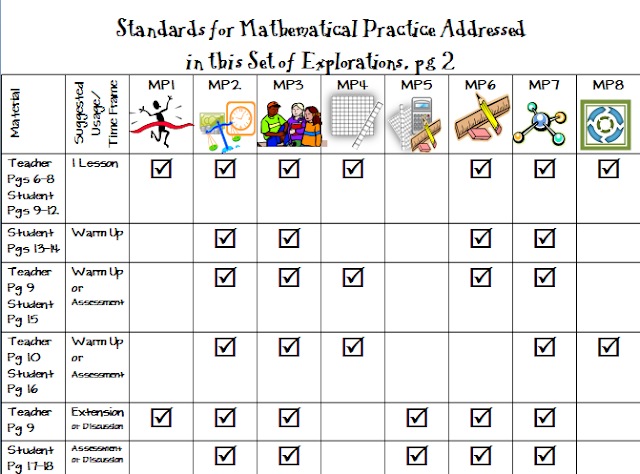
Common Core Explorations are designed to meet the Standards for Mathematical Practices. The chart above shows the mathematical practices touched on by some of the multiplication product pages. 


Monday, December 3, 2012

Thinking about Perspective: Monday's Minilesson Magic:

Currently, I am teaching a reading unit focused on the theme of conformity/nonconformity. My main read aloud is Stargirl by Jerry Spinelli. Through this unit, I am teaching/reviewing a number of fiction-focused lessons (like thinking about archetypes) to push students to think about Stargirl and their own reading.
Today I taught a lesson on thinking about the "unheard" characters' perspectives. My teaching point was "Readers think about the thoughts and feelings of characters who we are not hearing from. We consider things from that character's perspective." Because we are not hearing from certain characters, we have to infer what they are thinking and feeling when certain events in the story happen. 

Stargirl is an "unheard" character for much of the story. This often happens with characters who do not have best friends in the story--best friend relationships usually elicit discussions about character's feelings and thoughts, and so we often also get the secondary character's thoughts and feelings this way. But sometimes, like in Stargirl, we can only infer what she is thinking and feeling. (We are on 78 so Stargirl has not yet had any indepth conversations with Leo).

To actively engage students in thinking about Stargirl's perspective, I thought of 4 major things that happened to Stargirl and wrote each on a separate sheet of colored paper.
* Stargirl on the Hotseat
* Stargirl gets left at Red Rock High School because the MICA team tricked her
* Stargirl gets "tomato-faced" when cheering at a basketball game
* Stargirl goes to Anna Grisdale's Grandfather's funeral and Anna's mother attacks her

I then divided students into groups and had them discuss what Stargirl was thinking and feeling during each of these events. (We decided she was shocked, embarrassed, and humiliated for all of these). I found that it helped to push students' thinking by getting them to stop and think about what Stargirl was thinking and feeling in the moments before these events happened. We decided that in all of these situations, she thought she was doing something helpful, kind, or caring. Each of these events shows how she was treated when she had a good heart and was naive to the social expectations and norms of MICA High.

My students are also participating in partner reading. (It's like book clubs, but they are reading and discussing a book with one partner instead of a small group). I chose books that would help us build and compare/contrast the conformity/nonconformity theme.

I ended the lesson by explaining to students, "Some of you have characters in your book whose perspective we don't really get in-depth info about--like Jessica in Firegirl---while in other books, like, Schooled, you are getting lots of characters' perspectives (because each chapter of the book is told by a different character), but because of the way it is told, you do not get every characters' thoughts and feelings on every important event in the story. While in other books, you may get lots of characters' perspectives on the same event, but their perspectives vary, so you have to decide who you believe and most agree with."

I think this lesson was a good introduction for perspective and to get students to think about the "unheard" characters. It's so easy to put ourselves in the shoes of the main character because we are getting his/her thoughts and feelings--as readers, we need to push ourselves to consider other character's feelings. Hope you can use this lesson with your class!


Monday, November 19, 2012

Turkey Week Top 2 For Tuesday

Alright, it's been a crazy run for a few weeks now, but by golly, I'm gonna make it slow down a little as we round out the quarter in a few weeks.

I failed to post a Top 2 for Tuesday last week and will make up for it this week. The following items are "flying off of my shelves." Don't worry--you don't have to camp out at 4pm or days ahead to get these deals. The supplies are endless and the utility of these products will not diminish.

  The TOP product for the past two weeks was:

The runner up most downloaded product was my Common Core Math Exploration for Multiplication (4.NBT.B7 and 5.NBT.B7).
 
This product contains over 33 pages to support your exploration of multiplying with whole numbers. The exploration contains teacher direction/lesson pages for display on the smartboard


Common Core Explorations are designed to meet the Standards for Mathematical Practices. The chart above shows the mathematical practices touched on by some of the multiplication product pages. 

 
And, did you know that I finally uploaded another Common Core Math Exploration? My new Math Exploration focuses on strategies for identifying all factors in a number and how to use prime factorization for this concept.  (Operations and Algebraic Thinking 4.OA.B.4)
  This exploration includes 10 teacher pages (like below) and 20 student 1/2 sheets for math journals.

Each of these products will be on sale for 10% off starting now and all day Tuesday! Happy Shopping this week (for teacher things and of course for yourself!)

Monday, November 5, 2012

Top 2 for Tuesday (10% Off)

Once again, my most downloaded product this past week was:
 
This product contains over 33 pages to support your exploration of multiplying with whole numbers. The exploration contains teacher direction/lesson pages for display on the smartboard
 
Here's a sneak peak:


For the second week in a row, my Within Word Pattern Word Study Word Searches were a top downloaded product.


Catch these items 10% off Tuesday only! Happy week!
 

Sunday, November 4, 2012

Write about Reading Rubric Sort

Hi bloggy friends,
 
I wanted to share something I recently made for my readers' workshop. We have been focusing on "write about reading" heavily this quarter. To help students understand the expectations and goals of write about reading, I made a sort of the characteristics and behaviors I am seeing (and want to see) in my classroom. Students completed the sort by deciding if the description was a level 4, 3, or 2. Students sorted the descriptions in partners and were required to discuss why they would place the descriptions in a certain level. See the pics below:


Wednesday, October 31, 2012

Archetypes: the Roles Characters Play~Minilesson Magic!


Minilesson Magic on a Wednesday? I must be ready for a break :) Good thing I held out though because I have a great reading minilesson to share with a freebie handout.

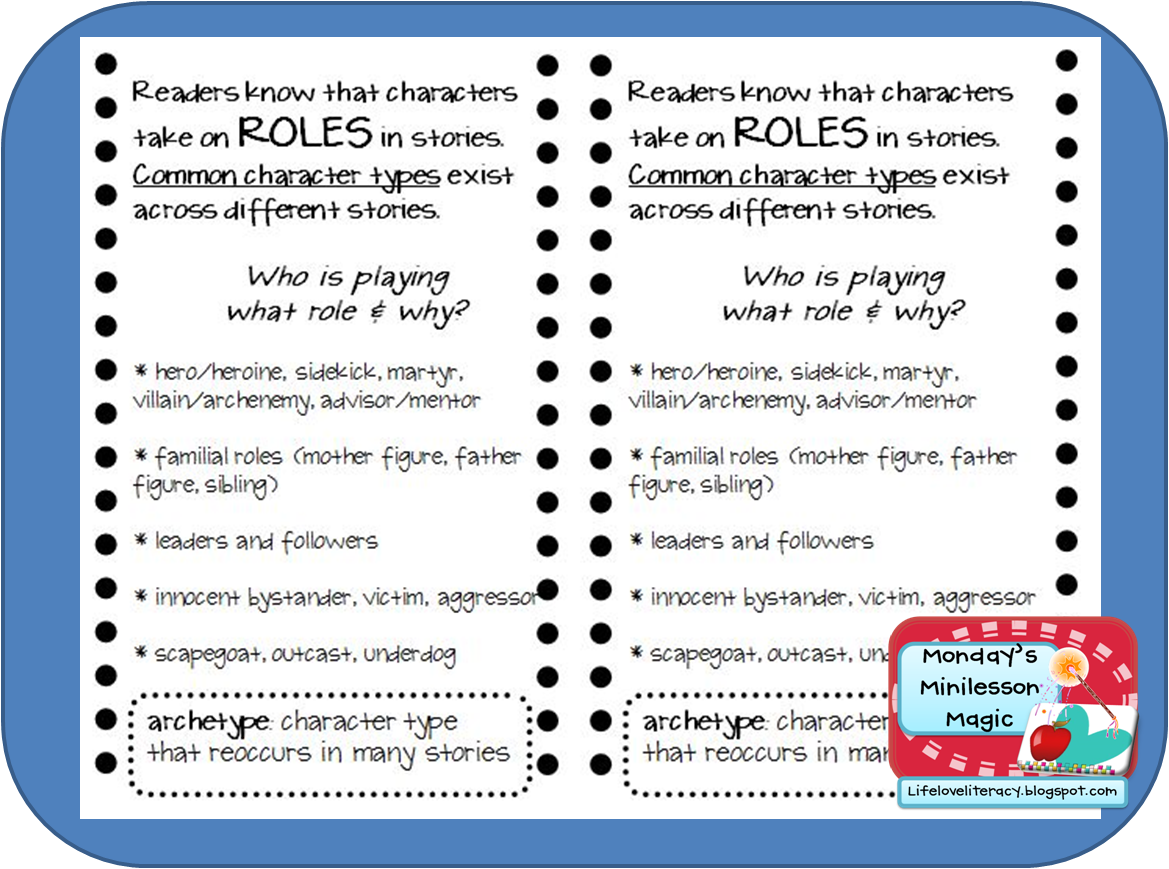
This week I want to share a lesson I did on archetypes. I am defining an archetype (on a 5th grade level) as a "character type that reoccurs in many stories." My students and I had already talked about archetypes last year, so this lesson was a review to remind them that it is a really good idea to be thinking about the roles that characters are playing. We are still on our journey of reading and analyzing holocaust-related historical fiction. (We took the time to read two book club books on this topic in order to target the Common Core anchor standard for comparing and contrasting). Although we will wrap this study up this week, I will come back to this lesson later in the quarter when we are in our realistic fiction book clubs.

To start this lesson, I reminded students that we know characters play roles in stories. We looked at Number the Stars and discussed how Peter played the role of the hero (and could also be called a martyr). Peter worked for the resistance and fought against the Nazi regime to help many Jewish people escape to Sweden for safety. In the end, we find out that Peter ended up dying because of his work with the resistance movement. You could also say that Anne-Marie, the main character is a heroine. (Then you could generalize that there were opportunities for many people to be a hero in their own way during the Holocaust--but save this for another minilesson or you will end up with a MAXILESSON. :)

I then pointed students to their handout and the list of roles I had identified. I made sure they understood what each one meant (mainly martyr, scapegoat, and outcast were new vocabulary for them).

Next, students listed the important characters from their books and tried to decide which role those characters played. I explained to students that they really shouldn't try to force a role on a character, but now that we are taking the time to think about the roles characters play in our books, the roles should be pretty obvious. If a character doesn't have an obvious role, maybe they don't have one but were still in the book for a reason. Again, we shouldn't force a role on a character just to label them.

I seriously had a kid ask "Is it okay if the character's role changes in the book?" Wow!!! That is minilesson magical! :)  This student was focused on Milkweed by Jerry Spinelli. Misha definitely plays a few of roles in the story. He is a hero in many ways for Janina, he is also a brother-figure, and to me, he is an underdog that we are rooting for through the whole book. In the beginning of the book, maybe he would be considered an innocent bystander because he is watching everything happen around him and not really understanding. (Have you read this book? It is one of my new favorites! :) Anything Jerry Spinelli PLEASE! <3)

For active engagement, I had students choose one of the characters and roles from their list and write about how the character was playing that role. Our grade level is REALLY focusing on Writing About Reading (or writing our thoughts about reading). Students wrote for about 10 minutes. For weeks, I have been encouraging students to use examples from the text and to try to elaborate on one idea instead of skipping from idea to idea and ending up with a list of ideas instead of a solid, elaborated idea.

I hope to take this lesson further by discussing how thinking about the roles characters play allow us to compare and contrast characters who played similar roles across different books. For example, how does Misha (Milkweed) being a hero compare to Bruno's (Boy in the Striped Pajamas) lack of heroism? We could also discuss why main characters need sidekicks and analyze how different sidekicks in different stories have supported the main character. So many exciting places to go with this lesson! I hope I have time to do it all :)

Click on the picture above for the student handout freebie. If you read about my Reader Response Journals, this sheet would go behind "Coach's Huddle" in our notebooks because it's a handout from me, the "Coach."


RL4.3: Describe in depth a character drawing on specific details in the text (e.g. a character's thoughts, words, or actions).
RL4.9: Compare and contrast the treatment of similar themes and topics and patterns of events (I think this objective fits because identifying archetypes allows you to compare/contrast and the archetype is highly connected to the themes of the story).
RL5.1: Quote accurately from the text when explaining what the text says explicitly and when drawing inferences from the text.
RL5.3: Compare and contrast two or more characters drawing on specific details in the text.
RL5.9: Compare and contrast stories in the same genre on their approaches to similar themes and topics.

You might not be reading Holocaust related books, but I hope your students can use a minilesson on the roles that characters play in books. If this is the first time you are teaching this lesson, you might start with the basics and just offer victim, innocent bystander, and agressor and maybe hero, sidekick, villain, and advisor/mentor as choices to discuss and apply to their own books.

I have used the roles of victim, bystander, and agressor with the book The Hundred Dresses by Eleanor Estes. I have applied the roles of heroine, archenemy, sidekick, and advisor to A Friendship for Today by Patricia C. McKissack. You can also use the same roles with biographies as most biographies write the famous person as a hero (or an underdog) that has overcome obstacles, including "villains" or people that were against them. I came up with the idea of underdog as an archetype by thinking about Wilma Unlimited by Kathlene Krull. Wilma is an underdog because we don't expect her to be so successful and we are rooting for her the whole time.

Tuesday, October 30, 2012

Top 2 for Tuesday (Save 10%)

This week, my most downloaded product was:
(Wouldn't it be nice if I got the other products finished? :) I edited my Factors/Prime Factorization product this weekend and am working on the finishing touches). Make sure to follow my store to see when I upload a new Math Exploration.

This product contains over 33 pages to support your exploration of multiplying with whole numbers. The exploration contains teacher direction/lesson pages for display on the smartboard


and student pages for math journals
 
My second most downloaded product was my Within Word Pattern Word Study Word Searches.
 
Happy week! I'm hoping to get a Monday's Minilesson Magic in later this week. I have a great lesson to share with archetypes/character roles with a freebie. Stay tuned!

Tuesday, October 23, 2012

Tuesday: Top 2 for 10% off


It's Tuesday and by now, you know what that means: Top 2 Products for 10% off. I hope you can benefit from these two products, one reading and one math product takes the spotlight this week. How exciting!

This week, my highest sold product was:
 
This packet contains 14 different nonfiction/informational templates, graphic organizers, reading strategies, and bookmarks for a total of 17 pgs worth of nonfiction supports. (This was also one of last week's top products, so I'm showing you two new images this week). Here's the BIG IDEA sticky graphic organizer:
A worksheet to help you scaffold students to deal with texts without subheadings:
 My second most downloaded product this week was: 
 
This product contains over 33 pages to support your exploration of multiplying with whole numbers. The exploration contains teacher direction/lesson pages for display on the smartboard
 
and student pages for math journals
If you love the Math Explorations, I have two more in the works and ideas for more, but haven't had time to get them finalized for TPT. Hopefully this weekend, I can upload my Exploration for Factors and Prime Factorization (it's almost ready!!!). I hope you have a great week! We are headed to DC Thursday and Friday for our 5th grade field trip. Meanwhile, I have Tues and Wed night to get the house in order, grab some cat food, and get my students' "History is Interesting!" Feature Articles edited, copied, and ready for our trip.  Send well wishes my way!!! :)

Monday, October 22, 2012

Monday's Minilesson Magic-Comparing and Contrasting Characters


Thanks for tuning in today! For today's Monday's Minilesson Magic, I'm focusing on:  
This week, I want to share ideas for books you can use to help students compare and contrast characters within a story. Each book is coded as a picturebook (pb) or chapter book (cb) to help you plan.
Compare Rose and Blanche (PB)
Compare Rob and Sistine (CB)
Compare Nyasha and Manyara (PB)
Compare Rosemary and Grace (CB)
To compare characters across books, you could look at:

(CB)

(PB)
Once again, it's important that students have a vocabulary that is developed enough for describing characters. I have posted a few times about my character trait cards that were developed for this very reason. After having a minilesson much like this one go bad because students could not get beyond simple words to describe the characters, I decided I would have appropriate words for describing the characters ready before the lesson. Giving students a quick definition of each word OR waiting until the end of the read aloud to define the words and decide if they describe the characters is a great strategy that will surely help students connect a new vocabulary word to the character in a book and their actions and therefore connecting with the definition. I have also printed the character trait cards (from the powerpoint) off in color and posted them in the room. Students constantly look up at these cards to try to find better words to describe the characters.


RL4.3 Describe in depth a character, drawing on specific details in the text (a character's thoughts, words, or actions).
RL5.3 Compare and contrast two or more characters drawing on specific details in the text.


What books do you use for comparing and contrasting characters or teaching character foils?

LinkWithin

Related Posts Plugin for WordPress, Blogger...