Minilesson Magic on a Wednesday? I must be ready for a break :) Good thing I held out though because I have a great reading minilesson to share with a freebie handout.
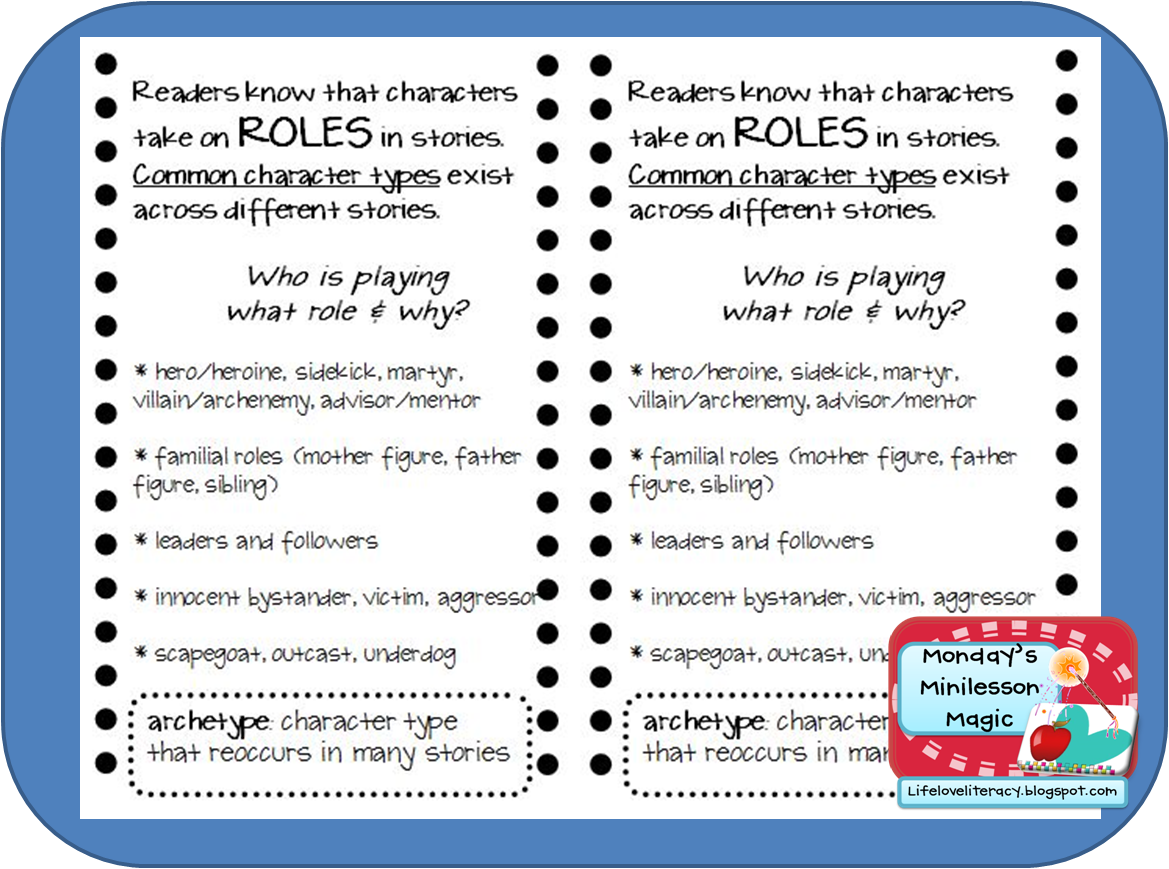
This week I want to share a lesson I did on archetypes. I am defining an archetype (on a 5th grade level) as a "character type that reoccurs in many stories." My students and I had already talked about archetypes last year, so this lesson was a review to remind them that it is a really good idea to be thinking about the roles that characters are playing. We are still on our journey of reading and analyzing holocaust-related historical fiction. (We took the time to read two book club books on this topic in order to target the Common Core anchor standard for comparing and contrasting). Although we will wrap this study up this week, I will come back to this lesson later in the quarter when we are in our realistic fiction book clubs.
 To start this lesson, I reminded students that we know characters play roles in stories. We looked at Number the Stars and discussed how Peter played the role of the hero (and could also be called a martyr). Peter worked for the resistance and fought against the Nazi regime to help many Jewish people escape to Sweden for safety. In the end, we find out that Peter ended up dying because of his work with the resistance movement. You could also say that Anne-Marie, the main character is a heroine. (Then you could generalize that there were opportunities for many people to be a hero in their own way during the Holocaust--but save this for another minilesson or you will end up with a MAXILESSON. :)
 I then pointed students to their handout and the list of roles I had identified. I made sure they understood what each one meant (mainly martyr, scapegoat, and outcast were new vocabulary for them).
Next, students listed the important characters from their books and tried to decide which role those characters played. I explained to students that they really shouldn't try to force a role on a character, but now that we are taking the time to think about the roles characters play in our books, the roles should be pretty obvious. If a character doesn't have an obvious role, maybe they don't have one but were still in the book for a reason. Again, we shouldn't force a role on a character just to label them.

For active engagement, I had students choose one of the characters and roles from their list and write about how the character was playing that role. Our grade level is REALLY focusing on Writing About Reading (or writing our thoughts about reading). Students wrote for about 10 minutes. For weeks, I have been encouraging students to use examples from the text and to try to elaborate on one idea instead of skipping from idea to idea and ending up with a list of ideas instead of a solid, elaborated idea.
I hope to take this lesson further by discussing how thinking about the roles characters play allow us to compare and contrast characters who played similar roles across different books. For example, how does Misha (Milkweed) being a hero compare to Bruno's (Boy in the Striped Pajamas) lack of heroism? We could also discuss why main characters need sidekicks and analyze how different sidekicks in different stories have supported the main character. So many exciting places to go with this lesson! I hope I have time to do it all :)
Click on the picture above for the student handout freebie. If you read about my Reader Response Journals, this sheet would go behind "Coach's Huddle" in our notebooks because it's a handout from me, the "Coach."

RL4.9: Compare and contrast the treatment of similar themes and topics and patterns of events (I think this objective fits because identifying archetypes allows you to compare/contrast and the archetype is highly connected to the themes of the story).
RL5.1: Quote accurately from the text when explaining what the text says explicitly and when drawing inferences from the text.
RL5.3: Compare and contrast two or more characters drawing on specific details in the text.
RL5.9: Compare and contrast stories in the same genre on their approaches to similar themes and topics.
You might not be reading Holocaust related books, but I hope your students can use a minilesson on the roles that characters play in books. If this is the first time you are teaching this lesson, you might start with the basics and just offer victim, innocent bystander, and agressor and maybe hero, sidekick, villain, and advisor/mentor as choices to discuss and apply to their own books.
I have used the roles of victim, bystander, and agressor with the book The Hundred Dresses by Eleanor Estes. I have applied the roles of heroine, archenemy, sidekick, and advisor to A Friendship for Today by Patricia C. McKissack. You can also use the same roles with biographies as most biographies write the famous person as a hero (or an underdog) that has overcome obstacles, including "villains" or people that were against them. I came up with the idea of underdog as an archetype by thinking about Wilma Unlimited by Kathlene Krull. Wilma is an underdog because we don't expect her to be so successful and we are rooting for her the whole time.