Showing posts with label love of language. Show all posts

Saturday, April 6, 2013

Pass the Torch!


Get Ready for Bloggy Olympics!!!

Photobucket Photobucket

Join The 3AM Teacher, the Reading Olympians, and over 80 SUPREME education bloggers as we take you through a tour of the Reading Olympians Root Study Program!!

To get started with Reading Olympians, I printed the raps for each set onto different colors of cardstock. (I made two sets of the copies so that I would have enough cards for each student with a few extras). This method goes along with my Task Card Love <3 as students or the cards can move around.

I also printed these babies on the same color cardstock as the set it matches.

Next, I made copies of the Journals for students. (We are still on the Nike Set).
During our first lesson, students received the rap cards randomly and worked on the 4 quadrant sheets in their journal until they felt that had thought of everything they could. Mainly, I wanted students to generate as many words as possible using the root. I explained that they could move on to other roots, but would likely be able to keep previous roots in mind and would probably come up with new ideas. You could have studenst work in partners to generate words, but my group is having a talking/playing issue, so I wanted this step to be independent.

After a few sessions of doing the steps above, I have students play a brainstorming "game":

* I put students in groups of four and everyone has a writing utensil. I give them a ledger-sized sheet of paper or chart paper.
* Students record one prefix on each side of the paper to prepare for the brainstorming session.
* I set the timer for 5 minutes and all students silently record words that contain one of the prefixes. (The group decides which one to start with first; it really doesn't matter as long as they only work on one at a time). Students do not analyze the appropriateness of the words at this time, it is simply a brainstorming-get-it-on-paper session.
* When the timer goes off, students get 1 minute to discuss the words recorded and mark off any that do not fit the prefixes' meaning.
* Students flip the chart over and begin the 5 minute brainstorming session again with the new prefix.
* When the timer goes off, students get 1 minute to check their words and mark any off.

In the next lessons, we go through a whole-group sharing session where students report out the words they came up with. Students get 1 point for words that no one else came up with and -1 for words that we deem do not fit the meaning of the prefix. (Keeping score has been harry-and unnecessary for motivating my students, but if you have time for it, it could be a fun element).

As groups share words, I type them into a google doc so that we can all keep up and have a record for later.


I just started using the program 3rd quarter to work out any kinks and figure out how I wanted to do it so that I am fully implementing it starting at the beginning of the year next year. I can't wait to learn how everyone else is using the program and putting their own spin on it. (I'm sure I will make some tweaks next year as we go 1-1 laptop, like having students generate their word lists in group googledoc documents, then I can simply pull each groups set of words up on the smartboard to discuss. This would be a major time saver (and might allow me to better do something where I am keeping score). If you have not started implementing the program, I say, GET TO IT. Print out the Nike Set and just set yourself a goal of using it with the time you have 4th quarter to see how you want to use it in your classroom next year. I totally recommend the purchase!


Discover the program IN ACTION in more K-6th grade classrooms as you Pass the Torch!! Get ideas, discover the progression of the program, and enter the Raffle for a chance to win ONE of the three prizes listed below!!

First Place Winner : Gold Medal

  Prizes: Complete Reading Olympians Program
            $50.00 Amazon Gift Card
            50% off Discount Code for a 1-Day shopping spree at The 3AM Teacher's Etsy store!

Second Place Winner: Silver Medal

   Prizes: $25.00 Amazon Gift Card
              40% off Discount Code for a 1-Day shopping spree at The 3AM Teacher's Etsy store!

Third Place Winner: Bronze Medal

    Prizes: 30% off Discount Code for a 1-Day shopping spree at The 3AM Teacher's Etsy store!


Pass the Torch!!!
Click the image below to visit the next blog

Kindergarten:


Grade 1 & 2


Grade 3 & 4


Grade 5 & 6


    a Rafflecopter giveaway

Monday, December 31, 2012

Incorporate more Music into your Readers' Workshop

How often do you incorporate music and lyric analysis into your reader's workshop?

This year, I have tried to utilize lyrics at least once during each of our reading units. The kiddos LOVE it when we have a workshop that focuses on connecting to the lyrics, analyzing them, and discussing our ideas with each other. I LOVE LOVE LOVE it because no matter what connections I have in mind as I share the song with students, our discussions together always deepen my connections to the text and understanding of the lyrics. I also LOVE LOVE LOVE utilizing song lyrics  because it immediately pushes students to DEEPER THINKING.

Rather than trying to remember all of the songs I have ever incorporated or hoping that I will think of them next time I need them, I decided to dedicate a pinterest board to "Songs for Literary Analysis". I also thought this board might benefit other teachers. I always pull the songs up on youtube and play through the smartboard, so I pinned the youtube lyric videos to be most helpful. Follow this board if you would like to see the songs I pin--I think most of them will be relevant for 5th grade-high school, but lower grades may find some relevant songs too!

In the descriptions, I have included some of the lines that made me choose the song, some of the themes I think the songs address, and some of the texts that connect.

Why song lyrics?

* Shake it up for students--songs are so engaging and add some variety to the readers' workshop
* Text-text connections can be made much QUICKER than when trying to connect novel to novel (songs are fast, immediate, and students can make global connections or smaller connections to one or two lines of the song)
* Writing about thoughts (responding in writing) usually improves during these lessons and is one of the main purposes of my use of lyrics in the classroom

What are my goals and objectives? 

-connecting themes
-connecting figurative language in the song to events in a story
-quoting accurately and explaining thinking with support
-oral discussion
-pushing students to respond more deeply
-allowing students to see MORE in the read aloud or book club novel because of the connections they made with the lyrics

General Steps of a Lyric-Based Reader's Workshop Lesson:

-Explain to students that you are going to play a song that you feel connects with the current unit of study/read aloud/book club books
-Play song and ask students to simply listen
-Hand out copy of lyrics to students, ask students to think about how the song connects to texts in your reading unit, play song again (students may underline parts that they are making connections with)
-Depending on the difficulty of the song lyrics and vocabulary, I may go over a few of the poetic devices, vocabulary words, etc. Sometimes I choose to save this discussion for later, but with some songs, students will get more out of the thinking/writing part if they have a little more information
-Ask students to write about their connections for a set amount of time (usually 10 to start and students often want me to add more time). Since some students will have a hard time generating ideas for that long, I will play the song again to encourage them to develop more thoughts. I often scaffold for some students by focusing them on a specific line and how it connects to their book.
-Discussion/Share- this can take many forms--1) small group discussions if everyone wrote about the same book, 2) if you are using the song to connect to book club books, have book club members find another member's written response, read it, and respond with sticky notes, rotate until they have read all members' responses or until time is up, 3) whole group discussion-can go stanza by stanza discussing connections
-Wrap Up-direct all students to find a line that really stood out to them, go around the room having them say their line--no discussion, no explanation--this is like "found-poetry" and creates a poetic atmosphere in the room; OR have students choose a sentence from their written response that they think is a good idea and share around the room in the same way


During our Historical Fiction book club focused on the Holocaust, I used "Your Guardian Angel" by Red Jumpsuit Apparatus. I was able to connect the lyrics of this song to every book club book my students were reading (Boy in the Striped Pajamas, Yellow Star, Milkweed, and Number the Stars). The song talks about being there for someone forever and has the line "even if saving you sends me to heaven." In each of our books, someone played the role of the hero or father figure and might have been saying this to another character. With Boy in the Striped Pajamas, we decided that Bruno should have been singing this song to Shmuel, but he was too weak and naive to sacrifice everything for someone else. Or, he might sing the chorus, but not have the strength to follow through once faced with needing to stand up for Shmuel.

I hope I have inspired you to start using song lyrics with your students. Do you have any favorite songs that you already incorporate in this way? I LOVE using lyrics as a form of text and the days we use a song as a text always feel special!

Here are some of the common core connections I see with using song lyrics in this way:


CCSS.ELA-Literacy.RL.5.2 Determine a theme of a story, drama, or poem from details in the text, including how characters in a story or drama respond to challenges or how the speaker in a poem reflects upon a topic; summarize the text.
CCSS.ELA-Literacy.RL.5.3 Compare and contrast two or more characters, settings, or events in a story or drama, drawing on specific details in the text (e.g., how characters interact).
CCSS.ELA-Literacy.RL.5.9 Compare and contrast stories in the same genre (e.g., mysteries and adventure stories) on their approaches to similar themes and topics.
CCSS.ELA-Literacy.SL.5.1 Engage effectively in a range of collaborative discussions (one-on-one, in groups, and teacher-led) with diverse partners on grade 5 topics and texts, building on others’ ideas and expressing their own clearly.
CCSS.ELA-Literacy.SL.5.2 Summarize a written text read aloud or information presented in diverse media and formats, including visually, quantitatively, and orally.
CCSS.ELA-Literacy.L.5.5 Demonstrate understanding of figurative language, word relationships, and nuances in word meanings.


Monday, October 8, 2012

Monday's Minilesson Magic: Character Change Analysis

So, in my last post about how I set up my reader response, I mentioned that I would talk more about my lessons for "Coaching a Reading Life." I'm going to table that post for next week, given the computer-failure-disaster I have the pleasure of dealing with this weekend. 

Anyway, on to Monday's Minlesson Magic: Have you ever stopped to ask your students how the main character in their book changed by the end of the story? You might be surprised when they tell you “He/She didn’t really change.” Once I realized students were not closely analyzing their books for character change, or even realizing that they should be, I began teaching a mini unit on character change.
Albert by Jo Donna Napoli is my favorite mentor book for a unit on character change. Albert is a precious story about an introvert who looks out his city window each day and sees something that scares him from leaving his apartment. One day when he sticks his hand out his window to check the weather, a cardinal starts building a nest in his hands, and soon he is holding a nest of eggs. While annoyed at first, Albert begins to see that the things outside that once scared him are not so scary. For example, he sees a man and woman arguing—something that would normally make him choose to close the window and stay inside. However, since he is stuck at the window, he also gets to see that later the man and woman make up, walking away happy. Albert learns that the world has good in it and finally has the courage to explore outside. While we wouldn't call Albert an extrovert at the end of the story, he is braver and more adventurous.
If you are interested in getting students into book clubs, I usually launch "character change" minilessons at the same time I launch Jerry Spinelli book clubs. The characters in Jerry Spinelli’s books (Stargirl, Crash, Eggs, Wringer, Loser, Fourth Grade Rats, etc) change so much throughout the text, I want to make sure students are really prepared to analyze how they have changed when they finish reading the books. You can even plan to hold these books clubs later in the year and spiral back to character change lessons you have taught earlier in the year.

In order to be able to think about how the character changes, students need to be able to describe the character at the beginning, middle, and end of the book. (Sometimes this even means being able to describe the character before the book begins if the main events that change the character happen from the beginning). Often, students do not have a developed vocabulary for character-related adjectives to be able to describe the character meaningfully and deeply. For this reason, I created Character Trait Definition cards.

 
Another strategy that I have used before to help students access vocabulary for describing characters is to have a list of words ready that describe the characters in the book I plan to read and the antonyms of those words. I put those words on a 1/2 sheet of paper and have students research the definition, synonyms, and antonyms and then draw a picture to match. (This takes enough time that I do it the day before I plan to do the full minilesson and read aloud).

We use the following chart to analyze character change:


RL2.3 Describe how characters in a story respond to major events and challenges.

RL3.3 Describe characters in a story (traits, motivations, feelings) and explain how their actions contribute to the sequence of events. 


How do you teach students to analyze characters? What other minilesson ideas would you like for me to think about for Monday's Minilesson Magic? I would love to do some work for you and get my brain spinning! Please leave a comment :)

Happy Reading!

Sunday, August 12, 2012

Love of Language: Figurative Lang and Context Clue Examples

 
This year, I have decided to create a Love of Language in my classroom--not just with read alouds, but strategically and routinely through weekly lessons.


To prepare for my Love of Language Fridays, I pay attention to my read alouds throughout the week. I am on the lookout for examples of figurative language and unknown/new words that might allow us to practice developing our context clue skills. I pull examples of sentences and paragraphs that students would benefit from revisiting and analyzing. While a word may not be "unknown" to everyone (or I may have given a quick synonym for during the actual read aloud), I can still revisit the word to expose students to how to think about figuring out unknown words. Also, I choose examples from my read alouds because I like for the examples to be familiar to students when we discuss the figurative language/poetic devices and practice using context clues to figure out the meaning.

Friday's reading minilesson focuses on those examples of figurative language and unknown words in context. (After teaching these lessons a few weeks now, I have found that we only have time for working with figurative language or context clue examples if I have a lot of examples to share. I'm sure if I would keep it to one example of each, we could do both in one lesson.) To prepare for Friday, I type up the examples in cute font and print them on large sized paper (11x17).

Here are my examples for my first Love of Language lesson.

The figurative language example comes from Bedhead by Margie Palatini and the context clue example comes from Pictures of Hollis Woods by Patricia Reilly Giff. We used Bedhead as a writing mentor this week and we are reading Pictures of Hollis Woods for read aloud.
What do students do with these examples? Students have a Love of Language binder with 5 sections: 
Word of the Week (WOW)
 Nifty Thrifty Fifty (NFT)/Content Vocab 
Context Clues 
Figurative Language 
Poems

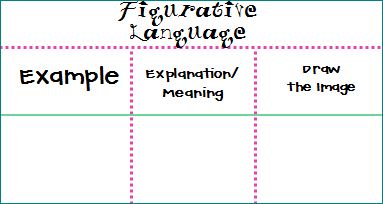
In the Figurative Language Section, students have a graphic organizer that looks like this: 
 
Through our discussion, students noted that in "spilled, spit, and sputtered" the author used alliteration. "Two-toast Toasties did triple back-flips onto the breakfast table" also contained alliteration but was an example of personification, too. Students recorded this example under the example column, then explained what the excerpt meant. Next, they drew a picture that represented the image.

In the context clues section, students complete a graphic organizer that looks like this:
 
Students record the example ("We lumbered up the main street of Hancock, passing a row of houses and a movie theater, and came to a stop in front of a diner."), we discuss the possible clues given--we decided that lumbered was a verb and that it must have described some sort of movement, maybe slowly or maybe they were walking up hill or maybe they were tired as they traveled through the town. Then, students record the meaning of the unknown word and the type of context clues we used to help us decide on the meaning. In this case, we decided that the placement of the word in the sentence let us know it was a verb/movement and the context helped us with the mood of the word.

Are you ready to start a love of language? Click here to read more or here to preview my teacherspayteachers love of language product.


Monday, July 23, 2012

Back to School 2012-2013 Bulletin Boards Tour #1

One of my biggest goals for this year was to create bulletin boards that represent our curriculum, tie everything together, and most importantly that are interactive and serve a purpose. With my goal of creating a Love of Language and dedicating more time to language and vocabulary study this year, I needed bulletin boards that would help me represent our Love of Language as it develops throughout the year. I created this bulletin board where I will post our Figurative Language and Context Clue examples for the week.  This board should be in full action on Friday when I post examples. I will be sure to take another picture to share with you.
 
I used my messy (now sort of organized) storage cabinet for another component of our Love of Language studies. This is where I will display our Nifty Thrifty Fifty words as they are introduced. (We already have some posted from this week but I forgot to snap a picture of it.) Can you see that brown contact paper in the background? I think I found the perfect use for it and it ties in with my brown/aqua theme nicely.
Under our Love of Language bulletin board, I have created a space for us to classify our read alouds into themes. I think this is so important to get started with right away this year so that we can take our understanding of theme deeper as we reach for the common core standards.

Have you checked out my Love of Language classroom materials? You can learn more about it here: http://lifeloveliteracy.blogspot.com/2012/07/for-love-of-language-classroom.html

Stay tuned! Next, I'll share my content area bulletin boards. 

Sunday, July 8, 2012

For the Love of Language--classroom materials ready!

I have been working on (and tweaking) my love of language materials for about a month now. I finally have the graphic organizers, student notebook covers, and bulletin board materials in a stage that I love and am EXCITED to use in my 2012-2013 classroom (only 1 week until the first day!)

Have I told you why I began thinking about implementing a "Love of Language" in my classroom this year? My "Love of Language" program was inspired by the Common Core State Standards. As I read through and studied the standards this year, I was hit with a strong conviction that the standards require a more strategic focus on word and language learning than my instruction thus far has included. Yes, I have done bits and pieces here and there--poetry units, content area vocabulary, a week on context clue strategies, one year of implementing "A Word a Week" consistently, minilessons on figurative vs literal language, etc. All of that doesn't sound very strategic does it?

It was kind of hit or miss--you know, focusing on interpreting language and how we learn words can be one of those things that constantly gets pushed to the side. Dedicating an entire day a week (I choose FRIDAYS! :) ) to language allows me to strategically set aside the time necessary for engaging my students in language lovin' and word learnin'. This is my way of doing what I feel will truly meet the language and vocabulary acquisition standards in the common core. It will ensure that students are not only exposed to these concepts, but are given multiple opportunities to master word learning strategies. The idea that I can get students to LOVE language is also exciting; through that focus, I will be creating learners who can use the skills they have learned to analyze language, infer word meaning, and teach themselves new things!

Want to Check it Out?
Here are a few samples of the Love of Language graphic organizers:


As I gear up for my NEW SCHOOL YEAR, I will be writing more about my "Love of Language" program plans, including sharing pictures of my "love of language" bulletin boards--they are on my workday "To Do" list for tomorrow :)

Sunday, June 17, 2012

Love of Language-Studying Words

I know it's been a while! It seems like tons of teacher-bloggers are apologizing for the lack of  blogging and blaming the "end of year" craziness. I will totally jump on that bandwagon! We have been out of school for one week and one day, and I have yet to take a break. Last week, I went in to work on my classroom for 4 days and had a Common Core committee workday. Lucky me, I get four more committee workdays this week. :)

Anyway, the guilt is piling up for not having shared some of my "Love of Language" ideas with you. I will thank you ahead of time for bearing with me as I try to verbalize ideas that I have yet to try out. (Many of these ideas I have tried in various years of my teaching, but never have I tried to implement them all in one day). I'm sure when my new year starts (the 3rd week in July!!!), and I start to implement these things, I will tweak and change things, so follow me into this journey of creating and honoring a "Love of Language" in my classroom. :)
  • I will be using a number of resources to implement my "Love of Language" Fridays to help students increase their vocabulary and develop an appreciation for interesting words. I also know the "studying words" component of the day will help students deal with multi-syllabic words that they encounter in their own reading.

A Word A Week Vocabulary ProgramOne of the resources  I will be using is the "A Word a Week Vocabulary Program" from Teacher Created Resources. The book provides one page on each of the words using interesting stories and poems that elaborate on the word using a vast array of synonyms and antonyms. (Awesomely, this will also help students develop their knack for using context clues.) I plan to have students complete a frayer-model-type graphic after listening to a read aloud of the passage. I have also typed up each of these words with the definition and printed them on cardstock so that we can post them in the room and refer back to them constantly. You could also prepare sheets with each word and allow a different student each week to record a definition and illustrate the definition card.


I will also be using the Nifty Thrifty Fifty word list that contains 50 words based on root words, prefixes, and suffixes. The Nifty Thrifty Fifty program claims that for every NTF word a student can read, they can read at least 7 other words.  I have to do a little more research and make some decisions about how I want to implement the Nifty Thrifty Fifty word list, but other teachers at my school have implemented this list with great success. Here are some helpful websites I have found as I am trying to get my ideas and plans together for this component of "Love of Language."
- A Month at a Glance PPT I really like the idea of having students create their own cards with the prefix, suffix, and root words on different colored index cards. I plan to give students time every week to work with a partner to create new words from the word parts. I also like the idea of letting them make up words and define the meaning because it will help them solidify and transfer the meanings to other words.
- Nifty Thrifty Automaticity Powerpoint (go down to # 2)
---Click on # 4 of the same website above for a great color coded set to post in the classroom
-Another idea I have is to play "Word Storm" with my students. I will give them a word part or root from the NTF and set a timer for them to brainstorm as many words as they can before time is up. We will then share them as a class.
-I also love this idea I found at Steve Gipson's teacherspayteachers store (The Greek/Latin Roots Art Book) and think it will be perfect for NTF work.
-Here's a template we will use to collect our NFT words and record related words.

Hope you found an idea you can use!

Sunday, May 13, 2012

Weekly Poetry Post---Developing Learners who Love Language

A little over a week ago, I told you guys about my love of poetry and how glad I was to have saved it for the end of the year. With my new-found love of poetry (again, how did my kids and I go almost the whole year without poetry?!?!?), a few ideas that have been swimming in my head from reading Kristen's vocabulary ideas at ladybugsteacherfiles, and our upcoming transition to Common Core, I am ready to launch "Love of Language Learning Fridays" in my classroom (trying to think of a more catchy name for the kiddos, but haven't yet). Shouldn't Friday be a little different (and exciting) anyway? So, while we are winding down the year, I am obsessing over how Language Learning Fridays will look. My plan is to incorporate language learning throughout the whole day. I'll explain some of my ideas for modifying our Friday schedule in the next few Weekly Poetry Posts.

First, let me explain that my POETRY POSTS will not always focus strictly on poetry, but on this love of language learning. We can find poetic language in lots of other texts (of course you know this!), and this revamped day for my students focuses on learning interesting language, content-area vocabulary, interesting new words, and a Poetry Workshop component. During reader's workshop, we will revisit examples of figurative language, challenging words, idioms, juicy words, etc. that have come up throughout the week's read alouds. This will allow us to spend more time talking about the language the author used and also help us develop interpretive skills and our ability to use context to figure out the meanings of unknown words and sayings. Examples from our read alouds will also help me teach the difference between figurative and literal language, and how figurative language often makes reading so much more interesting.

The Talking EggsHere's an example of a read aloud excerpt that would be EXCELLENT for coming back to at the end of the week:

"Rose, the older sister, was mean and cross and didn't know beans from birds' eggs. Blanche was sweet and kind and sharp as forty crickets. But their mother liked Rose the best, because they were alike as two peas in a pod--bad tempered, sharp-tongued, and always putting on airs."
            ~The Talking Eggs by Robert D. San Souci

Students will have some format for collecting these language examples and doing some analysis with them. I'm hoping the notebook or whatever will be something they refer to when doing their own writing or analyzing other stories/characters. I am also hoping that this will spread like wild fire with students collecting their own figurative language, challenging word examples, etc. throughout the week to be shared and analyzed with the group on Fridays. I love how Kristen (ladybug'steacherfiles) displays her word detective/word wizard work and I think I will do a similar bulletin board for collecting our Love of Language work.

To plan for Friday's read-aloud re-visit, I am going to keep a running list of examples in a google doc. Each day as I read aloud, I will pay close attention to interesting language, challenging words, etc. and leave myself a sticky note so that when I get a chance that day, I can type up the examples. Of course, students and I may quickly discuss these words or interesting language while reading the story to make sure we understand before we move on, but since my focus will most likely be another reading skill, we won't spend too much time on working with the words or language. Also, if you teach, you know it's probably likely that not every child is paying attention, so the Friday revisit will ensure that everyone has had ample opportunities across the year to enrich their language.
 
Raining Cats and Dogs: A Collection of Irresistible Idioms and Illustrations to Tickle the Funny Bones of Young PeopleWhat if I have very few examples to choose from with our weekly read alouds? I've already thought about this. Lots of great picture books (like Raining Cats and Dogs by Will Moses) can serve as fillers for any Friday that is lacking in great examples.


Stay tuned for more ideas.....

Wednesday, May 2, 2012

Poetry Fever!

We are in the midst of test prep for math and reading EOG's, but fortunately for my students (and myself) we saved poetry for our writer's workshop unit this nine weeks. It has been such an enjoyable, relaxing, fun, amazing break from the rest of our day that I was a little upset at myself for not doing more poetry throughout the year. Some teachers groan at poetry, but when I have the peace of mind to sit and actually read poetry---I LOVE IT! I'm also a big fan of music in general and I see a huge connection between the two...I guess I am a lover of words.

That's it!*!*! I'm putting my foot down for poetry next year! (and fun language learning lessons) I already have an idea for a revamped Friday schedule that allows me to infuse the day with figurative language, word of the week learning, idioms, poetry, song, (maybe a little dance), and content area vocabulary.


And this brings me to the exciting unveiling of my Weekly Poetry Post for the love of language! My goal is to share a weekly lesson, resource, favorite poem, or idea for a LOVE OF LANGUAGE DAY...starting NOW!!!

The best thing I did during our poetry unit was decide to bring music into the equation. I chose to use songs to introduce the metaphor, simile, and personification segment of our unit. I used:

The World's Greatest by R. Kelly ("I am a mountain. I am a tall tree. I am a swift wind, sweeping the country. I am an eagle...etc)
I Am a Rock by Simon and Garfunkel--I'm a new fan of these oldie guys (I am a rock. I am an island. I've built walls, a fortress deep and mighty...A rock feels no pain, and an island never cries) 
The Show by Llenka (Life is a Maze, Love is a Riddle...and just enjoy the show. The sun is hot in the sky just like a giant spotlight., etc.) I think the song is actually an extended metaphor comparing life to a "show." At the end she says "I want my money back, I want my money back." LOVE IT!

I pulled these songs up on the smartboard on youtube. (Making sure to turn off the smartboard until I had the video I wanted). You can find them with words so students can see the lyrics. We listened quite a few times for enjoyment. I did the World's Greatest first and had students record how they would describe the "speaker in the poem" or the person singing the song. In another listen, I asked them to record as many "I am" statements as they could. It wasn't until my next lesson that I taught them that these "I am" statements were metaphors. Next we listened to "I am a Rock" and they recorded how they would describe the person speaking in that song. It was an interesting contrast to think about the person in "World's Greatest" being proud and confident and the person in "I am a Rock" wanting to be alone, obviously hurt by the world. If you are thinking "I am a rock" is too mature, it actually was my students favorite (still requesting it) and my kiddos are 4th graders. I think they got it and it allowed us to talk about serious life stuff.

We had to save Llenka for the next day, and I almost cut it because I felt I had enough to work with from the other two songs, but I'm so glad I went ahead and did another day of songs because it gave us more examples. (Ever not notice stuff until you are in the moment with your kids? That's totally how it was with this song.) The line "I'm a fool out of love" allowed us to discuss how just because the line says "I am" does not make it a metaphor.We also discussed whether or not "I'm just a little girl caught in the middle" was really a metaphor because she was comparing herself to another person. We decided yes and no.

What next? Now that my students understood and had good examples of simile, metaphor, and personification, they used our classroom poetry books to search for examples of their own. They recorded their work on this graphic organizer:


 Stay tuned for another poetry/language idea next week!


LinkWithin

Related Posts Plugin for WordPress, Blogger...