Showing posts with label MathEOG. Show all posts
Wednesday, May 8, 2013
~Multiplying and Dividing Decimals: House Plans Themed Task Cards~
Do you use my Themed Task Cards in your math classroom? I just made a set of DECIMAL multiplication and division task cards based off of my Multiplying and Dividing FRACTIONS: House Plan themed task cards. Get students to work on accuracy with multiplying and dividing decimals as the work to solve area problems and recreate the given house plan.
Sunday, April 7, 2013
Peek at My Week: Show me the Plans!!!
Hi Everyone!
Spring break, now over. I nearly laid in the bed all day (well, until 11:30). Then did some blog-stalking-pretending-I-was-planning-procrastinating. I watched an episode of undercover boss and cried when the boss gave a kid a full-ride to college so that he wouldn't have to work and go to school at night. Wow! If only everyone felt as grateful as this kid to be getting his education paid for. As happy as he was, I cried because I knew he was getting an opportunity for higher education that he wouldn't have otherwise. {Did you know I'm a softy?} I finally talked myself into a run-jog, walk-around-and-look-at-the-birds around 5. Now I sit here needing a shower, needing to pack my lunch, needing to pick out tomorrow's outfit, and needing to finalize my plans for the week so that I can link up with Mrs. Wills' Kindergarten blog for her AWESOME Peek at My Week linky.
Don't get me wrong, I am excited about our upcoming quarter, but I always get a little paper-bag hyperventilating when it feels like we are starting so many new things at once. I know I will be fine by Tuesday, and seriously, I am planned-and-ready for tomorrow, so calm down!
If you take a close look at my plan...you.will.find.some.holes. Seriously, I am a 3-day planner. I want to see how things go and then re-organize. I have some ideas in my mind (usually) but I wait to make final decisions on what comes next based on what my kiddies do. So, don't-judge, please :)
If you click on the images above, it will take you to a google doc where you can click on the hyperlinked plans. (Can't figure out why the google doc does not allow you to click on hyperlinks, but if you download, you can get them that way).
I made these plans in word and converted them to a PDF. Then, I watched Deedee's video about how she makes her visual lessons and she does it in powerpoint. You know I love to make stuff in powerpoint over word but I thought word would be easier for these lesson plans...I might be converting over to powerpoint next week! If you haven't hopped over to see Deedee, you definitely want to check out her blog and the other bloggers that are giving a "Peek" at their week.
Spring break, now over. I nearly laid in the bed all day (well, until 11:30). Then did some blog-stalking-pretending-I-was-planning-procrastinating. I watched an episode of undercover boss and cried when the boss gave a kid a full-ride to college so that he wouldn't have to work and go to school at night. Wow! If only everyone felt as grateful as this kid to be getting his education paid for. As happy as he was, I cried because I knew he was getting an opportunity for higher education that he wouldn't have otherwise. {Did you know I'm a softy?} I finally talked myself into a run-jog, walk-around-and-look-at-the-birds around 5. Now I sit here needing a shower, needing to pack my lunch, needing to pick out tomorrow's outfit, and needing to finalize my plans for the week so that I can link up with Mrs. Wills' Kindergarten blog for her AWESOME Peek at My Week linky.
Don't get me wrong, I am excited about our upcoming quarter, but I always get a little paper-bag hyperventilating when it feels like we are starting so many new things at once. I know I will be fine by Tuesday, and seriously, I am planned-and-ready for tomorrow, so calm down!
If you take a close look at my plan...you.will.find.some.holes. Seriously, I am a 3-day planner. I want to see how things go and then re-organize. I have some ideas in my mind (usually) but I wait to make final decisions on what comes next based on what my kiddies do. So, don't-judge, please :)
If you click on the images above, it will take you to a google doc where you can click on the hyperlinked plans. (Can't figure out why the google doc does not allow you to click on hyperlinks, but if you download, you can get them that way).
I made these plans in word and converted them to a PDF. Then, I watched Deedee's video about how she makes her visual lessons and she does it in powerpoint. You know I love to make stuff in powerpoint over word but I thought word would be easier for these lesson plans...I might be converting over to powerpoint next week! If you haven't hopped over to see Deedee, you definitely want to check out her blog and the other bloggers that are giving a "Peek" at their week.
Monday, March 25, 2013
Multi-Step Word Problems Ready!!!!!
Finally...
I
am
SO EXCITED
to have this set of word problems finished!
Not only can I not wait to get into the classroom this week and get these babies printed off to use the first day we come back from break, I am SUPER DUPER excited to share these with you! This is the first product I have made by purchasing a set of clip art and I love the way it turned out. (So, now I think I will be addicted to buying clipart to make snazzier goods for my class and other teachers!)
Teach your students how to solve multi-step word problems with these 10 problems from "School Supply Central." The 10 math problems in this set require students to think through the problem solving process. These problems mainly require students to multiply and divide whole numbers and interpret remainders, but other concepts are also embedded. If you require students to write equations for the problems, you are also incorporating the Algebra standards. (Common Core Alignment: 4.OA.3, 4.OA.4, 5.NBT.2, 5.NBT.5, and 5.NBT.6)
These problems would be a good challenge for 4th graders, designed for 5th graders, and would provide challenge to most 6th grade students still learning to analyze word problems.***These problems were modeled after NC EOG released items and other state's released testing problems but can be used at any time of the year*** (Like this problem I talked about earlier today) Click on over to check out my School Supply Central problem set.
Now, while I was working on this product, I knew I also had to revamp my "problem solving process" so that I can teach how to solve these problems when we return from break AND I wanted to create a new product for linking up with All Things Upper Elementary.
And was born (or re-born), the problem solving graphic organizer:
I also included step-by-step explanations of the graphic organizer that you can use with your students (pull up on the smartboard, go through the comments to explain the 4 parts of the problem solving sequence).
I feel like this product took forevah-eva to get ready, but it's all those finishing touches that we must do before we upload! Hope you LOVE LOVE LOVE it, and I hope you can use the freebie! (PS: If you purchase the multistep problem solving task cards, the problem solving steps graphic organizer is included in the download).
Thanks for stopping by!
Tammy
I
am
SO EXCITED
to have this set of word problems finished!
Not only can I not wait to get into the classroom this week and get these babies printed off to use the first day we come back from break, I am SUPER DUPER excited to share these with you! This is the first product I have made by purchasing a set of clip art and I love the way it turned out. (So, now I think I will be addicted to buying clipart to make snazzier goods for my class and other teachers!)
Teach your students how to solve multi-step word problems with these 10 problems from "School Supply Central." The 10 math problems in this set require students to think through the problem solving process. These problems mainly require students to multiply and divide whole numbers and interpret remainders, but other concepts are also embedded. If you require students to write equations for the problems, you are also incorporating the Algebra standards. (Common Core Alignment: 4.OA.3, 4.OA.4, 5.NBT.2, 5.NBT.5, and 5.NBT.6)
These problems would be a good challenge for 4th graders, designed for 5th graders, and would provide challenge to most 6th grade students still learning to analyze word problems.***These problems were modeled after NC EOG released items and other state's released testing problems but can be used at any time of the year*** (Like this problem I talked about earlier today) Click on over to check out my School Supply Central problem set.
Now, while I was working on this product, I knew I also had to revamp my "problem solving process" so that I can teach how to solve these problems when we return from break AND I wanted to create a new product for linking up with All Things Upper Elementary.
And was born (or re-born), the problem solving graphic organizer:
I also included step-by-step explanations of the graphic organizer that you can use with your students (pull up on the smartboard, go through the comments to explain the 4 parts of the problem solving sequence).
I feel like this product took forevah-eva to get ready, but it's all those finishing touches that we must do before we upload! Hope you LOVE LOVE LOVE it, and I hope you can use the freebie! (PS: If you purchase the multistep problem solving task cards, the problem solving steps graphic organizer is included in the download).
Thanks for stopping by!
Tammy
Sunday, March 24, 2013
Testing...testing...Ditto Rachel Lynette!
I spent a late night working on a set of multi-step word problems. Yes, it is my spring break, but I have all but decided to discontinue use of my districts adopted textbook. (I just fantasized about moving the stack of textbooks in my storage cabinet to our storage closet when I get back from break). The textbook just isn't engaging and when I use it, I have to send students to so many pages with SO LITTLE practice on the same type of problem that it is futile. I have used it all of 3 times this year I bet, but that's mainly because of the strong love for task cards <3 that I have developed this year.
Yesterday I was reading Rachel Lynette's post about (not) making test prep materials. Rachel says she has quit making task cards specifically for test prepping and I can only applaud her for this tough decision. I personally don't mind testing too much. During 4th quarter, I keep a cool head, prepare questions that look and sound more like the test, and do my best to encourage students. After reading many of the comments on the blog post, I have to be so APPRECIATIVE of my district this year. We have moved away from multiple-choice benchmarks in ELA and Math to open-ended assessments. You know, the kind you might actually design yourself if you had the time and had not been brainwashed by a system of multiple choice (easy to grade) assessment? Our benchmark assessments are created by a team of teachers (not getting paid extra, not trying to make money off of testing kids), not giant test-textbook corporations. And these assessments are constantly going through a revision process so that they will be better next year.
So, Rachel's post put me through a little reflection as my goal was to create some math questions to help my students get ready for the EOG's. Although you can call it test prep, I feel I am really polishing the skills they learned earlier in the year based on Common Core Standards. As "Test the Season" is upon us, my goals remain the same--provide challenging, relevant, fun math work for students. And after years of doing this, I know it comes down to a little bit of skill and a lot of survival strategies.
When I am faced with an EOG problem that makes my eyes go crossed a little (see below):
I can only imagine how my kiddos will feel looking at a problem like this. First of all, too much information, are you trying to trick me into picking 12? (The answer is 15 if I did my math right). This problem catches me off guard a little because I feel like we have been challenging our kids all year with multi-step problems and by creating rigorous unit tests. However, never have we put them in front of 4 hours worth of questions, said "don't ask questions," "don't talk to each other," "don't ask to go to the bathroom unless it's an emergency," and made what feels like almost all of the questions multi-step.
Upon closer look at this set of released questions, one would find that not all of the problems are multi-step, but I think that students will be so stressed by the other problems they will hardly breathe a sigh of relief when they get to the easier questions.
Unless...
Unless...
Unless...

Combine Rachel's post with word from my new principal that we shouldn't be "test-prepping" as the year winds down, and here I am. Here's what I believe:
* As the adults in the room we HAVE to prepare our students for the future (in the short-term, that means a test in May). Our parents expect it and our students deserve it.
* As the ones with the most experience, we must unlock the secrets of the test and unveil that for students. We must not allow them to sit in a fog of unpreparedness during the week of testing.
* We do not need to cheer for the test. We do NOT need to call it SURVIVING the test. We DO NEED to constantly mention HARDWORK, PERSEVERANCE, BELIEF IN ONESELF, and remind students of how hard they have worked all year and how much they have grown.
* We can teach (most) test-prep skills in a way that is transferable to many environments.
In many places, testing~failure~ results in re-testing (sometimes 2 more times before the last two weeks are over). When faced with these unfair consequences, I believe we have to ethically do everything in our power to help our students achieve. This includes teaching with a sense of urgency ALL~YEAR~LONG, maintaining an engaging learning environment, and not betraying out students' trust with DRILL-KILL-SNOOZE as we get closer to the test.
If things were different, some of my beliefs might be different. But, the state of testing is not different yet. So while we "teachers in the trenches" keep fighting for it to change, we have to prepare our students for these tests while maintaining our CORE beliefs.
I also believe there is a time and a place for pencil to paper~packets of practice~work, mainly because of the beast of testing that our society enforces on our students, but that mode of reviewing skills does not have to (or need to) happen every day up until the test. So, it hit me (like it's hit me all year in waves), I need to focus my math word problem sets on themes that are relevant to students. I will try my best to make sure the products I am creating for "test-prep" usage are just as engaging as the products I create and use with my students all year long.
Keeping it relevant and fun, I have worked on word problems with a "School Supply" company theme and am working on word problems related to Washington, DC (so my kiddos can relive memories of our field trip through math problems). Here's a sneak peak at my School Supply MULTI-STEP Word Problem Set that is almost finished! Check back later today for an update and explanation of this product.
Clip Art/Image Credits:
Coverpage Purple Chevron Background
by Mrs. Dixon @ Teaching Special Thinkers
www.teachingspecialthinkers.blogspot.com
Silly Frames, Crayon Frames, and School Supply Clip Art by the 3AM Teacher
http://www.teacherspayteachers.com/Store/The-3am-Teacher
Yesterday I was reading Rachel Lynette's post about (not) making test prep materials. Rachel says she has quit making task cards specifically for test prepping and I can only applaud her for this tough decision. I personally don't mind testing too much. During 4th quarter, I keep a cool head, prepare questions that look and sound more like the test, and do my best to encourage students. After reading many of the comments on the blog post, I have to be so APPRECIATIVE of my district this year. We have moved away from multiple-choice benchmarks in ELA and Math to open-ended assessments. You know, the kind you might actually design yourself if you had the time and had not been brainwashed by a system of multiple choice (easy to grade) assessment? Our benchmark assessments are created by a team of teachers (not getting paid extra, not trying to make money off of testing kids), not giant test-textbook corporations. And these assessments are constantly going through a revision process so that they will be better next year.
So, Rachel's post put me through a little reflection as my goal was to create some math questions to help my students get ready for the EOG's. Although you can call it test prep, I feel I am really polishing the skills they learned earlier in the year based on Common Core Standards. As "Test the Season" is upon us, my goals remain the same--provide challenging, relevant, fun math work for students. And after years of doing this, I know it comes down to a little bit of skill and a lot of survival strategies.
When I am faced with an EOG problem that makes my eyes go crossed a little (see below):
I can only imagine how my kiddos will feel looking at a problem like this. First of all, too much information, are you trying to trick me into picking 12? (The answer is 15 if I did my math right). This problem catches me off guard a little because I feel like we have been challenging our kids all year with multi-step problems and by creating rigorous unit tests. However, never have we put them in front of 4 hours worth of questions, said "don't ask questions," "don't talk to each other," "don't ask to go to the bathroom unless it's an emergency," and made what feels like almost all of the questions multi-step.
Upon closer look at this set of released questions, one would find that not all of the problems are multi-step, but I think that students will be so stressed by the other problems they will hardly breathe a sigh of relief when they get to the easier questions.
Unless...
Unless...
Unless...
Combine Rachel's post with word from my new principal that we shouldn't be "test-prepping" as the year winds down, and here I am. Here's what I believe:
* As the adults in the room we HAVE to prepare our students for the future (in the short-term, that means a test in May). Our parents expect it and our students deserve it.
* As the ones with the most experience, we must unlock the secrets of the test and unveil that for students. We must not allow them to sit in a fog of unpreparedness during the week of testing.
* We do not need to cheer for the test. We do NOT need to call it SURVIVING the test. We DO NEED to constantly mention HARDWORK, PERSEVERANCE, BELIEF IN ONESELF, and remind students of how hard they have worked all year and how much they have grown.
* We can teach (most) test-prep skills in a way that is transferable to many environments.
In many places, testing~failure~ results in re-testing (sometimes 2 more times before the last two weeks are over). When faced with these unfair consequences, I believe we have to ethically do everything in our power to help our students achieve. This includes teaching with a sense of urgency ALL~YEAR~LONG, maintaining an engaging learning environment, and not betraying out students' trust with DRILL-KILL-SNOOZE as we get closer to the test.
If things were different, some of my beliefs might be different. But, the state of testing is not different yet. So while we "teachers in the trenches" keep fighting for it to change, we have to prepare our students for these tests while maintaining our CORE beliefs.
I also believe there is a time and a place for pencil to paper~packets of practice~work, mainly because of the beast of testing that our society enforces on our students, but that mode of reviewing skills does not have to (or need to) happen every day up until the test. So, it hit me (like it's hit me all year in waves), I need to focus my math word problem sets on themes that are relevant to students. I will try my best to make sure the products I am creating for "test-prep" usage are just as engaging as the products I create and use with my students all year long.
Keeping it relevant and fun, I have worked on word problems with a "School Supply" company theme and am working on word problems related to Washington, DC (so my kiddos can relive memories of our field trip through math problems). Here's a sneak peak at my School Supply MULTI-STEP Word Problem Set that is almost finished! Check back later today for an update and explanation of this product.
Clip Art/Image Credits:
Coverpage Purple Chevron Background
by Mrs. Dixon @ Teaching Special Thinkers
www.teachingspecialthinkers.blogspot.com
Silly Frames, Crayon Frames, and School Supply Clip Art by the 3AM Teacher
http://www.teacherspayteachers.com/Store/The-3am-Teacher
Friday, March 22, 2013
GEOMETRY VOCAB Update
Hi everyone!
Happy Spring...or freezing, cold, windy, whatever this is :) I was pretty excited to see a little sunshine today as cold as it was. I'm on Spring Break! :) WHooo Hooo. One of my goals for break is to update some of my older products. My newest products look pretty snazzy, but my old ones need some of the dust knocked off.
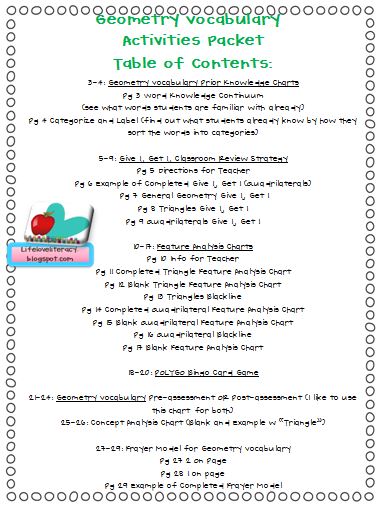
And silly me, I thought updating things would be a fast task, but it's taking a lot to turn something old into something new. The first product I started working on was my Geometry Vocabulary Activities pack. I ended up doubling the size of this packet in my revising. I added a table of contents, common core connections, direction pages, and sample completed pages. (These activities are tried and true, but I added a few things and tried to spice up the look of some of the pages).
Here's a look at what's in the Geometry Vocabulary Pack.
This set of activities is based on the idea that students need multiple exposures to vocabulary in order to master unfamiliar words. While the activities might seem repetitive, using them with a variety of levels of support (whole group, partner, and individual) will allow you to see when students have truly mastered the concepts/definitions and to identify misconceptions that still exist after teaching.
If you have purchased this product before, you can go to your purchases and re-download for the updates.

3RD Grade
CCSS.Math.Content.3.G.A.1 Understand that shapes in different categories (e.g., rhombuses, rectangles, and others) may share attributes (e.g., having four sides), and that the shared attributes can define a larger category (e.g., quadrilaterals). Recognize rhombuses, rectangles, and squares as examples of quadrilaterals, and draw examples of quadrilaterals that do not belong to any of these subcategories.
4th Grade
CCSS.Math.Content.4.G.A.1 Draw points, lines, line segments, rays, angles (right, acute, obtuse), and perpendicular and parallel lines. Identify these in two-dimensional figures.
CCSS.Math.Content.4.G.A.2 Classify two-dimensional figures based on the presence or absence of parallel or perpendicular lines, or the presence or absence of angles of a specified size. Recognize right triangles as a category, and identify right triangles.
CCSS.Math.Content.4.G.A.3 Recognize a line of symmetry for a two-dimensional figure as a line across the figure such that the figure can be folded along the line into matching parts. Identify line-symmetric figures and draw lines of symmetry.
5th Grade
CCSS.Math.Content.5.G.B.3 Understand that attributes belonging to a category of two-dimensional figures also belong to all subcategories of that category. For example, all rectangles have four right angles and squares are rectangles, so all squares have four right angles.
Happy Spring...or freezing, cold, windy, whatever this is :) I was pretty excited to see a little sunshine today as cold as it was. I'm on Spring Break! :) WHooo Hooo. One of my goals for break is to update some of my older products. My newest products look pretty snazzy, but my old ones need some of the dust knocked off.
And silly me, I thought updating things would be a fast task, but it's taking a lot to turn something old into something new. The first product I started working on was my Geometry Vocabulary Activities pack. I ended up doubling the size of this packet in my revising. I added a table of contents, common core connections, direction pages, and sample completed pages. (These activities are tried and true, but I added a few things and tried to spice up the look of some of the pages).
Here's a look at what's in the Geometry Vocabulary Pack.
This set of activities is based on the idea that students need multiple exposures to vocabulary in order to master unfamiliar words. While the activities might seem repetitive, using them with a variety of levels of support (whole group, partner, and individual) will allow you to see when students have truly mastered the concepts/definitions and to identify misconceptions that still exist after teaching.
If you have purchased this product before, you can go to your purchases and re-download for the updates.

3RD Grade
CCSS.Math.Content.3.G.A.1 Understand that shapes in different categories (e.g., rhombuses, rectangles, and others) may share attributes (e.g., having four sides), and that the shared attributes can define a larger category (e.g., quadrilaterals). Recognize rhombuses, rectangles, and squares as examples of quadrilaterals, and draw examples of quadrilaterals that do not belong to any of these subcategories.
4th Grade
CCSS.Math.Content.4.G.A.1 Draw points, lines, line segments, rays, angles (right, acute, obtuse), and perpendicular and parallel lines. Identify these in two-dimensional figures.
CCSS.Math.Content.4.G.A.2 Classify two-dimensional figures based on the presence or absence of parallel or perpendicular lines, or the presence or absence of angles of a specified size. Recognize right triangles as a category, and identify right triangles.
CCSS.Math.Content.4.G.A.3 Recognize a line of symmetry for a two-dimensional figure as a line across the figure such that the figure can be folded along the line into matching parts. Identify line-symmetric figures and draw lines of symmetry.
5th Grade
CCSS.Math.Content.5.G.B.3 Understand that attributes belonging to a category of two-dimensional figures also belong to all subcategories of that category. For example, all rectangles have four right angles and squares are rectangles, so all squares have four right angles.
Wednesday, March 30, 2011
"Test" the Season--Math Reflections
This year I find myself in a wonderful predicament. What do I do with nearly 6 weeks before the Math End of Grade test? Typically I have about ONE week that I am not teaching new material before the week of testing. In past years as soon as 4th nine weeks starts, we spend about ½ of our math time on new material and ½ on reviewing old material in the form of released items from NC DPI. Perhaps this is one of the perks that comes from looping with a group of children—all year I knew what I had already taught them in 4th grade and was able to quickly review that material and build off of it for our 5th grade curriculum.
We have many concepts that my students need to spend more time on and some areas that we need to look at for precisely how the concept might show up on the EOG. For example, my students are really good at completing function tables when it is in the basic “look at the table, figure out the rule” form, but questions often describe functions without giving the scaffold of a table—students must create the table themselves in order to be successful in figuring out the pattern and predicting later values. But, how do I keep these six weeks from being nothing but mundane test-prep packets where students do the work and I go over the answers? And, how do I make sure this “test prep” is actually preparing them and helping them become BETTER math students? I came up with two strategies:
One sheet is a tool I created to have students gauge how much they know about the concepts we will be reviewing. We will do this on Mondays for the concepts I plan to review that week. At the end of the week, students will reflect on their understanding of each concept now that we have worked on them more. Here’s an example:
Each day, I also plan to incorporate SMART clickers/Senteos to go over our math homework. Then, I plan to have students analyze the problems they missed, noting whether or not it was because of a mathematical mistake OR lack of understanding the concept/question. Next, students show how they should have solved the problem and decide if they actually get it or still don’t get it. Here’s an example:
(You can download these forms for FREE on TPT and modify them for your math content.)
I hope that these two reflection strategies will help students gain more control over their knowledge and help them meaningfully correct their mistakes through analysis and explanation (instead of finding out the right answer and just moving on). I am also thinking that I will have students staple these reflections on top of their review work for the week to send home to parents. As I start to realize patterns in students’ mistakes or misunderstandings, I will probably spend a few weeks (or maybe every Friday) with students placed in small groups focused on different topics that target what they need help on. Of course some students will need it all, and I might have them in each review group OR I could prioritize concepts for them focusing more on their confidence than having them try to improve on everything. I might even open it up for students to place themselves into the groups they think they need to be in.
I also plan to incorporate a 10-15 minute game time each day using some of the games we have used throughout the year to allow students to review concepts in a fun way. Have you used the games on DPI? Look through the Weekly Essentials files. The games are ready to go!
I hope at least one of these ideas is helpful to you as you work through “Test the Season!”
Subscribe to:
Posts (Atom)