Showing posts with label human body. Show all posts

Tuesday, April 30, 2013

~Writing Riddles for Mini-Research: Minilesson Magic

Common Core requires that students perform mini-research projects throughout the year. The part that I have trouble with is how something can be "mini" while also "meaningful." I tend to dig deep on our writing units. How can we write smaller and make our kids smarter writers at the same time?

Warning: This post is going to be long because my kids' writing riddles are too cute not to share! Check them out, then read about how we got to this point :) 

One of the intents of my plans with our Human Body Systems unit was to have students complete a research project on a disease of interest. My goal was to encourage healthy living as an outgrowth of our Human Body objectives. However, it is the end of the year and we have a LOT left to do. I felt a little lazy making this decision, but I decided not to launch a huge, in-depth research project. But, I did come up with what I think is an AMAZING idea for my classroom because of its ability to meet many common core objectives, to transfer fluidly to a 1-1 classroom environment next year, how it connects with my students' LOVE of celebrating and sharing their writing, and how it capitalizes on our love of task-card-like learning modes. What am I talking about? "Writing Riddles for Mini-Research." It will be ALL-the-RAGE! :) I promise! <3

How did I get my students started? I wanted to use their curiosity about the human body to my advantage. I created a simple "Wonder" sheet. I gave students 4 categories for generating topics: organs and other body parts, habits, diseases, and curiosities. (You can click to catch it for free from my google docs!)
 After brainstorming, students circled their top two choices (or wrote them in the bottom block on the worksheet). I then went through each one and approved their topics. I just wanted to make sure everyone studied something different. Next, we spent one day in the lab researching and one day in the lab typing. Here's a sample of my favorite Writing Riddle paragraphs:
What is "Progeria"? 
What are "the kidneys"?
What is "the brain"?
What is "ear wax"?
 What is "motion sickness"?
What is "eczema"?
What is "the appendix"?
What is a "muscle cramp"?
What is a "heart attack"?

What's a Writing Riddle? 
After reading those great examples, I'm sure you've got it, but basically, students write paragraphs  in a riddle-like format. (For once, I encouraged my students to be a little vague!) Once the paragraphs were drafted (we use a wikispace as a writing portfolio), I went into our wikispace and cut and pasted all of the paragraphs into powerpoint slides. Then I added cute frames to make the paragraphs a little more jazzy (but in a rush, you could just pick a cute font and move on!). I also included a number on each slide (you could also do this by just writing a number on each if you don't have time for a huge production).

How will we share our writing riddles? After printing all of the slides, I will set up an around-the-room task-card like reading/writing celebration. Students receive a worksheet with all of the questions listed. As students move around the room reading each card, they decide which question the riddle paragraph answers. For example, if I read #8 and know it is describing a heart attack, I would write #8 beside of the question "What is a 'heart attack'?"

Writing riddles...why I love it:
I was perplexed by the idea of "short research" called for by the common core. I mean, I get that it can be done and that what we often do in science or social studies (using our textbooks) can be considered "short research." However, I also interpret short research to mean short-term research projects that still culminate in some type of product created by the students. Short research should still be purposeful and have a sharing component. (See why I was perplexed? I can rarely do something small-scale and feel like it was meaningful to students). Wow! In our "Writing Riddles" project, I got all of that and more. In total, it took students about one day to research, one day to type, and it may take us two days to have enough time for everyone to read most of the riddle paragraphs. I can't wait to do this next year~~more often and with more topics. How much better will my students be at synthesizing researched information and turning it into interesting pieces of writing?!?!?! (You can already see some of the creativity coming out in some of the examples above.)


W5.2 Write informative/explanatory pieces to examine a topic and convey ideas and information clearly.
W5.2d Use precise language and domain-specific vocabulary to inform about or explain the topic.
W5.6 With some guidance and support from adults, use technology, including the internet, to produce and publish writing as well as to interact and collaborate with others; demonstrate sufficient command of keyboarding skills.
W5.7 Conduct short research projects that use several sources to build knowledge through investigation of different aspects of a topic.
W5.10 Write routinely over extended time frames (time for research, reflection, and revision) and shorter time frames (a single sitting or a day or two) for a range of discipline-specific tasks, purposes, and audiences.
L5.1-3 All Conventions of Standard English and Knowledge of Language Standards are included in this activity
L.5.6 Acquire and use accurately grade-appropriate general academic and domain-specific words and phrases, including those that signal contrast, additoin, and other logical relationships (e.g., however, although, nevertheless, similarly, moreover, in addition.

Room to Grow Objectives (Future Minilessons): 
W.5.2b Develop the topic with facts, definitions, concrete details, quotations, or other information and examples related to the topic.
W.5.2e Provide a concluding statement or section related to the information or explanation presented. (Some students concluded in interesting ways, like the one who wrote about car sickness).

Next year when we are 1-1, it might make sense to have students post their Writing Riddles on our classroom blog. This would allow them to include other aspects in their research, like multi-media components, images, and diagrams from a web-based source. I'm thinking, students could have the Writing Riddle Post set up with their paragraph, the reader could make their guess, then have a video and/or image link to click on in order to reveal the answer and learn more.
* SL5.5 Include multimedia components (e.g. graphics, sound) and visual displays in presentations when appropriate to enhance the development of main ideas or themes.

Anyone else SUPER EXCITED about the possibilities of this little idea? (I can't wait to use it a million times next year and see how it evolves!)

Since this is a new idea that I have tried with my class, I am linking up with Tried  it Tuesday. Hop on over to check out more new ideas from other great teacher blogs.
Photobucket

PS: Those super cute polka-dot frames are from. Graphics From the Pond: http://frompond.blogspot.com

Sunday, April 28, 2013

~~Peek at My Week: Lots of Science! and Test Talk~~

It's a busy week. Unlike last week, I might actually get to teach all day long, every day this week! (Except we have our DARE ceremony on Friday.) Otherwise, this week is perfectly intact, which means I should be getting my plans together!

Here's what we have on the agenda this week:

Reading EOG: Test Talk Time! We are starting this week with our Reading EOG prep. This is really a review since I had my babies last year and know what they are capable of. I am proud to say that we only have 4 weeks until testing. I am not stressed and neither should they be. But, we are going to turn our attention to making sure we remember to do what we know how to do. I created the following format/board for our EOG Minilessons. Basically, I want to take what students already know how to do, discuss why they use this strategy/skill with their own reading choices and then why it will be important and helpful on the EOG. The green/yellow signs are a few strategies that I remembered right off. My students have already reminded me of others that I have taught them. I will add those to the board later this week. (I may upload this set to TPT later this week, I'm just not sure it's ready yet!)
 
 
 To review for the science EOG, we are using:

Science Links: 
Matter: Properties and Change Vocabulary Mats
Matter: Properties and Change Vocabulary Activity Pack
Force and Motion Illustrated Dictionaries
Ecosystems Vocabulary Mats
Ecosystems Vocabulary Activity Pack
Weather Vocabulary Mats

I will be using these during my science block, some for morning work, and during some of our word study blocks. Students will also be able to take their vocabulary mats home to study their science vocabulary words. (Those words are make-it-or-break-it for the Science EOG!)

For more science products, click here.

Math Links:
Multiplying/Dividing Fractions
Add/Subtract with Unlike Denominators

Video Links:
A Child With Blindness (for morning meeting)
Check out Cafe Mom Studios for more videos like this (I am going to start using them during morning meeting to teach more about diversity, accepting others, compassion, overcoming our own obstacles, etc.)
Head over to Mrs. Wills for a Peek at everyone's Week. If you are a blogger, you should really start linking up with this linky. I LOVELOVELOVELOVELOVELOVE it! :)
And a teaser for tomorrow's Minilesson Magic (it's set to go live at 6 am so catch it!): Learn about Writing Riddles for Mini Research! :)


Wednesday, April 24, 2013

Purpose Games: Human Body System Links to Matching Games

Have you seen the purposegames.com website? I found it when I was planning for human body systems (but it has a million other concepts on it). Link this website NOW!!!!! I am especially excited about it because we will be 1-1 next year and with all of the concepts included (like 13 colonies), I will surely be able to find things for my students to practice daily. I love the idea of giving them 5 minutes at the beginning or end of each class period and watching them improve in their knowledge.

We are currently in the computer lab working on our Human Body System books. I took the time to link all of the following labeling games on my classroom website. (Lucky for you, if you want them, you should be able to copy them from my blog, paste them into your own website, and the hyperlinks will stay intact.)

Hope this website is a winner for your classroom! My kids are highly motivated to increase their accuracy percentages and reduce the time it takes them to complete the labeling. Happy Wednesday! 

Tuesday, April 23, 2013

Science Day Photo Blast!

Have you checked out my wacky week? It all started Monday with our Science Fun for Everyone Day.
Here are a few pics from our 3 sessions from today. (I have more, but they have kids in them and I just don't share their pics...I may have time to cover their faces later in the week. If so, I will update and share :) Now, I was totally off-focus today, so I'm not sure I can tell you everything they did! I had an IEP meeting for one hour of their sessions, then visited our book fair to choose my books.

Here goes....Sheep parts--see the brain, stomach, intestines, oh wow! I missed this part.
 Salt/Cell Experiment
 Cell goo...they got a little in a cup and put a fuzzy "nucleus" inside of the cell.
 Air pressure experiments: Can you fill the tube (made of grocery-bag-like plastic). You make it look full by applying pressure (pressing in) the ends. I also thought this would have been a great way to demonstrate/test students' lung capacity for Human Body Systems
 Newton's Law: You can hardly tell, but she is spinning a cup of water on a board attached to rope. No water spilled!
We LOOOOOOOOOVE science days at our school! If you are in the NC area, you should really look into these guys for next year. We have 3-70 minute sessions in one day. I am always amazed at how many activities the scientists are able to cram into one session and how engaged the kids are with all of the materials and learning opportunities. It's a great way to anchor future learning or future review. "Remember when you did...on your science day?" Let me explain more about that!

Happy Tuesday!

Tuesday, April 16, 2013

~~**Photo Blast!**~Human Body and More!

What have we been up to? Take a visual look!


Coordinate Plane art in math (my students had some amazing artwork, but this is the only one I snapped a picture of). The kids made a design, had to record the coordinates with "START"/"STOP" directions to help know when to connect the dots and when to start new lines. Then, on the second day, students received a copy of the coordinate directions and had to recreate the design. I will try to get more pics, but I am definitely doing this again next year! Great break from hard math concepts.

Have a great rest of the week! Enjoy your kiddos, this year won't last forever! :( 

Sunday, April 14, 2013

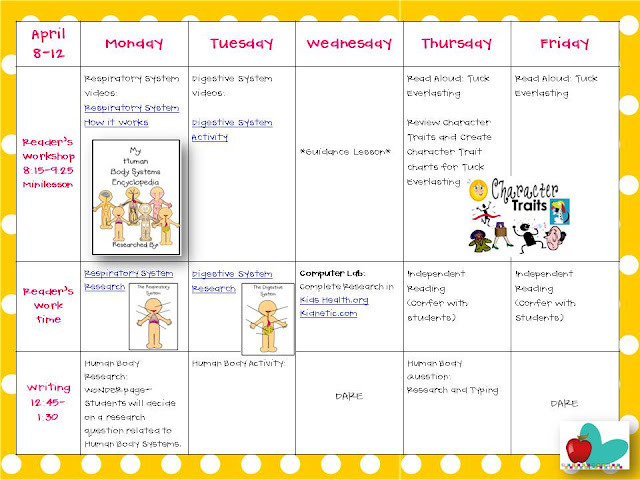
Peek at My Week: Math Review, Human Body, Force and Motion

I'm linking up again for a Peek at My Week with  Deedee.
If you already checked out my plans for last week, I have updated them and moved things around to represent what we actually did. (You will notice I made changes with the Human Body Systems lessons and included links for the videos I used during reader's workshop to help students understand the body systems before they researched through reading. I also included what we discussed for morning meeting--this cannot always be planned the week before. Often, our topic comes from what we did the day before).This will probably be an obsession of mine--updating my posts to show my actual plans versus my projected plans. :) There's just never enough time for me to get ahead!


Weblinks:
Ms. Nelson is Missing Video (by Kindergartners found on Deedee's blog)--Too Stinking Cute not to use for Morning Meeting!)
Good Information for the confusing parts of Force and Motion (velocity, speed, and motion)

Bumper Car Physics
Roller Coasters: Build Your Own


Links to Products I am using this week:
Character Traits Definitions/Bulletin Board Posters


Force and Motion Illustrated Dictionary (Tarheelstate Teacher)
Bowling Ball Basics (FREE from Mrs. Kaiser, another NC teacher)
Math Common Core Assessments (Jennifer Findley)
Math Common Core Test Prep Helper (Jennifer Findley)
Cupcake Shoppe Multiply/Divide Fractions Problems (Tarheelstate Teacher)


Multiplying and Dividing Fractions with Area (House Plan Theme) (Tarheelstate Teacher)

Have a great week! I hope to get time to share something else this week too, even if it is just a photo dump! :)

Monday, April 8, 2013

Minilesson Magic: Helmet Law Debate (Interpreting and Comprehending Data in an Article)

Back to reality! And boy was it a great day! I was prepared (did you catch yesterday's post of my week's plans?) Monday is also my day that my team covers recess and lunch for my kiddos, so I got triple planning time with that and my after school time~no meetings, yay! Needless to say, I still have things to think about...remember my "I'm a 3-day planner" confession. I have a problem with OVER-THINKING things, especially in science and social studies. Maybe it's because we have so little time for these subjects but sooooooo many ideas that we could do. It's hard to weed it all out and make decisions (and then have time cut even shorter and have to re-adjust).
ANY-who. I decided to check in today to share my reading minilesson. Since I shared my plans with, I spent the whole day thinking, man, I should take a picture of that or blog about that to share what exactly I did and how it went. So, this week we are focusing on the human body systems during reading and writing (research, science, nonfiction reading, all rolled into one topic). Then, in our regular science time, we are studying Force and Motion, but I didn't just want to jump right in with that on our first day back, so I planned something that connects all of this, but my little babes barely knew it today. (They will see the connections throughout the rest of our week). Let's call today an ENGAGE. :)

We spent ALL--ALL--ALL last quarter working on opinion based essays and while we are not going to have TONS of time this quarter for a large writing project, I want to continue developing students' ability to write about their opinions and to structure an essay paragraph using PEEL (free download from Tracee Orman--we have used this method to the max this year!). They have grown so much, but ya know, "Ya use it or lose it."

In walks the NC Helmet Law Repeal Debate. Should motorcyclists be forced to wear helmets? Should our state (or yours) repeal their helmet requirements? (I used the word 'forced' instead of required because it's a strong sounding opinion-e word.) Some states require motorcyclists to wear helmets, others do not. Now, I am not a motorcyclists and do not plan to be. I may never be on one in my entire life (although I would have LOVED a helmet while at Carowinds last week :) But, this topic might just stir up some excitement for my kiddos and they can connect to wearing a helmet (or not) while riding a bicycle (meanwhile, I can teach them the importance of protecting their craniums and their brain--a key part of the nervous system).

Long story short, I quickly chose three articles for them to read today, made copies, etc. Then, I read them Sunday and thought WHOA buddy. I cannot send them loose on this article, "North Carolina Motorcycle Helmet Repeal Bill Passes First Mile Marker."  So, I quickly decided to turn this into a guided lesson where we interpret the information in the article. I decided not to give students the article at all (yet) and just work from the 6 excerpts I pulled out. For each snippet of the text, I wrote a question or two.
Most of the questions focus on interpreting what point the person quoted is trying to make or "talking back" to the text. Talking back to the text is something we learned to do last quarter. (When you are reading an opinion-based text, you often want to talk back to the text with your ideas. Critical readers should be talking back to opinion based texts because we know the author is trying to get us to agree with them and may be leaving out important information).

To get their little minds engaged,  I started with a bicycling questionnaire just to see where their thinking was before we talked about the issue.

After a quick sharing of our survey answers, I explained the issue at hand and then we went through the excerpts from the article one at a time. I read aloud from the smartboard and then had students try to interpret the info or talk back. Next, we shared, I helped interpret/explain when necessary, then we moved on to the next excerpt. It sounds boring or too teacher directed, but they actually seemed to get a lot out of it and wanted to talk about their opinions the WHOLE time! My~smart~little~thinkers :)

If you would like to do this lesson, I am linking the google presentation I made, the questionnaire and worksheet, and the article so that you can implement it PRESTO! Magic! :)

In my students article packet, I also included two others articles that have a heavy opinion that motorcyclists should have the freedom to choose, but we didn't get to those today.
Helmet Law Hypocrisy from ncrider.com (I only pulled a few paragraphs from this; while I don't agree, I thought it was a good example of strong opinion and something students could "talk back" to)
The Twisting of Data in Helmet Safety Studies from bikersrights.com

If you would like the packet I made (straight copy and pasted the articles above into a packet for the kids, shoot me an email and I will send it to you. I just don't feel comfy sharing that on the web). Also, these are not 'pretty,' but they are down and dirty minilesson materials that get the job done.

RI.5.1 Quote accurately from a text when explaining what the text says explicitly and when drawing inferences from the text.
RI.5.2 Determine two or more main ideas of a text and explain how they are supported by key details; summarize the text.
RI5.3 Explain the relationships or interactions between two or more (ideas) based on information in the text.
RI5.8 Explain how an author uses reasons and evidence to support particular points in a text, identifying which reasons and evidence support which point(s). 
Hope you can use this, if not now, next year!


lifeloveliteracy@gmail.com

LinkWithin

Related Posts Plugin for WordPress, Blogger...