Showing posts with label science EOG. Show all posts

Monday, March 9, 2015

Ecosystems & Animal Research Booklets

Animal Research in the UPPERGRADES? I have to admit, I have always underestimated the power of "Animal Research" in my 4th and 5th grade classrooms~I always thought it would be too basic for my students. Is it possible to take this typically lower-grades project to a higher level? I think so! Today I'm popping in to share my latest science research booklet, but WAIT...this booklet is MORE than just a booklet! It's also a project~based learning unit! I have been envisioning, processing, tweaking and adding to this booklet since November and finally uploaded it on Friday.

I had to create this set of research/notebook pages for myself because nothing I found when searching for “animal research projects” really fit my needs for upper elementary students and our curriculum. Utilizing NC standards from 4th grade and 5th grade, I focused on habitats, ecosystems, biomes, adaptations, and on supporting students as they develop an in-depth understanding of a specific organism {all were consumers}.

I designed my research booklet with lots of opportunities for students to sketch in response to their research and learning. I also defined key vocabulary on each page. This gave me the option to use some of the pages for lessons and science notebooking while others were specifically for my students' "Consumer Research" projects. The pages included provide students with ecosystems basics (physical and behavioral adaptations, abiotic factors (sunlight, soil, temperature, landforms), biotic factors (producer, consumer, decomposer), niche, food chains, etc) while also offering opportunities to extend the curriculum (symbiosis, human impact, environmental changes, etc).

What did I do with the research booklet?

I wanted my students to learn about the two main biomes in North Carolina—temperate deciduous forests and the coastal plain (including wetlands/estuaries). I printed the following pages on 1/2 sheets for students to research the temperate deciduous forest (for 2 days) and the coastal plain (another 2 days):

I printed these sheets twice (one set for Temperate Deciduous Forests and one for the Coastal Plain). If your curriculum focuses on world biomes, I have included similar sheets titled "Ecosystems" and "Biomes" so that you have choices. If I were teaching 5th grade this year, I would have students complete the biome sheets for multiple biomes. {Maybe strategically picking two that I would want them to compare after researching both}.I have also included “World Biomes” cover pages and a world map.

After students built background knowledge for our two main ecosystems (and some key vocabulary) we began our organism Research Projects. I created a list of key organisms in NC that students could choose from for their research project. Each student was required to choose a different organism to allow variety. Students received a “Consumer Research Booklet” that included:

• Cover page (you have many versions to choose from)
• Map (I have included a world map and NC Map)
• Habitat, Sweet Habitat
• Physical Adaptations
• Behavioral Adaptations
• Diet (Food Chain)
• Interactions with Other Organisms (Food Web)
• That’s Just “Niche”
• Interactions with Humans
• Relationships Between Organisms
• Ch-Ch-Changes (organism version)

For about two weeks of science/writing time, students used a list of websites that I provided to learn more about their organism. The booklet provided them with a guide for information they should seek out and a way to collect and organize that information, it made the connection to the science standards for our curriculum, and also included some extension topics for their research.
You have many options with the sheets included in this research booklet. I used some of the sheets during science lessons as they are perfect for capturing information in science notebooks; you can complete these sheets together, have students use websites to fill in, or have students work in partners. (You can't go wrong, if I do say so myself ;)

What happened next? Students used their booklets to create a research paper...and later, a google slideshow...and a WHOLE LOT MORE!!!

In this product, I have included “starter” materials for a possible project-based learning unit where students create a mobile museum based on their research booklets. I'm going to share all of our PROJECT BASED fun with you in my next post. Look for it on Thursday or download this baby now and get yo-self started on this engaging unit!

Sunday, July 21, 2013

Peek at My Week: Science Genetics Unit and MORE!


Here's to another Sunday spent planning.  The goal for next week is to get a few things planned before the weekend comes! To make this post a little shorter, I am breaking it into two parts. Tomorrow, I will share my reading and writing plans for some Minilesson Magic :)
Science:
This week, we have our mini-unit on genetics scheduled. Our students need to learn the following objectives:
* Explain why organisms differ from or are similar to their parents based on the characterisitcs of the organism.
* Give examples of likenesses that are inherited and some that are not.
For my student journal pgs, click here (free and in a pdf).

Monday: Set up science journals. The label shown above will be pasted into their notebook as a divider for our first unit of study. Complete the "Mice" assessment probe to see what students already think about how traits show up in organisms.
After students think about their own explanations, we will use the explanations above to make a bar graph for how they think offspring's fur color is decided. (This assessment probe comes from Page Keeley, Uncovering Student Ideas in Science).
Use 1st page of heredity video to explain heredity.
Tuesday: Fingerprints Lab (found this gem linked for free online)
Wednesday: Observing Human Traits Lab (free from Tamra Young on TPT); explain dominant and recessive traits and draw conclusions about what traits are dominant/recessive for humans based on classroom data)
Thursday: Complete active sort around the room for Inherited vs Acquired traits and make flipbook (free materials from Jennifer Findley)
Friday: Learn about Punnett Squares with Leprechaun Genetics (free from Making it Teacher

on TPT)
Other Resources that might be thrown in w/ extra time: 
Unit Outline from Moore County (includes a smartboard file to guide the mini-unit)
Peas in a Pod (Mendelian Genetics) online freebie; Questions to go along with the reading selection included (I made these last year)
Heredity (from Brainpop)
DNA (from Brainpop)
Animated Videos that explain DNA, genes, chromosomes, protein, heredity, and traits

Math:
This week in math, I will be getting to know my students better as mathematicians. I'm using some of the journal prompts/explorations from my Math Explorations that focuses on factors. (Not only will we learn about decomposing numbers, but students will be forced to use their multiplication facts). Since my Math Explorations are aligned with the mathematical practices, I thought it would be a good way to introduce concepts like communicating in math, perseverance, using multiple methods for showing work, using different strategies, etc. We are also going to continue working on our Summer Slide questions, which we started on Friday. 
Given time, I will also begin to introduce some of our math stations. For math stations, my team decided that we would have 4 stations this year, MATH SUPERSTARS, CONCEPT FOCUS, ALGEBRAIC, and something computer-based like Moby Max. 


 Morning Meeting:

 We are going to focus on perseverance all week. We have a county-wide assessment that is designed with all tasks focusing on perseverance, so this fits in nicely with morning meeting. The kiddos may not even realize they are being assessed.
Finish Strong
Erik Weihenmayer on Oprah (start at 1:21)


Hope you enjoyed peeking at my week! Tune in tomorrow for my reading/writing minilesson ideas for the week.

Sunday, May 12, 2013

Peek at My Week (this week and last!)

Hello all,
I missed Peek at My Week last week. I had all intentions of getting things shared before the week was up but I spent a lot of time on my Thinking through Reading Tests product and even revised it a little the day after I originally posted it.

If you missed my lessons on sorting question types, check it out. It's three days at least of meaningful test-prep plans with strategies that kids can use forever for all reading-type tests and even for open-ended questions. Heck, I think I will teach my QAR lessons from the beginning of the year next year.
I even had time last week to finish up a new product, Multiplying and Dividing with Decimals Task Cards. These questions are exactly like my Multiplying and Dividing Fractions task cards with the house plans theme, but the kids won't really care, will they? I teach those concepts so far apart, it will be nice for them to see the connections between decimals and fractions with these questions.

What did we do last week? You know, we worked on a lot of questions from released packets in math and used our questioning strategies on a passage a day during reading.

In science, we learned about Gregor Mendel and genetics. I had some good freebie resources I wanted to share with you in case you teach that too.
Peas in a Pod: Mendelian Genetics from Mensa for Kids. It looks like they have A LOT of other good resources that fit my science curriculum, so I will definitely be checking them out for more stuff later.
I made questions to go with the first two lessons from the Mensa for Kids Genetics lessons. You can grab it from my google docs to use with your students.

Finally, peek at my week, visually!
Morning Meeting:
Inspiring Kindness Video (song in video is GREAT!)


Hope you enjoyed peeking at my two weeks. What do you have going on?

Sunday, April 28, 2013

~~Peek at My Week: Lots of Science! and Test Talk~~

It's a busy week. Unlike last week, I might actually get to teach all day long, every day this week! (Except we have our DARE ceremony on Friday.) Otherwise, this week is perfectly intact, which means I should be getting my plans together!

Here's what we have on the agenda this week:

Reading EOG: Test Talk Time! We are starting this week with our Reading EOG prep. This is really a review since I had my babies last year and know what they are capable of. I am proud to say that we only have 4 weeks until testing. I am not stressed and neither should they be. But, we are going to turn our attention to making sure we remember to do what we know how to do. I created the following format/board for our EOG Minilessons. Basically, I want to take what students already know how to do, discuss why they use this strategy/skill with their own reading choices and then why it will be important and helpful on the EOG. The green/yellow signs are a few strategies that I remembered right off. My students have already reminded me of others that I have taught them. I will add those to the board later this week. (I may upload this set to TPT later this week, I'm just not sure it's ready yet!)
 
 
 To review for the science EOG, we are using:

Science Links: 
Matter: Properties and Change Vocabulary Mats
Matter: Properties and Change Vocabulary Activity Pack
Force and Motion Illustrated Dictionaries
Ecosystems Vocabulary Mats
Ecosystems Vocabulary Activity Pack
Weather Vocabulary Mats

I will be using these during my science block, some for morning work, and during some of our word study blocks. Students will also be able to take their vocabulary mats home to study their science vocabulary words. (Those words are make-it-or-break-it for the Science EOG!)

For more science products, click here.

Math Links:
Multiplying/Dividing Fractions
Add/Subtract with Unlike Denominators

Video Links:
A Child With Blindness (for morning meeting)
Check out Cafe Mom Studios for more videos like this (I am going to start using them during morning meeting to teach more about diversity, accepting others, compassion, overcoming our own obstacles, etc.)
Head over to Mrs. Wills for a Peek at everyone's Week. If you are a blogger, you should really start linking up with this linky. I LOVELOVELOVELOVELOVELOVE it! :)
And a teaser for tomorrow's Minilesson Magic (it's set to go live at 6 am so catch it!): Learn about Writing Riddles for Mini Research! :)


Sunday, April 14, 2013

Peek at My Week: Math Review, Human Body, Force and Motion

I'm linking up again for a Peek at My Week with  Deedee.
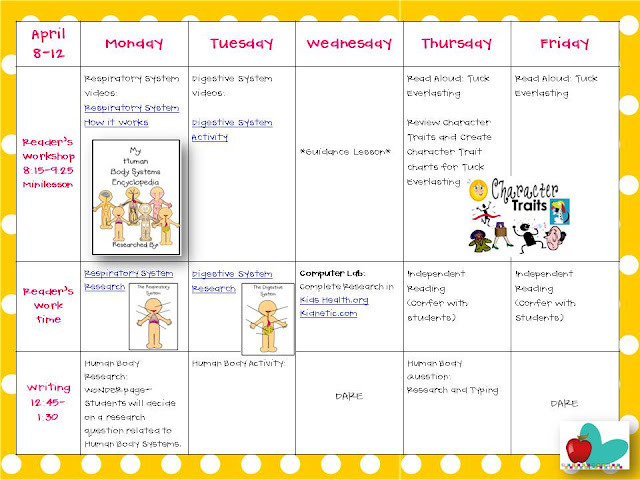
If you already checked out my plans for last week, I have updated them and moved things around to represent what we actually did. (You will notice I made changes with the Human Body Systems lessons and included links for the videos I used during reader's workshop to help students understand the body systems before they researched through reading. I also included what we discussed for morning meeting--this cannot always be planned the week before. Often, our topic comes from what we did the day before).This will probably be an obsession of mine--updating my posts to show my actual plans versus my projected plans. :) There's just never enough time for me to get ahead!


Weblinks:
Ms. Nelson is Missing Video (by Kindergartners found on Deedee's blog)--Too Stinking Cute not to use for Morning Meeting!)
Good Information for the confusing parts of Force and Motion (velocity, speed, and motion)

Bumper Car Physics
Roller Coasters: Build Your Own


Links to Products I am using this week:
Character Traits Definitions/Bulletin Board Posters


Force and Motion Illustrated Dictionary (Tarheelstate Teacher)
Bowling Ball Basics (FREE from Mrs. Kaiser, another NC teacher)
Math Common Core Assessments (Jennifer Findley)
Math Common Core Test Prep Helper (Jennifer Findley)
Cupcake Shoppe Multiply/Divide Fractions Problems (Tarheelstate Teacher)


Multiplying and Dividing Fractions with Area (House Plan Theme) (Tarheelstate Teacher)

Have a great week! I hope to get time to share something else this week too, even if it is just a photo dump! :)

Sunday, April 7, 2013

Peek at My Week: Show me the Plans!!!

Hi Everyone!

Spring break, now over. I nearly laid in the bed all day (well, until 11:30). Then did some blog-stalking-pretending-I-was-planning-procrastinating. I watched an episode of undercover boss and cried when the boss gave a kid a full-ride to college so that he wouldn't have to work and go to school at night. Wow! If only everyone felt as grateful as this kid to be getting his education paid for. As happy as he was, I cried because I knew he was getting an opportunity for higher education that he wouldn't have otherwise. {Did you know I'm a softy?} I finally talked myself into a run-jog, walk-around-and-look-at-the-birds around 5. Now I sit here needing a shower, needing to pack my lunch, needing to pick out tomorrow's outfit, and needing to finalize my plans for the week so that I can link up with Mrs. Wills' Kindergarten blog for her AWESOME Peek at My Week linky.

Don't get me wrong, I am excited about our upcoming quarter, but I always get a little paper-bag hyperventilating when it feels like we are starting so many new things at once. I know I will be fine by Tuesday, and seriously, I am planned-and-ready for tomorrow, so calm down!

If you take a close look at my plan...you.will.find.some.holes. Seriously, I am a 3-day planner. I want to see how things go and then re-organize. I have some ideas in my mind (usually) but I wait to make final decisions on what comes next based on what my kiddies do. So, don't-judge, please :)


If you click on the images above, it will take you to a google doc where you can click on the hyperlinked plans. (Can't figure out why the google doc does not allow you to click on hyperlinks, but if you download, you can get them that way).

I made these plans in word and converted them to a PDF. Then, I watched Deedee's video about how she makes her visual lessons and she does it in powerpoint. You know I love to make stuff in powerpoint over word but I thought word would be easier for these lesson plans...I might be converting over to powerpoint next week! If you haven't hopped over to see Deedee, you definitely want to check out her blog and the other bloggers that are giving a "Peek" at their week.

Sunday, March 31, 2013

Human Body Systems-Ready to Teach!


When we return from break, we will be learning about human body systems. We have to learn about the respiratory, circulatory, muscular, skeletal, nervous, and digestive systems. This is new in our curriculum this year, which means  I get to learn new stuff too and figure out how best to teach it. Unfortunately, I feel like I have struggled all year to teach science in truly meaningful ways. Mainly, I feel like our new curriculum is shallow and widespread (we went from 4 goals/units to 7 domains). I'm not trying to be a baby (maybe I am) but I didn't like science to begin with when I became a teacher and then as I became a 5th grade expert on my science content areas, I began to like it more. I even got over my hatred of sand all over my room when we were learning about erosion, deposition, and weathering (no more landforms in 5th grade :( )

Now, with no {real} training or investment from our district, we got to start from scratch on a number of these units. We get the impression that no one is interested in investing in these standards because we will be transitioning to Next Generation standards in another year. (So, why didn't we just leave our old standards the hell alone as we also transitioned to the common core? In addition, we also have a 5th grade science EOG...on new standards...love it! That's education for you.) Discovery Ed's science tech-book was the only new resource we were given, which I'm also not that big of a fan of because it's pretty basic. Maybe I will appreciate it more next year when we are 1-1 and I can more easily assign components of the units to my students.

Okay, now that I have (somewhat) vented, I wanted to share my plans for the Human Body Systems with you. I'm actually kind-of excited about this unit.

We are going to start with nonfiction-based research in reader's workshop. I am going to try to embed as many nonfiction review lessons as I can, probably spending a majority of my lessons focusing on how author's signal vocabulary words and provide us with definitions (aka-context clues). Dedicating about two weeks for this in reader's workshop, we will still have a few weeks for looking at "Test Talk" for the reading EOG.

To hold all of my students' research together and to help them learn the important parts of the Human Body Systems content, I created a Human Body Systems Student Encyclopedia.

This is meant to be a down and dirty science unit. (Did I mention I will also be teaching FORCE and MOTION at the same time during our science block? Phew! Maybe I could have taught all of these standards if  I totally ignored social studies all year. How sad! :( )

During reader's workshop, I will start with a minilesson (probably a video, a journal question for students to respond to, or some other type of engagement activity, and a nonfiction-reading based review lesson), then students will move to articles that I have placed around the room. (I am getting articles from Discover Ed, readworks.org, http://kidshealth.org/kid/htbw/, and kidnetic.org, and I will be pulling books from the library.) I included links from readworks in the Human Body Systems research project. If you don't know about readworks.org yet, you should really check it out for decent nonfiction--free--and lexiled. (You can check out the list here and go to readworks.org to search for them.)

Another great resource I found was kidnetic.com/innerg. You can see below that you put a body part in place, then click on BRIGHT PAPERS on the RIGHT to learn more about the body part. I will either print off the Bright Papers for more research and/or head to the lab at the end of our 6 body systems reader's workshop cycle and let them click around to learn more and add info to their encyclopedias. We will also be using http://kidshealth.org/kid/htbw/.

Each day, we will focus on a different body system. The research sections for each body system include: coverpage/labeling diagram, structure/description/function chart for body parts, a more detailed diagram for labeling or other extension graphic organizer, a chart for students to list "Top 5 Ways to Keep this System Healthy" and "Illnesses and Syndromes that Can Affect this System," lastly, students complete a page where they try to find connections between different systems.

Then, in our writer's workshop block (since I plan for this to turn into a mini-writing project), we will do some sort of science activity to help students better understand the parts of the systems. When we are ready for the mini-writing project, I hope to have students focus on how to take care of one body system by doing more detailed research to understand how a specific disease or ailment affects a system (or multiple systems). I am hoping to make this unit deeper by providing a healthy living spin on it.

Human Body Systems now includes an answer key to help teachers provide feedback and help your students complete their research booklets! This was the most requested change to the Human Body Systems product and I'm so thankful for all the love sent through feedback and everyone's patience! If you have already purchased this product, please re-download for the updates! In addition the answer key, I included a page of the suggested activities that are listed in this blog post.

As I was planning this unit, I also showed some "love" to a few other TpT sellers. I purchased these posters from Mrs. Bell at Tangled with Teaching. It will make a great bulletin board and I will probably copy a set to place around the room when students are rotating to read their articles (it will provide a short break from longer articles and maybe reinforce something they have read. The posters come in two versions.
The human body systems clip art I used for my encyclopedia's came from Teachers Clipart and I found a great packet to use for my language/word study block from Mark Aaron, a FREE set of lessons for Human Body Idioms....go...grab...it...now!

Here are a few activity ideas: (you can also find these by following my Science Ideas pinterest board)
Make a Spinal Cord (spelloutloud.com)
Make a Skeleton (post includes possible read alouds--I would use toothpicks instead of chalk)
Make a Model of  Lung
Digestive System Activities
Importance of Cerebrospinal Fluid w/ an Egg (cool!)
Edible Bone Model (yum!)
Ideas for Cardiovascular System Activities

Phew! Long post, but I hope you found some ideas you can use :) Oh yeah, do you have any favorite activities you do with HBS? Other ideas? Feel free to let us know in the comments section!

LinkWithin

Related Posts Plugin for WordPress, Blogger...