Showing posts with label JerrySpinelli. Show all posts

Saturday, June 15, 2013

Favorite Classroom Read Alouds

 
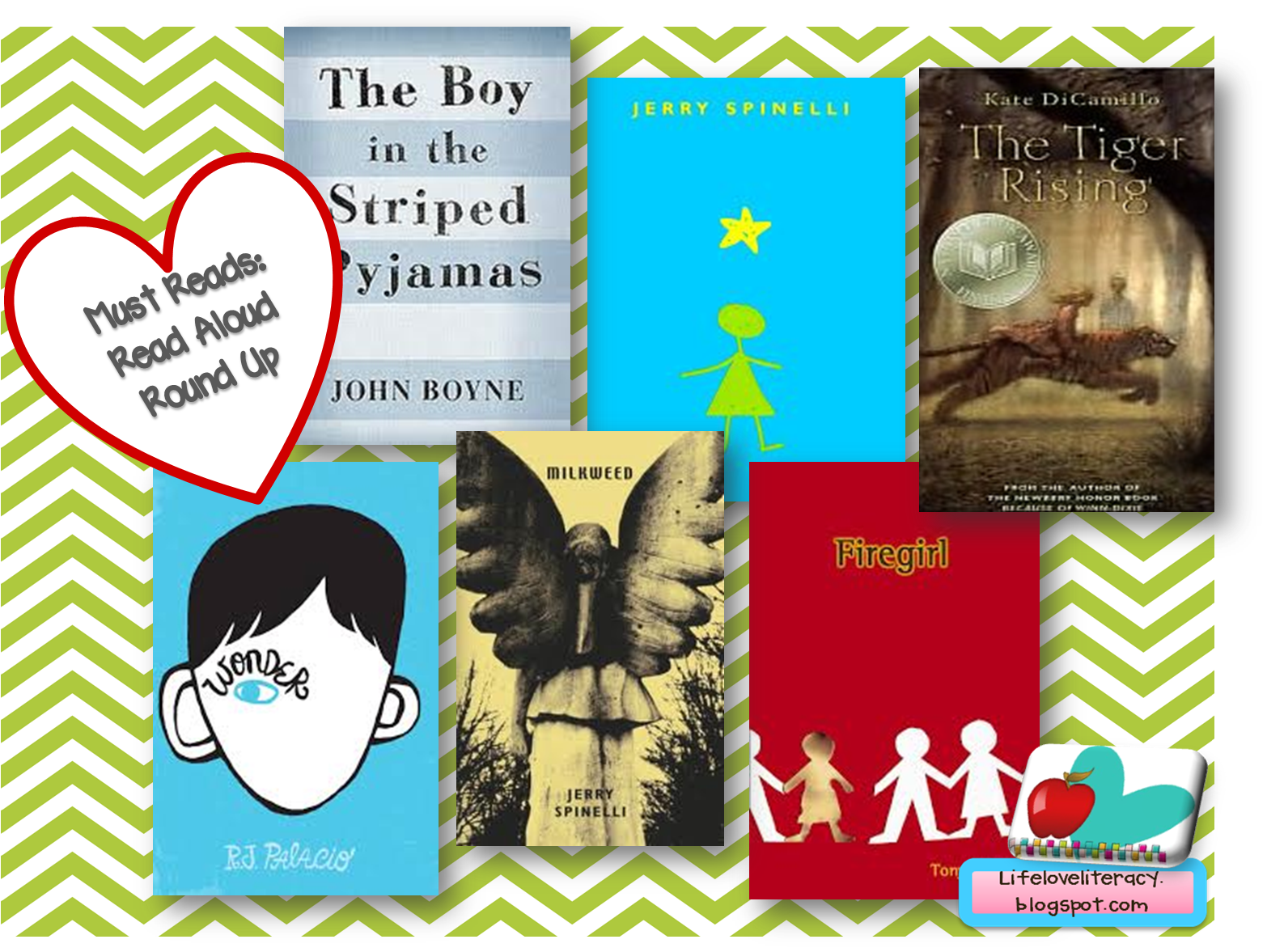
1. Wonder by RJ Palacio: Wonder is so "hot of the presses" new. It's the first summer read that I finished (in just a few days and I am a SLOW reader). I am so excited to share this book with students as my first read aloud this year. Auggie was born with a craniofacial disorder. He was born with droopy eyes, a cleft pallet, and missing part of his jaw. He is used to people looking at him and quickly changing their gaze or looking down. His parents chose to homeschool him until 5th grade. The book chronicles his 5th grade year in a middle school setting. As you would predict, he experiences bullies, fake friendships, and hurt feelings, but he also experiences true friendship, triumph, and finally--acceptance. I had to fight off the urge to sob the entire time I was reading this book. I truly think it's a wonderful way to start the year, bring together a group of students, and teach compassion. I also feel that this book challenges every reader (young and old) to see through how superficially we live our lives and to challenge how critical we are of our own looks. I can't say enough amazing things about this book (but I can promise you will hear more about it as I use it with my students!) Other key highlights:

* The inspiration for the name of the book, Natalie Merchant's "Wonder" is icing on the cake and will provide opportunities for text-text connections. ("I must be one of the wonders, God's own creation!")
* The story is told by a number of characters, mostly chronological, but sometimes overlapping the previous teller's section (opportunity for multiple-perspectives)
* A number of mantras are shared throughout the book through Auggie's English teacher
* RJ Palacio quotes a song at the beginning of each characters' section
* Many references to pop culture--Elephant Man, Star Wars, the Ugly Duckling, Beauty and the Beast (just to name a few)


2-3. Boy in the Striped Pajamas by John Boyne AND Milkweed by Jerry Spinelli: I must confess that these two were not read alouds this year, but book club books. However, through my minilessons on themes, symbolism, re-reading to catch things you might have missed originally, etc. I pulled excerpts of each of these books into my lessons. And, students were so into discussing their books and making connections during minilessons that I felt like every student got a good sense of the books no matter what they were reading individually. This year was the first time I read The Boy in the Striped Pajamas and Milkweed myself, and after sharing the experience with my 5th graders, and knowing that we referred to and repeated lines from these books ALL the YEAR LONG, these books top my FAVORITE books of ALL time list. The symbolism of angels throughout Milkweed is so strong that I now believe in "everyday" angels. The Holocaust is a sensitive topic for 5th graders, but we got so much out of the unit last year that we plan to do this unit again. I created a parent letter to inform them of our plans to learn about the Holocaust. (You can download it for free and change to fit your needs.) For more about my Holocaust lessons...
 
4. Stargirl by Jerry Spinelli: Stargirl almost always makes itself into my year as a book club, but this year,  I used it as a read aloud to target the theme of "conformity."  I hope you are already familiar with Stargirl, but basically Mica Area High School is the "hotbed of conformity." Everyone, even the unpopular kids, seems to follow along with Hilary Kimball and Wayne Parr. Until, Stargirl, a homeschooled, unique, march-to-the-beat-of-her-own-drum, girl comes along. Leo, the narrator, eventually falls in love with Stargirl, but soon realizes that he is being ostracized because of his friendship with her. The critical conflict in the book is the choice Leo feels he must make between being accepted by his peers and continuing a friendship with Stargirl. Regret, "being caught between a rock and a hard place," and accepting others for their uniqueness (rather than expecting them to conform) are huge themes in Stargirl.

5. Firegirl by Tony Abbott: I have used Firegirl as a read aloud once and in a book club this year. If you want a read aloud that gets at some of the same themes as Stargirl and Wonder but that is a shorter, less complex read, Firegirl is the one for you. Jessica comes to Tom's school mid year because she is receiving burn treatments at a local hospital. Jessica was badly burned when a gas tank exploded while her mom was pumping gas. As you can imagine, the environment in the classroom totally changes when Jessica joins the class. Although she is not able to come to class all of the time because of her medical treatments, when she does, no one speaks to her or wants to touch her. Mid-book, Tom begins a friendship with Jessica when his teacher asks him to drop off some of her school work at her house. When Jessica returns to her regular home, Tom has major regrets about not reaching out to Jessica and befriending her sooner. This book again gives you the opportunity to teach compassion and regrets, but also lends itself to discussing with students how to be a leader rather than a bystander.


5. The Tiger Rising by Kate DiCamillo: The Tiger Rising is CAPTIVATING for students, but I love it because it has so much to teach us about dealing with our demons. The amazon.com description does not do this book justice, "Walking through the misty Florida woods one morning, twelve-year-old Rob Horton is stunned to encounter a tiger—a real-life, very large tiger—pacing back and forth in a cage. What’s more, on the same extraordinary day, he meets Sistine Bailey, a girl who shows her feelings as readily as Rob hides his. As they learn to trust each other, and ultimately, to be friends, Rob and Sistine prove that some things—like memories, and heartache, and tigers—can’t be locked up forever." During my reading aloud of this novel, I taught students to walk in the characters' shoes, have compassion, and deal with their own "suitcase" of emotions. I seriously felt like I was teaching guidance lessons at the same time that I was teaching reading skills. To me, the tiger is the LEAST of importance in this book, but it keeps the kids wanting more and is a symbol of Rob and Sistine's own imprisonment by their emotions. Sistine's father is out of the picture and Rob's mother has recently died. Rob's father moved them to another town to get away from the pain, never talks about his mother, and has a hard time showing love towards Rob. Rob stuffs his feelings inside a metaphorical suitcase. On the otherhand, Sistine is always ready to let her feelings explode and often lets them out by beating on the bullies at the school. If you have not read this book, you MUST put it on your "to read" list. It took me all of an hour to finish and I did not want to put it down!!!!

From the looks of this list, it's safe to say that I like to choose read alouds that help teach my students how to treat one another with tolerance and compassion, how to face life, and how to become better people. I think each of these read alouds stick with students forever.

Hop on over to Mr. Hughes blog, Created by Mr. Hughes to check out this growing list of suggested read alouds. Although I suggested read alouds for 5th grade, the linky list ranges from 3rd through 8th and is divided by grade level. If you are a blogger, you can link up too!

Happy reading!


Green Chevron Background in first picture by

Monday, December 3, 2012

Thinking about Perspective: Monday's Minilesson Magic:

Currently, I am teaching a reading unit focused on the theme of conformity/nonconformity. My main read aloud is Stargirl by Jerry Spinelli. Through this unit, I am teaching/reviewing a number of fiction-focused lessons (like thinking about archetypes) to push students to think about Stargirl and their own reading.
Today I taught a lesson on thinking about the "unheard" characters' perspectives. My teaching point was "Readers think about the thoughts and feelings of characters who we are not hearing from. We consider things from that character's perspective." Because we are not hearing from certain characters, we have to infer what they are thinking and feeling when certain events in the story happen. 

Stargirl is an "unheard" character for much of the story. This often happens with characters who do not have best friends in the story--best friend relationships usually elicit discussions about character's feelings and thoughts, and so we often also get the secondary character's thoughts and feelings this way. But sometimes, like in Stargirl, we can only infer what she is thinking and feeling. (We are on 78 so Stargirl has not yet had any indepth conversations with Leo).

To actively engage students in thinking about Stargirl's perspective, I thought of 4 major things that happened to Stargirl and wrote each on a separate sheet of colored paper.
* Stargirl on the Hotseat
* Stargirl gets left at Red Rock High School because the MICA team tricked her
* Stargirl gets "tomato-faced" when cheering at a basketball game
* Stargirl goes to Anna Grisdale's Grandfather's funeral and Anna's mother attacks her

I then divided students into groups and had them discuss what Stargirl was thinking and feeling during each of these events. (We decided she was shocked, embarrassed, and humiliated for all of these). I found that it helped to push students' thinking by getting them to stop and think about what Stargirl was thinking and feeling in the moments before these events happened. We decided that in all of these situations, she thought she was doing something helpful, kind, or caring. Each of these events shows how she was treated when she had a good heart and was naive to the social expectations and norms of MICA High.

My students are also participating in partner reading. (It's like book clubs, but they are reading and discussing a book with one partner instead of a small group). I chose books that would help us build and compare/contrast the conformity/nonconformity theme.

I ended the lesson by explaining to students, "Some of you have characters in your book whose perspective we don't really get in-depth info about--like Jessica in Firegirl---while in other books, like, Schooled, you are getting lots of characters' perspectives (because each chapter of the book is told by a different character), but because of the way it is told, you do not get every characters' thoughts and feelings on every important event in the story. While in other books, you may get lots of characters' perspectives on the same event, but their perspectives vary, so you have to decide who you believe and most agree with."

I think this lesson was a good introduction for perspective and to get students to think about the "unheard" characters. It's so easy to put ourselves in the shoes of the main character because we are getting his/her thoughts and feelings--as readers, we need to push ourselves to consider other character's feelings. Hope you can use this lesson with your class!


Wednesday, October 31, 2012

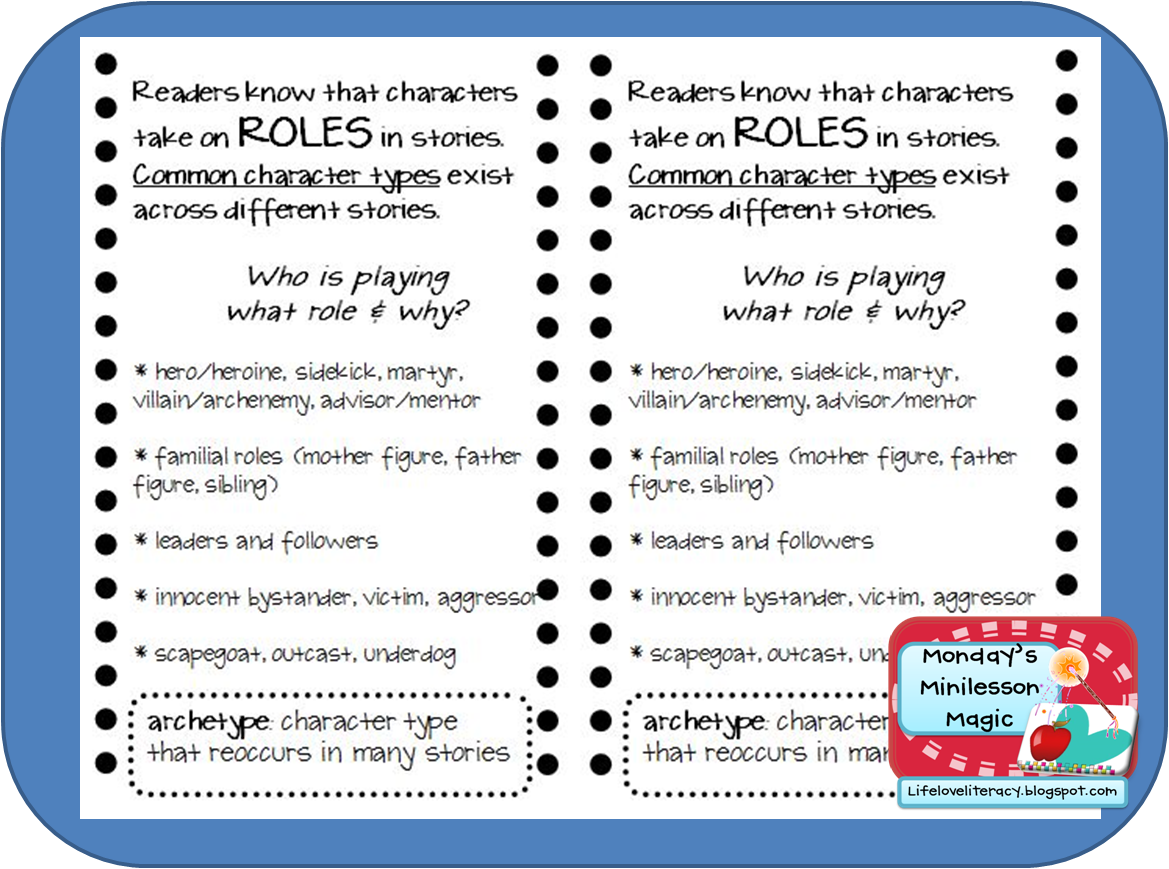
Archetypes: the Roles Characters Play~Minilesson Magic!


Minilesson Magic on a Wednesday? I must be ready for a break :) Good thing I held out though because I have a great reading minilesson to share with a freebie handout.

This week I want to share a lesson I did on archetypes. I am defining an archetype (on a 5th grade level) as a "character type that reoccurs in many stories." My students and I had already talked about archetypes last year, so this lesson was a review to remind them that it is a really good idea to be thinking about the roles that characters are playing. We are still on our journey of reading and analyzing holocaust-related historical fiction. (We took the time to read two book club books on this topic in order to target the Common Core anchor standard for comparing and contrasting). Although we will wrap this study up this week, I will come back to this lesson later in the quarter when we are in our realistic fiction book clubs.

To start this lesson, I reminded students that we know characters play roles in stories. We looked at Number the Stars and discussed how Peter played the role of the hero (and could also be called a martyr). Peter worked for the resistance and fought against the Nazi regime to help many Jewish people escape to Sweden for safety. In the end, we find out that Peter ended up dying because of his work with the resistance movement. You could also say that Anne-Marie, the main character is a heroine. (Then you could generalize that there were opportunities for many people to be a hero in their own way during the Holocaust--but save this for another minilesson or you will end up with a MAXILESSON. :)

I then pointed students to their handout and the list of roles I had identified. I made sure they understood what each one meant (mainly martyr, scapegoat, and outcast were new vocabulary for them).

Next, students listed the important characters from their books and tried to decide which role those characters played. I explained to students that they really shouldn't try to force a role on a character, but now that we are taking the time to think about the roles characters play in our books, the roles should be pretty obvious. If a character doesn't have an obvious role, maybe they don't have one but were still in the book for a reason. Again, we shouldn't force a role on a character just to label them.

I seriously had a kid ask "Is it okay if the character's role changes in the book?" Wow!!! That is minilesson magical! :)  This student was focused on Milkweed by Jerry Spinelli. Misha definitely plays a few of roles in the story. He is a hero in many ways for Janina, he is also a brother-figure, and to me, he is an underdog that we are rooting for through the whole book. In the beginning of the book, maybe he would be considered an innocent bystander because he is watching everything happen around him and not really understanding. (Have you read this book? It is one of my new favorites! :) Anything Jerry Spinelli PLEASE! <3)

For active engagement, I had students choose one of the characters and roles from their list and write about how the character was playing that role. Our grade level is REALLY focusing on Writing About Reading (or writing our thoughts about reading). Students wrote for about 10 minutes. For weeks, I have been encouraging students to use examples from the text and to try to elaborate on one idea instead of skipping from idea to idea and ending up with a list of ideas instead of a solid, elaborated idea.

I hope to take this lesson further by discussing how thinking about the roles characters play allow us to compare and contrast characters who played similar roles across different books. For example, how does Misha (Milkweed) being a hero compare to Bruno's (Boy in the Striped Pajamas) lack of heroism? We could also discuss why main characters need sidekicks and analyze how different sidekicks in different stories have supported the main character. So many exciting places to go with this lesson! I hope I have time to do it all :)

Click on the picture above for the student handout freebie. If you read about my Reader Response Journals, this sheet would go behind "Coach's Huddle" in our notebooks because it's a handout from me, the "Coach."


RL4.3: Describe in depth a character drawing on specific details in the text (e.g. a character's thoughts, words, or actions).
RL4.9: Compare and contrast the treatment of similar themes and topics and patterns of events (I think this objective fits because identifying archetypes allows you to compare/contrast and the archetype is highly connected to the themes of the story).
RL5.1: Quote accurately from the text when explaining what the text says explicitly and when drawing inferences from the text.
RL5.3: Compare and contrast two or more characters drawing on specific details in the text.
RL5.9: Compare and contrast stories in the same genre on their approaches to similar themes and topics.

You might not be reading Holocaust related books, but I hope your students can use a minilesson on the roles that characters play in books. If this is the first time you are teaching this lesson, you might start with the basics and just offer victim, innocent bystander, and agressor and maybe hero, sidekick, villain, and advisor/mentor as choices to discuss and apply to their own books.

I have used the roles of victim, bystander, and agressor with the book The Hundred Dresses by Eleanor Estes. I have applied the roles of heroine, archenemy, sidekick, and advisor to A Friendship for Today by Patricia C. McKissack. You can also use the same roles with biographies as most biographies write the famous person as a hero (or an underdog) that has overcome obstacles, including "villains" or people that were against them. I came up with the idea of underdog as an archetype by thinking about Wilma Unlimited by Kathlene Krull. Wilma is an underdog because we don't expect her to be so successful and we are rooting for her the whole time.

Monday, September 3, 2012

Quick Freebie: Historical Fiction: Holocaust Parent Letter

Hi Friends!

Happy Labor Day!

Have you upper grades teachers been brave enough to embark on a study of the Holocaust? This year, we decided to use the Holocaust as our topic for our Historical Fiction reading unit, which includes student book clubs.

Here are the books we chose to use:


All of these books (except # the Stars were new to me). I had seen snippets of The Boy in the Striped Pajamas movie, but had not read the book. Of course, we were concerned about age appropriateness. Although I don't think I would embark on this study with lower than 5th graders, I felt all of the books were very appropriate and held students attention the whole time.

I love Jerry Spinelli and was so pulled into Milkweed (and Jerry's poetic, rich way of writing) that I had to run to Barnes and Noble to buy my own copy so that I could mark it up with underlines, stars, and comments. Yellow Star was the perfect book for my readers who need to build stamina. Jennifer Roy writes the story of her aunt Syvia (who was taken to Lodz ghetto with her family at the age of 4) and crafts the scenes of the story in short, easy to read poems. I also love this book for the historical fiction unit (although of course it isn't fiction) because each historical change or transition that happened in Lodz ghetto is written about through a nonfiction introduction before each section of the story. So, we hear about what was happening in a direct, historical summary sort of way, and then we read about it through Syvia's young eyes.  

The Boy in the Striped Pajamas was an easy read. If you have not read it, Bruno and his family move from Berlin to Auschwitz because Bruno's father is a high-ranking general. They live right outside of the concentration camp, and through exploration, Bruno meets Shmuel (a young Jewish boy, ironically born on the same exact day as Bruno) who lives on the other side of the fence. Throughout reading this novel, we have to pick up clues about how the Jews were treated, who Bruno's father is, and deal with the naivety of Bruno who complains about having to leave his 5 story house in Berlin as Shmuel is wasting away in the concentration camp.

In this unit, we have created double-timelines (using the top half for what is happening in the character's life and the bottom half to record the historical information we learn from the book). Students launched their book clubs by creating club names and club norms that they hold themselves accountable for following. My goal is that students read two books from the unit in their book clubs so that we can focus on making rich text-text connections and compare and contrast the characters, setting, and the author's handling of the material.

I thought you might like a copy of our parent letter that we sent home prior to the unit to give families a chance to talk about the topic, preview their child's book if desired, and ask questions about the unit. This has been one of my most favorite units as it has allowed us to talk about human behavior and to question history.

I have uploaded the letter to my teacherspayteachers store as a freebie. It is a word doc so that you can modify it however you like for your own use. 

I hope to have more time to write about this unit and share some of our minilessons. As for now, it's off to work on report cards...fortunately, we only have 9 more school days until our FALL BREAK!!! :) 

LinkWithin

Related Posts Plugin for WordPress, Blogger...