Showing posts with label Math. Show all posts

Tuesday, February 24, 2015

Multiplication, Factors, and Multiples for Number Sense Intervention Group

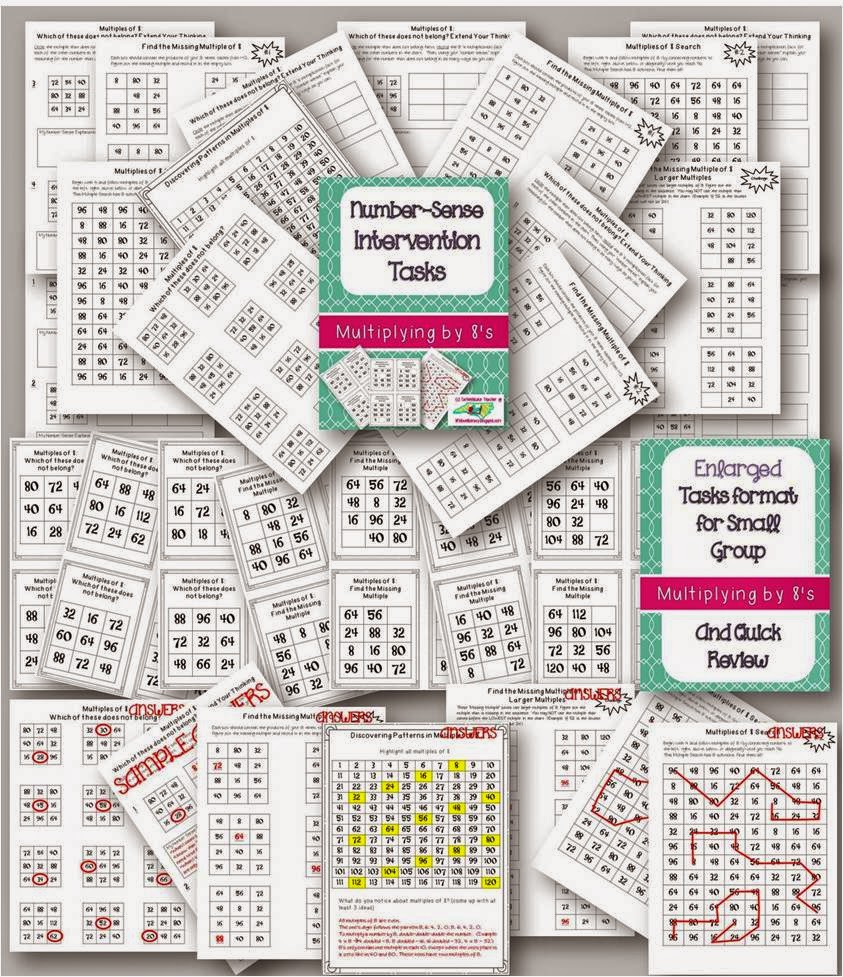
I finally had time to take pictures of my Number Sense Intervention tasks and wanted to share with you today. In an earlier post, I told you guys:
I have been on a journey this year to ensure that my 4th graders master their multiplication facts. When I use the term "master," I mean with fluency and automaticity--no tricks, no fingers, no count-by's down the side of their page--just automatic fact recall.
Back to the cards, I took all of the "Find the Missing Multiples" and "Which Multiple Does Not Belong" activity cards, printed them on a different color of cardstock for each number set, and put them each on a ring. I try to meet with my Multiplication Intervention group for 20 minutes 3 or more times a week. I meet with them during one of their stations or while other students are completing task cards. I prioritize this group because I know that their math success and confidence lies in gaining better number sense. {I'm even thinking about starting a math/multiplication club during lunch once a week to move some of our practice time out of math class time}.

I love having these cards on a ring because they are ready to grab at any time that we have an extra minute to go over multiples and factors, and multiplication facts. (Think--lining up for specials, lunch, whole-class bathroom break times, end of the day, etc.) Just show one of the cards to your kiddos and teach them to allow others "wait time" before they shout out the answers. You can even have them give you a thumbs up when they are ready with an answer.
Let's take a look at a week with one set of these number sense intervention tasks:

Day 1:
Pre-Assess the Group using 1 to 4 of the "Which of These Does not Belong" puzzles. (I'd use the student notebook pages rather than the task cards for now because it gives them a place to write how they know the number does not belong.) Allow students to share their ideas to provide space for you to gauge misunderstandings and depth of understandings. {Some students have really great insights although they may have trouble with fact memorization}.

Day 2:
Work together using Discovering Patterns to find patterns and rules for "multiples of..." the number you are working/intervening on. Continue getting students to verbalize the patterns they see. (For example, have you realized that some of your students may not realize that a multiple of 4 or 6 must ALWAYS be an even number? When I saw a student write 4 x 9 = 37, that's when I had my AH-ha! about number sense and multiplication facts.) I've included some of the ideas students should come up with in most of the downloads. This is the time to allow students to discover their own ideas, but also to hit home ones like when the multiples alternate even-odd-even-odd, or when all multiples are even.

Day 3-4: Go back to the "Which of these Does Not Belong" cards (for fun, game-like use in small group--I like to have students use a white board to jot down, rather than call out, their answer.) Use student notebook pages to have them explain how they know the number does not belong. Students can share in pairs or in the small group. Expect individual students to begin being able to explain deeper number sense as they pick up ideas from your teaching and other students' insights.

Day 5 and on...Practice with reciting multiples using the "Find the Missing Multiple" and the Number Searches (like word searches). Students can complete these for morning work or in a quiet center/station. Encourage students to recite their multiples even if they know the answer to the puzzles. Multiples recitation is one of the building blocks to multiplication fact memorization. And dang, if they can't memorize a fact for whatever reason, I surely want them to be able to accurately and rapidly recite multiples WITHOUT finger-counting.

Other Ideas for Using the activity cards: 
1) These intervention tasks are perfect for having a volunteer work with a child as an intervention. While I like to use these in a small group (to meet more students' needs), a volunteer could pull one child at a time and work more closely on the multiplication set that student needs. These resources and activities could even be used by an eager parent who wants to help their child master multiplication facts more quickly.

2) Based on where students are with mastering multiplication facts, create student groups. Once or twice a week, you can give students practice time in their small groups with the activity cards.

3) Using all of the multiplication intervention activity card sets (or combinations of sets) have students deal cards equally to one another (2-3 players) and play War or other type of game where students compare the answer they get when solving the puzzle and then whomever has the highest result (factor/multiple) gets to keep the cards.

4) Display problems on interactive whiteboard for "bell-ringers" or when you have extra time. Have students show their answers on a white board

I designed these intervention activities on the basis that many of my students who are not mastering their multiplication facts need to develop greater number sense and to increase their "count by" speed and ability. The more practice you can allow students, the better. They can complete the same activities again and again until they are comfortable with the multiples of a specific fact family. If you want to check these out on TPT, here's links to the BUNDLE pack and the individual sets. (Note that you can grab two right away for free!)

Multiplying by 2's TRY IT FREE
Multiplying by 3's
Multiplying by 4's
Multiplying by 5's
Multiplying by 6's
Multiplying by 7's
Multiplying by 8's
Multiplying by 9's
Multiplying by 10's
Multiplying by 11's
Multiplying by 12's

All of the Facts: Number Sense Intervention Bundle

And don't forget, the Teachers are Heroes sale is on {in about 10 minutes here!} and you can get many products up to 28% off. My store is on sale for ya and my cart is full!! It's a great time to re-stock since we are mid-year or pick up some bundles to save even more!
Happy night yall!


Thursday, February 19, 2015

Math~Math~Math for your Parent Blog!

I have been blogging away this year *2015* on my classroom blog for parents and today I wanted to share with you some of the information I have shared with them.

Math is one of the areas that I feel is so important to communicate with parents about because of the different methods that we introduce and because parents see it daily through homework. It's one of those tangible things they can try to understand about what their child is learning in school. And for that reason, I think it stirs up a lot of concerns, questions, opinions, and ultimately, a desire to help.{I have a secret strategy for math homework that is perhaps a little sneaky--I don't send homework on a concept until students have had ample time to play with it in math class. This means that homework is usually a week behind my instruction. Still, parent questions often arise from math homework}.

We know, it's called "New Math" and parents can sometimes push against that, but a lot of the way I teach math was also new to me (and I'm a stubborn beast when it comes to change sometimes). I loved math when I was in school and was good at it. All those old methods worked for me too, but I see merit in our "new methods" which are really conceptual models for understanding math procedures.

Anywhooo, although I think communicating about math is extremely important, this year, I haven't been doing a good job of taking the time and sharing information with parents on the classroom blog. In a perfect storm with the new year, it was time for our mid-year reviews of our individual growth plans. I decided to change one of my individual growth goals to increase my focus on parent communication related to math instruction {committing to posting once a week about math}. I have been doing a little research here and there and firing away blog posts about how I think about and organize my math instruction, how I differentiate, and how parents can help with homework. I am also working on explanations of how I taught multiplication and division--I'm a little behind, but I see this being so helpful next year when I already have some posts ready to go. The "Levels of Understanding" post is my favorite. Take a look below! 

Introducing: Math Spotlights!

One of my goals for the New Year is to share more information with you all about math instruction. I hope to share the methods students are learning, details about our math class routines, and examples of below-, on-, and above-grade level expectations. This post will serve as an overview of our math routines and my approach to math.

What does math look like in our classroom?

  • A typical week in 4th grade math includes 2-3 days ofstations with students completing activities at different levels of difficulty. Students may be working independentlyor in a guided group with me, Mrs. Morris (our teaching assistant), or Mrs. Kuhl (our AIG teacher). In stations, students solve computation problems where we focus on being more accurate and making sure we understand the steps to different methods. Students also have stations where they review concepts, work with word problems, and use dreambox. 
  • 1-2 days a week, I introduce new concepts while reviewing old concepts. For example, in the upcoming week, I will be introducing fractions concepts with some picture and number sorts (to gauge students current understanding of fractions). In addition, we will spend half of our math timereviewing and extending our understanding of how to divide larger numbers. 
  • On Fridays, students complete some form of assessment. This may be review questions from concepts we learned earlier in the year or directly related to what we are currently studying. Often, this information is used to create leveled groups in stations for the following week. The difference between regular math days and "assessment Fridays" is the level of support that I am willing to give students. On assessment Friday assignments, I offer as little support as possible and really try to encourage students to show what they know. When I offer support to help a student get the answer, I write directly on their paper and/or initial it so that I know they did not complete the problem independently. 
Hopefully, this post has shed light on my approach to math instruction and my strong belief that learning is a process. While your child needs to learn given math concepts, it's not my belief that they must (or even should) master the concept on the day I introduce it. Coming up in our next Math Spotlight, how you can help your child with math homework!

Math Spotlight: Helping with Homework

I have chosen to use spiraled math homework that covers many concepts instead of homework that only focuses on the concept that we are learning on a given day. This means that your child will see concepts that they have learned months ago, weeks ago, and possibly even concepts that are coming up. While I believe that this type of homework is really beneficial for me (and the child) as I hope to keep students' previous learning sharp, assess their ability to independently complete concepts we are currently focusing on, and see who can solve problem-types that I have not yet discussed, I know this may also be a source of confusion and frustration at times. How do you know what your child should have mastered already? (I'll address more about this in an upcoming post). And, most importantly, how do you help?

Can you help your child with math homework? Absolutely! It seems that resisting a parent's help with math homework is a typical "coming of age" behavior for 4th and 5th grade students. However, many of you feel that it is an important role for you to play in your child's education and I would agree.  Read more here...


Math Spotlight: Levels of Understanding

Typically, before introducing students to the traditional way of solving math problems, I use manipulatives (ones cubes, tens sticks, hundreds blocks, etc) or printed models (pictures) to help students think about and understand what the computation really means. Using hands-on activities and guiding students through different types of questions helps me assess the depth of their understanding. My goal is not to simply teach students to memorize steps and procedures, but to ensure that they understand why they are doing what they are doing in each step.

When we think about learning skills and concepts, we should imagine those skills and concepts on a continuum of learning with children at different levels of readiness. Given a specific concept, your child may be at different levels at different times. I found the following descriptors from Kathy Richardson (she's a math guru that develops materials for assessing students' true understanding and misconceptions):

Ready to Apply (A) – The student can already do a particular task and is ready to use this skill in other settings. (This student receives more challenging work).
Needs Practice (P) – The student can do a particular task with some level of effort but still needs more experiences to develop facility and consistency. (This student typically receives work at grade level that increases in difficulty as his/her readiness increases.)
Needs Instruction (I) – The student has some idea of what a task is about but needs support. (This student receives direct instruction that begins with the lowest level of their individual understanding and builds up to problems with increased difficulty to help meet grade-level expectations.)
Needs Prerequisite (N) – The student does not yet understand the concept and needs to work with mathematical ideas that precede the concept being assessed.

When I discovered these descriptors, I really wanted to jump up and down--I was excited because these categories of learning really capture how I think about individual students' understanding of a math concept and how I choose materials and create groups for focused instruction.

It is also important to consider the size of the number(s) when placing students at these levels for a given concept--the size of the number with which they are independently successful needs to be taken into consideration. I often find that concepts that students may seem to have "mastered" are merely in the process of truly being understood when they are presented with larger numbers. As we know, accuracy also becomes a larger issue as the size of numbers increase. To instruct students having difficulty (say learning the procedures for how to multiply 23 x 67), I begin by taking a step back and instructing them on how we would solve a simpler problem, like 23 x 7. Once the student has consistently demonstrated that they are able to complete problems at this level, we move on to adding a digit in the tens place for the second factor.

Next up...
I'm going to share examples of problems that are below, on, and above grade level based on NC state standards for math. When you see your child's math work, you can use these levels to have a better understanding of what they have accomplished. If they are successfully completing below and on grade level problems, but having difficulty with above grade level, this means that they are where they are supposed to be and that they are being challenged to push beyond the average 4th grade expectations. If they are having difficulty with "on grade level" problems, rest-assured that they are being served in a small group that meets them where they are and works to help them build up to solid grade-level abilities. 

I have a few things in the works for math that I am super-excited about, including an upcoming giveaway that you won't want to miss...we are on our 3rd snow day and I have been using this time to work away on a few things I have been wanting to create. Thanks for stopping by and stay tuned! 

Tuesday, December 30, 2014

Multiplication Intervention: "Count-By" Activities to Improve Number Sense and Fact Fluency

I have been on a journey this year to ensure that my 4th graders master their multiplication facts. When I used the term "master," I mean with fluency and automaticity--no tricks, no fingers, no count-by's down the side of their page--just automatic fact recall. {Although, I will admit, I still use some mental tricks for a few of my math facts ;)} Being a 5th grade teacher at heart who is teaching 4th grade, I know how critical multiplication facts are. I know that students who know their multiplication facts have an easier time learning how to multiply and divide larger numbers, how to recognize fractions that need to be simplified, noticing patterns in numbers, and using algebraic reasoning. Other concepts that are embedded in knowing our multiplication facts include prime, composite, common multiples, finding common denominators, and divisibility.

Multiplication fact fluency is SOOO important for continued math success. Students who know their multiplication facts are more confident when learning a new skill. Students who do not know their multiplication facts may feel that they don't understand new concepts (everyone who can multiply quickly is already ahead of them in solving the multiplication, division, or simplifying fractions problem), when in actuality, they are so hung up on figuring out a multiplication fact that what comes next in the process goes on the back burner and they have most likely forgotten what the teacher has just shown them to do next. I know what you are thinking {maybe}--give them a multiplication fact chart that they can refer to. Great idea, but is this a "forever" solution?

This year, I implemented Rocketship Math, a math facts program that I was trained on a few years ago and had implemented into my 5th grade classroom once. I'll share more about Rocketship in another post, but you can click on the program's website to learn more. For the purposes of this post, you just need to know that it's about a 10 minute fact fluency routine that my students do each day.

So, we have been using Rocketship since the second week of school and I have students who have already moved on to division...I also have students who seem to have flat-lined around levels I-L. Students get 6 tries to pass a level before something else needs to be implemented. Often, the something extra is that my students choose to study at home when they have tried 2-3 times without passing. However, some students do not choose to study at home and are just not moving.

One day, I watched a student write "4 x 9 = 37" and it hit me...this student doesn't even realize that all multiples of 4 are even. This student lacks number sense and has perhaps not had the "obvious to me" pointed out to her. I have students who count-by to get to their facts, but their count-by's aren't even efficient (like in the image above "6, 12, 18--19, 20, 21, 22, 23, 24--24...what was I doing again?"). This student doesn't realize that they can count by 6's then add 3 and 3 or have other ways to efficiently count up to multiples they do not yet have memorized.

Somewhere in my research, I read that to master multiplication facts, students need lots of experiences with "county-bys." I follow Donna's blog Math Coach's Corner {like a stalker ;} and read this blog post that suggested a "Count around the Circle" activity. That sounds great for the younger grades. I read that wishing my students could go back in time and have that circle experience, but  I couldn't see myself getting my whole class to sit in a circle and productively play this game when only about 5 of my students really need it.

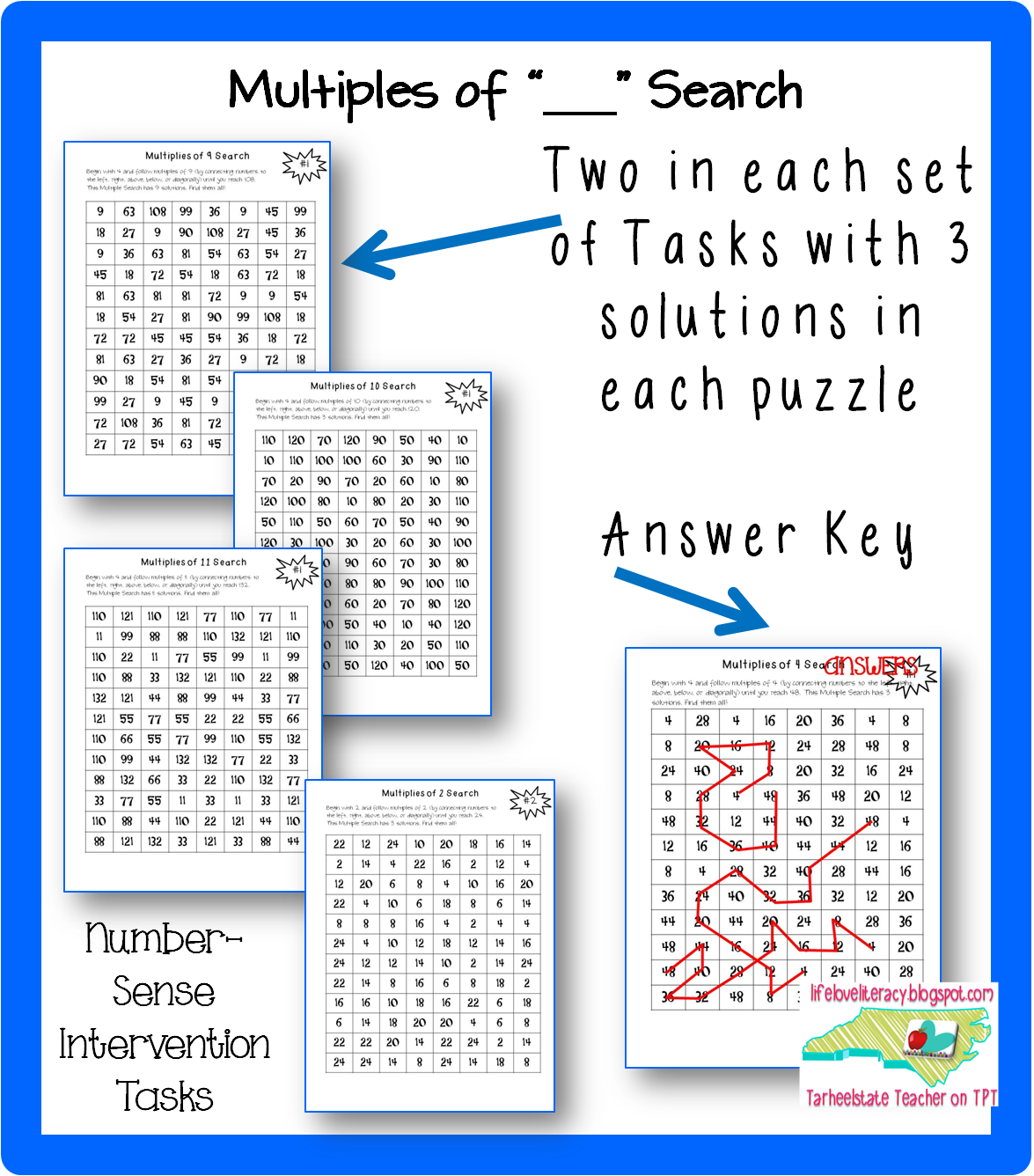
I realized that a handful of my students need a separate intervention that is a few steps back from the fact memorization I'm aiming for. These students need extra time working with "count-bys" and looking for patterns in their fact families. Out of this realization, grew my Number Sense Intervention Tasks, fun ways for students to look for number patterns and practice "count-by's" so that they become more efficient. I have finished all of the sets and made Multiplying by 2's and 7's FREEBIES.

In every set, you will find the following activities:
Which of these Does Not Belong? Students use number sense to figure out which number does not make sense for that multiple, maybe it is too close to a multiple students know, maybe it is odd and should be even, maybe it does not have the correct number in the ones place, etc.
Which of these Does Not Belong~Extension Pages
Find the Missing Multiple-forces students to "count-by" for a purpose and to become more efficient doing so by noticing whether or not the next multiple is in the chart. Use these cards a lot and hopefully it will break students from counting up to the next multiple one-number-at-a-time.
Multiple Search: another fun reason to "count-by" to find three strings of multiples from the 1st multiple all the way to 12th.
120's boards for analyzing patterns and having aha moments (like all multiples of 4 are even!)

I hope you take the time to check out these Number Sense Intervention Tasks:
Multiplying by 2's TRY IT FREE
Multiplying by 3's
Multiplying by 4's
Multiplying by 5's
Multiplying by 6's
Multiplying by 7's TRY IT FREE!
Multiplying by 8's
Multiplying by 9's
Multiplying by 10's
Multiplying by 11's
Multiplying by 12's
Number Sense Intervention Bundle

In my next post, I will go through a format for using these tasks {with repetition} in a small group intervention setting. Happy New Year to you!


Sunday, October 26, 2014

Whole Numbers Estimation: Real World Math Freebie

Math is a subject that I love to teach. I was a math nerd when I was in school. It just made sense to me and I could usually find the "right" answer. I also enjoyed problem solving and would push myself until I got it. There's just something about math that never makes me want to give up. As a teacher, I have always wanted to make math a "real-world" subject. I mean I always want to be able to answer "Why am I learning this?" when I'm teaching students. (My 4th and 5th graders rarely ask that question, maybe because most of them enjoy math, but aren't they lucky that I always want to make the real-world connection for them?) Now, I will admit, I spend way too much time stressing myself out about this, especially when it is an objective where I am the one saying "Why the heck do my kids need to know this?!?" And sometimes, I just have to move on with my life and just teach the concept at the highest level possible without addressing the "why we need to know this" question. 

Rounding and estimation are two topics that I now introduce with a "real-world" experience. This year, I wanted students to round larger numbers and estimate a total. I scoured the internet for good catalogs to use. Lego catalogs would be really cool if you had enough for the whole class. (I signed up for their mailing list, but plan to call and ask them to send me 25 of one catalog for future lessons). I asked parents for any suggestions--I really wanted the activity to be fun for the kids and for the catalog to contain things that they would enjoy shopping for, and I just didn't want to go the clip-art catalog route yet. FAO Schwartz was the perfect answer for my needs. 

For the lesson, students are guided through a number of "rounds" that have different constraints. In round one, we are just introducing rounding and estimation. Students: 1) have $1000 to spend and must buy three items, 2) have $1000 to spend and can buy as many items as they want, and 3) have $1500 to spend and can buy as many items as they want. They calculated the estimated amount and exact amount by hand and then checked it with a calculator. (These directions are all provided on the student handout in a chart format. After each part of round 1, I am sure to ask students to discuss the strategies they used for estimating. One of my students shared that they were looking for combinations of numbers--they chose an item that would round to 100 then they chose two items together that would round to 200 (like a $160 item and a $40 item). As I walked around and helped them fill out their charts, I asked how they were choosing their items. In the first rounds, of course, students are looking for things they want in the catalog, but by the end, they are challenged by the criteria to consider the costs more.  
My favorite part of the lesson (which spanned a few days) was when students were challenged in Round 2 to get as close to $1500 as possible with only 5 items. I did the challenge with them and many strategies came about that provided for interesting math discussions. For example, I was $4 away from $1500. I challenged them to see who could get closer than I did. Then, I started trying to figure out how I could get closer. Well, if one of my items cost $169 and I needed $4 more, then I needed to look for items that cost $173. I took my list of items and made added $4 to each one to see what exact cost I should be looking for. We loved this so much, it hit me that it would have been an AWESOME, engaging way to practice addition skills without students actually realizing it. 
Click here to get your free download of the FAO Schwartz Shopping Catalog and here for the student worksheets/guide I used for my lessons. 

In 5th grade, rounding decimals is huge, so I like to use a grocery store advertisement and follow a similar process as I did with the whole numbers estimation lesson. (You might want to go through the ad and change some of the prices to make the rounding task more challenging).  

Happy math teaching!


Tuesday, January 14, 2014

Multiplying and Dividing Fractions Plans

You might recall that going into this quarter, I figured out a planning routine for differentiation that I think is AWESOME applesauce! I take all of the materials I have (task cards, worksheets, etc) and place them on a continuum of difficulty. (If I need to fill in holes for lower levels or higher levels, I begin searching for resources or create my own). In addition, I outlined the quarter with FOCUS CONCEPTS (new material) and REVIEW CONCEPTS (1 day/wk).

I outlined my fractions unit {loosely} before the quarter began, and of course, things have already changed a bit. Mainly, I realized that it would be okay to push a few things to next quarter (like coordinate planes) and spend an extra week on multiplying and dividing fractions. {Keep in mind that I do not suggest only teaching fractions for 4 weeks. We already spent a large chunk of 2nd quarter on fractions--adding, subtracting, and a little intro to multiplying. Can you tell I could literally spend ALL year on fractions and be in MATH~nerd~HEAVEN?}.

I thought I was differentiated to the max already, but as I began to teach my three classes, I understood that what I had considered lower-level needed to be even more straightforward or scaffolded for one of my classes (for this group, I have went back to my old math workbooks). Now, don't get me wrong, these kiddos that I have to drop back to the worksheet for CAN get it and have done so, but I found that they need a more straightforward approach first and then they move into the task card sets. With a worksheet, they seem to get more accomplished and grow more in their confidence that they CAN solve the problems--and they know they will be moving on to task cards, which they have a positive attitude about.

Here's my fraction outline in a continuum format. The first icon will be the easiest/basic entry level, with the activities/practice work moving into increasing levels of difficulty. Also, it is important to note that some of the individual sets of task cards (like the Chili Math Multiplying Fractions) already include questions in increasing level of difficulty. This pack of task cards has 60 cards that I broke into sets. Some of the first questions are straightforward multiplying fractions problems, while some of the later task cards make students think backwards to figure out the factors that were multiplied instead of just the product. Needless to say, these cards have kept us busy busy for a week (with whole group minilessons also included at the beginning of each math class). The extension column includes materials for those students who finish the tasks above and beyond and are ready to move on to other concepts or look at the focus concept in a new way.
Based on my routine math schedule that I brainstormed before the quarter began: 

Mon-Wed: Practice with Focus Concepts (new material we are trying to master, students work through the continuum)
Thurs: 1/2 time Data Day (charting our exit slips performance and assessing on an OLD skill); 1/2 time: Algebraic Thinking Day
Friday: 1/2 time remediation on old skill (based loosely on assessment performance) and 1/2 time continued work on Focus Concept (some students may be working on extensions while others are 'secretly' being remediated, and others are completing work from the week that they understand but just need more time to work on). Some students may also use mobymax.com as a differentiated spiral review/to fill in some unmastered skills.

I will say that in getting the quarter started last week and getting to know my new students, I decided not to implement the Thursday/Friday schedule until our second week back. We will definitely have assessment/data/algebra on Thursday and Remediation/Review on Friday this week.

By the time I teach math for the third hour, I am burned out...and worried that I can't fix everyone's issues and misunderstandings. But, after having a little lunch and getting to my planning time to further differentiate and plan for the next day, I get really excited and LOVE the ability to focus on only a few subjects (I'm also teaching reading/social studies integrated into an hour and 20 minute block).
I hope your teaching life is happy, and please comment with questions as I am hoping that I am able to explain what I am doing clearly, but I am not always sure it is!


Sunday, January 12, 2014

Pre-Assessment: Multiplying and Dividing Fractions

This past week, our run at departmentalizing our grade level began. If you have been checking in to the blog, you know that I was lucky enough to be the one who gets to teach math! I see the other two classes first, then my class returns to me for math. I was initially worried about behavior, routines, etc. but I really think behavior has improved dramatically because I am a new teacher to these kiddos and they get the impression that I am not going to put up with any mess. I love math and my main goals are to help them feel confident, learn to persevere, and to teach them what they need to know. I recently shared my math outline for the quarter which {of course!} changed a little once this week began.

Since I'm teaching two groups of students that I don't know, it was important to me to get to know them as math students as quickly as possible and to be ready to differentiate for them immediately. To prepare, I had each teacher group students into the following descriptors:
* Needs extra support
* Understands/Average
* Quickly Understands (Above Average)
* First to Finish (will always need something more)

These groups were recorded in a chart in google docs and I printed off multiple copies of it to help me learn student names, know how to group them for lessons, and to take notes on how they were doing with concepts during the week.

Since classes are at different levels and each of us got to different points in teaching multiplying and dividing fractions, I started on Monday with a low-pressure assessment that was also leveled in depth of knowledge demonstration. My students who easily know how to solve fraction equations had to write steps for solving the problem and then explain why they did certain steps. Why do we multiply fractions straight across and not have to find common denominators? :)
This assessment was more interesting than I expected and truly did what a pre-assessment is supposed to do. With the first class, many students completed the first problem by multiplying the numerators and keeping the denominators the same. Then for the second problem, some students began trying to find a common denominator. It was interesting (and nice) to be able to tell them that they were remembering how to add and subtract fractions and I was very proud of them for that. I explained that it is important to have a common denominator when adding/subtracting fractions, but you don't have to have one when multiplying. I tried to convince them that they would love multiplying fractions more because you don't have to have common denominators...they had already learned the harder concept last quarter! For students who knew how to multiply, I was able to see if they would simplify the final answers and turn improper fractions into mixed numbers. 

I hope this assessment was able to help students feel confident, rather than like they didn't have any idea what to do. (I was afraid some of them would shut down and not try anything, so I know I'm repeating myself, but I was really glad to be able to say "This is what you do know! I'm so glad you remembered that.")

I also have the same type of worksheet ready for dividing fractions, although I may use it differently with different classes. I haven't talked to my students about dividing fractions yet, so we may use this together to think about WHY flipping the second fraction makes sense. (If you want these, click on the images. I have put the file in my google drive for sharing with you.)
In my next post, I'm going to share with you how my plans {really} worked out and the modifications/change in pace that I already made this past week. 

You can catch up on other posts from my Departmentalizing Math Journey by clicking the icon below!
Happy Sunday Funday :) I hope you are looking forward to the workweek ahead!


Sunday, December 29, 2013

Modeling Multiplication of Fractions

It sure feels like I have been writing about fractions like CRAZY~CRAZY, but we spend almost all of 2nd quarter and part of 3rd quarter learning fraction concepts. Are you looking for a way to launch your unit on multiplying fractions (read-elicit some prior knowledge and a reality check on where students are in their fraction understanding?) I created these task cards to do just that with my students. I wanted to focus on representing situations/word problems with models and equations. I also incorporated the opposite--representing models and creating word problems. It was interesting to see my students try to color the fraction models to represent the word problems.

Did I mention that these cards grew from the fact that I was pretty sure that many of my high-achieving students could solve the equations for multiplying fractions, but I was not sure that they truly understood what they were doing or why you would multiply a fraction by a fraction or a fraction by a whole number. With these cards, students were exposed to examples, had to represent what it meant on a picture, and had to create their own situations/word problems.

I included 16 task cards each for multiplying fractions times a whole number and fractions times a fraction. 8 of the cards in each set focus on modeling a word problem and 8 of the cards focus on writing a word problem and equation to represent a model.
 Multiplying Fractions with Models Task Cards 5NF
 Multiplying Fractions by Fractions and Fractions by Whole Number Task Cards
The student answer sheets for these task cards include all parts students are to complete (IE-models, equations, written word problems, etc).
I also made a version of the task cards that are one to a page so that you can show them on the smart board. This is actually how I used the problems to launch the lesson (students had their recording sheets and I displayed the cards on the board so that we could "math talk" about what we were thinking and share our representations.) After day 1, students worked on the task cards independently. These task cards fit 4th and 5th grade Common Core standards for fractions.
Have you checked out my other recent math posts? Here's a run-down: 
Fractions Fractions Fractions  (differentiation strategies and subtracting fractions with regrouping)
Division with Fractional Parts (Multistep and CHALLENGING!)

You can check out all of my fractions products HERE @ TPT

Oh yeah, I also made an "Everything Fractions" pinterest board, if you want to follow along. I've already pinned some goodies, especially websites for integrating technology in math, but I will keep pinning every time I see a great fraction idea.

I'm cooking up one more idea for an interactive fraction lesson that I hope I can make work...

Thanks for stopping by!


Saturday, December 28, 2013

Math Routine: Algebraic Thinking Day

I love to integrate algebraic thinking throughout the year, rather than as a separate unit. Over the years, I have come to love a number of materials. Today I'm going to share websites and a new set of task card that I purchased for Algebraic Thinking Thursdays. You can check out an outline of my math schedule if you want more info.

Math Playground houses my favorite online games for Algebraic Thinking, and since we just went 1-1, this will be a perfect way to use the laptops in math. I'll be sure to have discussions where students share some of the strategies they have developed (as well as push them to verbalize their strategies with me one on one as they are working).
1) Algebra Puzzle
http://www.mathplayground.com/algebra_puzzle.html
 2) Algebraic Reasoning
http://www.mathplayground.com/algebraic_reasoning.html
 3) Calculator Chaos
http://www.mathplayground.com/calculator_chaos.html
 4) Weigh the Wangdoodles
http://www.mathplayground.com/wangdoodles.html
I have a set of really cool Algebraic Thinking worksheets. These sets of activities are special because each problem builds and gets more challenging as students move through them. In addition, students are successful when they are able to carry previously learned strategies and concepts with them to future puzzles. (Unfortunately, I can't find an example of these anywhere online, so I will have to share them in another Algebra post when I return to school and can get some pictures!)

I love this game called "24." Students must use all 4 numbers and any operations (make an equation basically) to get a result of 24. In poking around on the net today, I found out there are multiple versions of this game--providing for challenge at many grade levels.

I also bought Order of Operations Task Cards from Chilimath. I thought the cards were great because they have three different sets that require students to find answers in different ways:           1) simplifying an expressions, 2) multiple choice where students simplify the expression then pick a multiple choice answer, then 3) students have three choices of expressions and choose the one that gives the listed result (I like this one because potentially students have to solve three problems to get the answer to the task card and problems of this type often show up on state tests).

I hope you found a resource that you can incorporate into your math time. Did you know that if you use blogger or a google site for your classroom, you can straight copy my links and pictures above and paste it into your site? I'm going to do this to share the algebra links with students. Easy peasy!

Saturday, December 21, 2013

Math Routine: Exit Slips and Data Tracking

To catch up on previous math posts, check out My Math Schedule/Routine and Departmentalizing 3rd Quarter.

Once my team made the decision to departmentalize and I became "the" math teacher for my grade level, I knew that I had to step it up. I relish in the opportunity to do an even better job teaching math and in the fact that all energy I put into teaching math next quarter will benefit not just one class of students, but an entire grade level. I also love the fact that this opportunity means that I don't have to plan for science or writing. While I'm focusing lots of my attention on math, I don't have to worry that another subject area is not getting planned. I felt stingy stealing math because I know we all love to teach math, but my team so graciously let me take it. So, I made a few promises to them and myself:

* I will differentiate math for students to the highest level of my abilities
* I will do a better job of tracking data
* We will implement assessments more regularly (I've only given 2 math tests this year!)
* I will further analyze our state test samples and align parts of my instruction with the way questions are presented
* I will not only focus on students who need extra challenge, but implement a structure that allows for remediation and extra support for those who need it (see yesterday's post)

With these goals in mind, I needed some new materials. I made two fantastic purchases from TPT, including One Stop Teacher Shop's Spiral Math Homework and Math Mojo's Math Exit Slips.

I'll talk about homework in another post, but today, I'm going to focus on Exit Slips and Data Tracking.
http://www.teacherspayteachers.com/Product/Math-Exit-Slips-5th-Grade-Common-Core-All-Standards-Mega-Bundle-937921
Math Mojo's Math Exit Slips contain 5 to 10 problems for each of the 5th Grade common core math standards. (She has also created exit slips for 3rd and 4th grade). When I saw these at such a good price, I new it was exactly what I needed for a quick morning work assignment for all grade levels. (Now, these were created as "exit slips" but I am using them as review/entry slips.)

On our workday, I got right at "getting ahead." I copied the exit slips for Numbers and Operations in Base 10 with two sets to a page to save on paper. Then I cut all the sets, paper clipped them,
and organized them into bags by concept.
Since the slips are so well organized by standard (and a dependable 5-10 practice problems for each concept), I also knew that I wanted students to be aware of their performance in each area and track their data. I created "Bar Graphs for Tracking Student Success" to go along with the exit slips.
http://www.teacherspayteachers.com/Product/5th-Grade-CC-Math-Bar-Graphs-for-Tracking-Student-Success-1026674
I got carried away with my designs and ended up making 5 options. With Math Mojo's blessing, I uploaded this data tracking system to TPT.
 
How do I plan to use the exit slips?

1) Students receive 5 exit slips on Friday or Monday to glue into their math journals to prepare for the upcoming week. Students glue 2 exit slips on each page, leaving 1/2 of the page available to show their work or write a written response. (If you print the exit slips 4 to a page instead of 8 to a page like I did, students should have enough space to complete the problems on the slip).
2) Students complete one slip each morning for morning work and get it checked by the classroom teacher.
3) Since I am starting with exit slips mid-year, I will give students a mix of standards each week to allow for review and practice of previously taught concepts.
4) On data day, students color in their data bar graphs to show how they did on the week’s problems.

How do students fill out the bar graphs? Here's one possibility:
I'm so excited to use these math exit slips, and I think it will be exactly what my students need, no matter where they are on the continuum. (I have students who need review/remediation and then I have students who simply need to gain control of their accuracy with computations.) Next up, I will talk about my plans for "Algebraic Thinking Day."

LinkWithin

Related Posts Plugin for WordPress, Blogger...