Showing posts with label vocabularyinstruction. Show all posts

Sunday, February 2, 2014

Happy February Valentine Heart Personalities Anyone?

Hi All,

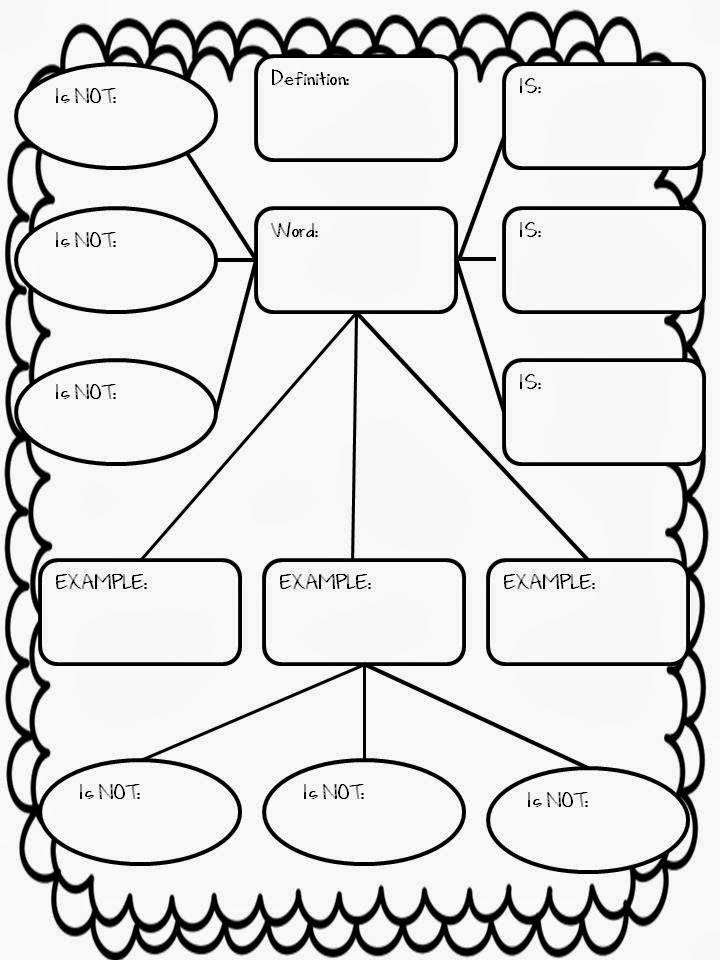
This is a quick post as I have to leave the house in a few minutes, but I wanted to share that I uploaded my Valentine Personalities Vocabulary and Creative Writing Project like my Snowman and Pumpkin Personalities products. Students research a chosen personality trait in-depth (finding synonyms, antonyms, definitions, etc), complete a character questionnaire to explore their character and word in more detail and then plan a story, poem, blog post, etc. Last, students write their story and design their Valentine/Heart Character.

Here's a sneak peak:


Choose Trait: 
Explore Trait:
 Explore Character:
 Plan Story/Write Story:
 Bonus Activity: Design a Valentine Card from this Heart/Valentine Personality:
 Design the Valentine Character (thinking about facial expressions and features):


I like to use these seasonal activities to infuse my year with creative writing. At this point, my students are involved in research-based writing and they spent last quarter writing essays. It was nice to take a week to write "Snowman" stories. And, during Valentine's week, students will research their Valentine Personality trait and write a creative piece (it can be a poem, narrative, blog post from the character, a wanted ad,--anything to allow them to breathe creatively for a mini-writing project. 

Snowman Personalities
Pumpkin Personalities

Thanks for checking out this new product. It's cheap and ~EASY~ to implement if you are looking for something simple for V-Day. ~Put a little love in your <3~

Saturday, November 9, 2013

Pumpkin Personalities Pictures AND Snowman Personalities!

http://www.teacherspayteachers.com/Product/Pumpkin-Personalities-Vocabulary-and-Writing-Project30-Words-909745 
My students' pumpkins turned out super cute! This post is super-duper late in sharing, but you can celebrate with pumpkins all FALL long, right? I shared a little bit about this vocabulary and creative writing project here.
http://www.teacherspayteachers.com/Product/Pumpkin-Personalities-Vocabulary-and-Writing-Project30-Words-909745
This project provided us a nice break from essay writing (which we are cycling through all quarter). I had so much fun with my students' stories and word exploration, that I decided we are going to do the same project again with SNOWMAN PERSONALITIES!

Here's a peak at some of the materials:

http://www.teacherspayteachers.com/Product/Snowman-Personalities-Vocabulary-and-Writing-Project30-Words-968165

http://www.teacherspayteachers.com/Product/Snowman-Personalities-Vocabulary-and-Writing-Project30-Words-968165

We are going to make our 3D snowmen out of paper plates. If you want to go all out, you can get styrofoam balls in different sizes and have them decorate that way. For our pumpkin personalities projects, I think I rushed things a lot because I was trying to juggle our first essay cycle at the same time. Students did a lot of the work of writing their story for homework. For our snowman writing projects, I plan to set aside two weeks and focus more of our time on deeply understanding the word before they develop a story.

PS: If you want to do both, the 30 Words for each creative writing set are different, so your students will be exposed to new words!

Happy creativity in the classroom!

Sunday, April 28, 2013

~~Peek at My Week: Lots of Science! and Test Talk~~

It's a busy week. Unlike last week, I might actually get to teach all day long, every day this week! (Except we have our DARE ceremony on Friday.) Otherwise, this week is perfectly intact, which means I should be getting my plans together!

Here's what we have on the agenda this week:

Reading EOG: Test Talk Time! We are starting this week with our Reading EOG prep. This is really a review since I had my babies last year and know what they are capable of. I am proud to say that we only have 4 weeks until testing. I am not stressed and neither should they be. But, we are going to turn our attention to making sure we remember to do what we know how to do. I created the following format/board for our EOG Minilessons. Basically, I want to take what students already know how to do, discuss why they use this strategy/skill with their own reading choices and then why it will be important and helpful on the EOG. The green/yellow signs are a few strategies that I remembered right off. My students have already reminded me of others that I have taught them. I will add those to the board later this week. (I may upload this set to TPT later this week, I'm just not sure it's ready yet!)
 
 
 To review for the science EOG, we are using:

Science Links: 
Matter: Properties and Change Vocabulary Mats
Matter: Properties and Change Vocabulary Activity Pack
Force and Motion Illustrated Dictionaries
Ecosystems Vocabulary Mats
Ecosystems Vocabulary Activity Pack
Weather Vocabulary Mats

I will be using these during my science block, some for morning work, and during some of our word study blocks. Students will also be able to take their vocabulary mats home to study their science vocabulary words. (Those words are make-it-or-break-it for the Science EOG!)

For more science products, click here.

Math Links:
Multiplying/Dividing Fractions
Add/Subtract with Unlike Denominators

Video Links:
A Child With Blindness (for morning meeting)
Check out Cafe Mom Studios for more videos like this (I am going to start using them during morning meeting to teach more about diversity, accepting others, compassion, overcoming our own obstacles, etc.)
Head over to Mrs. Wills for a Peek at everyone's Week. If you are a blogger, you should really start linking up with this linky. I LOVELOVELOVELOVELOVELOVE it! :)
And a teaser for tomorrow's Minilesson Magic (it's set to go live at 6 am so catch it!): Learn about Writing Riddles for Mini Research! :)


Saturday, April 6, 2013

Pass the Torch!


Get Ready for Bloggy Olympics!!!

Photobucket Photobucket

Join The 3AM Teacher, the Reading Olympians, and over 80 SUPREME education bloggers as we take you through a tour of the Reading Olympians Root Study Program!!

To get started with Reading Olympians, I printed the raps for each set onto different colors of cardstock. (I made two sets of the copies so that I would have enough cards for each student with a few extras). This method goes along with my Task Card Love <3 as students or the cards can move around.

I also printed these babies on the same color cardstock as the set it matches.

Next, I made copies of the Journals for students. (We are still on the Nike Set).
During our first lesson, students received the rap cards randomly and worked on the 4 quadrant sheets in their journal until they felt that had thought of everything they could. Mainly, I wanted students to generate as many words as possible using the root. I explained that they could move on to other roots, but would likely be able to keep previous roots in mind and would probably come up with new ideas. You could have studenst work in partners to generate words, but my group is having a talking/playing issue, so I wanted this step to be independent.

After a few sessions of doing the steps above, I have students play a brainstorming "game":

* I put students in groups of four and everyone has a writing utensil. I give them a ledger-sized sheet of paper or chart paper.
* Students record one prefix on each side of the paper to prepare for the brainstorming session.
* I set the timer for 5 minutes and all students silently record words that contain one of the prefixes. (The group decides which one to start with first; it really doesn't matter as long as they only work on one at a time). Students do not analyze the appropriateness of the words at this time, it is simply a brainstorming-get-it-on-paper session.
* When the timer goes off, students get 1 minute to discuss the words recorded and mark off any that do not fit the prefixes' meaning.
* Students flip the chart over and begin the 5 minute brainstorming session again with the new prefix.
* When the timer goes off, students get 1 minute to check their words and mark any off.

In the next lessons, we go through a whole-group sharing session where students report out the words they came up with. Students get 1 point for words that no one else came up with and -1 for words that we deem do not fit the meaning of the prefix. (Keeping score has been harry-and unnecessary for motivating my students, but if you have time for it, it could be a fun element).

As groups share words, I type them into a google doc so that we can all keep up and have a record for later.


I just started using the program 3rd quarter to work out any kinks and figure out how I wanted to do it so that I am fully implementing it starting at the beginning of the year next year. I can't wait to learn how everyone else is using the program and putting their own spin on it. (I'm sure I will make some tweaks next year as we go 1-1 laptop, like having students generate their word lists in group googledoc documents, then I can simply pull each groups set of words up on the smartboard to discuss. This would be a major time saver (and might allow me to better do something where I am keeping score). If you have not started implementing the program, I say, GET TO IT. Print out the Nike Set and just set yourself a goal of using it with the time you have 4th quarter to see how you want to use it in your classroom next year. I totally recommend the purchase!


Discover the program IN ACTION in more K-6th grade classrooms as you Pass the Torch!! Get ideas, discover the progression of the program, and enter the Raffle for a chance to win ONE of the three prizes listed below!!

First Place Winner : Gold Medal

  Prizes: Complete Reading Olympians Program
            $50.00 Amazon Gift Card
            50% off Discount Code for a 1-Day shopping spree at The 3AM Teacher's Etsy store!

Second Place Winner: Silver Medal

   Prizes: $25.00 Amazon Gift Card
              40% off Discount Code for a 1-Day shopping spree at The 3AM Teacher's Etsy store!

Third Place Winner: Bronze Medal

    Prizes: 30% off Discount Code for a 1-Day shopping spree at The 3AM Teacher's Etsy store!


Pass the Torch!!!
Click the image below to visit the next blog

Kindergarten:


Grade 1 & 2


Grade 3 & 4


Grade 5 & 6


    a Rafflecopter giveaway

Friday, March 22, 2013

GEOMETRY VOCAB Update

Hi everyone!

Happy Spring...or freezing, cold, windy, whatever this is :) I was pretty excited to see a little sunshine today as cold as it was. I'm on Spring Break! :) WHooo Hooo. One of my goals for break is to update some of my older products. My newest products look pretty snazzy, but my old ones need some of the dust knocked off.

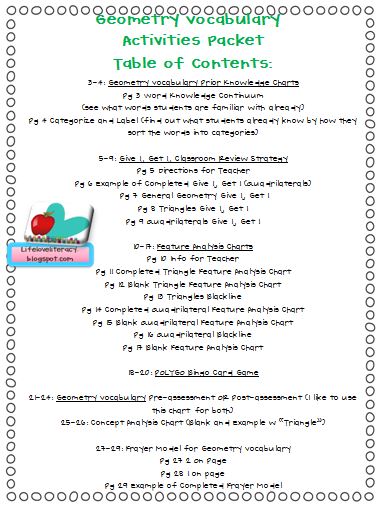
And silly me, I thought updating things would be a fast task, but it's taking a lot to turn something old into something new. The first product I started working on was my Geometry Vocabulary Activities pack. I ended up doubling the size of this packet in my revising. I added a table of contents, common core connections, direction pages, and sample completed pages. (These activities are tried and true, but I added a few things and tried to spice up the look of some of the pages).

Here's a look at what's in the Geometry Vocabulary Pack.


This set of activities is based on the idea that students need multiple exposures to vocabulary in order to master unfamiliar words. While the activities might seem repetitive, using them with a variety of levels of support (whole group, partner, and individual) will allow you to see when students have truly mastered the concepts/definitions and to identify misconceptions that still exist after teaching.

If you have purchased this product before, you can go to your purchases and re-download for the updates.


3RD Grade
CCSS.Math.Content.3.G.A.1 Understand that shapes in different categories (e.g., rhombuses, rectangles, and others) may share attributes (e.g., having four sides), and that the shared attributes can define a larger category (e.g., quadrilaterals). Recognize rhombuses, rectangles, and squares as examples of quadrilaterals, and draw examples of quadrilaterals that do not belong to any of these subcategories.
4th Grade
CCSS.Math.Content.4.G.A.1 Draw points, lines, line segments, rays, angles (right, acute, obtuse), and perpendicular and parallel lines. Identify these in two-dimensional figures.
CCSS.Math.Content.4.G.A.2 Classify two-dimensional figures based on the presence or absence of parallel or perpendicular lines, or the presence or absence of angles of a specified size. Recognize right triangles as a category, and identify right triangles.
CCSS.Math.Content.4.G.A.3 Recognize a line of symmetry for a two-dimensional figure as a line across the figure such that the figure can be folded along the line into matching parts. Identify line-symmetric figures and draw lines of symmetry.
5th Grade
CCSS.Math.Content.5.G.B.3 Understand that attributes belonging to a category of two-dimensional figures also belong to all subcategories of that category. For example, all rectangles have four right angles and squares are rectangles, so all squares have four right angles.

Wednesday, September 19, 2012

New and Updated SCIENCE Vocabulary Products/Ideas

Recently, I have been updating my vocabulary activities for science. This year, we have new "Essential" standards in NC for Science and Social Studies. This means that many of my vocabulary mats for NC science units needed to be updated and that some others needed to be created because we have completely new objectives this year. 

Do you strategically and habitually focus on vocabulary in your content areas? Read my "Why Vocabulary Instruction" post to see why I think it's so important.

What's a vocabulary mat? A vocabulary mat is an idea I came up with to use instead of a regular flashcard strategy for learning and studying vocabulary. Imagine students with piles and piles of science vocabulary words to study. It can get overwhelming. With vocabulary mats, the sheet of related vocabulary words stays intact (preferably copied on card stock). Students place the definitions over the top of the correct vocabulary word. You could do this the opposite way (definition sheet stays intact and the vocabulary words are placed by students), but I thought about which way would force students to engage more with the definitions and decided that they were more likely to read the definitions if those were the cards they cut apart and held in their hands. You can use the vocabulary mats right at the beginning of a unit to assess students' knowledge of the important vocabulary words/concepts for the unit.

Here's a quick list of the new-or newly updated-vocabulary mat products. While I was focused on the NC Essential Standards, I am sure these vocabulary strategies would be useful for anyone teaching units focused on these topics.
         
The updated ecosystems mat includes one mat for ecosystems related words (producer, consumer, decomposer, food web, food chain, carnivore, omnivore, herbivore, etc) and another mat focused on types of Ecosystems (temperate deciduous forest, estuary, wetland, salt marsh, riparian marsh, temperate ocean, tropical ocean, tropical rain forest, coniferous forest, etc.) If you have purchased this product in the past, you can download the new update for free.
   
For Energy and Matter, I combined these vocabulary mats into one product. The vocabulary words are still on two separate mats, but I felt that many teachers might combine these concepts into one unit and would like to have both mats readily available. 

I also worked on my vocabulary activities packs for Ecosystems, Energy, and Matter. 
    

Each vocabulary pack contains the following activities: 
-Word Knowledge Continuum (full sheet, 1/2 sheet for science notebooks, and the posters below to use for a 4 corners word knowledge activity)

-Categorize and Label prior knowledge strategy (full sheet, 1/2 sheet for science notebooks)-students group words into categories that make sense to them and label. 
 *I use both of the above strategies on the first day of each science unit. It allows me to gauge students' prior knowledge while also exposing them to key words and creating excitement for our upcoming unit. For categorize and label, I allow misconceptions without correcting students. In future lessons, students go back to the categorize and label sheet and create new categories based on new learning.

-Vocabulary Cards for Student Sorting these can also be used on the first day(s) of the unit or placed in a station for students to practice categorizing the words more often. (I like to have students work in partners and record their sorts. Later, they can turn their sorts into concept maps). I also like to copy these onto cardstock.
-Simple Word Wall cards/vocabulary cards to display in room. I like to copy these on cardstock (a different color for each unit) and place magnetic tape on the back. As part of our science workshop debrief, we create a classroom "Categories and Labels" visual. We turn it into a concept map later by making it more detailed. (I will try to get you all a picture of what we have done for our ecosystems unit as an example :))
-Give 1, Get 1 Vocabulary/Unit review game In Give 1, Get 1, students prepare their sheet by filling out 4 blocks. They then move around the room trading with classmates until their card is full. (More detailed explanation is included with the vocabulary packs).

 I have vocabulary mats for other topics, including:

I hope you found ideas here that you can use in your own science (or other content area) instruction. It's so important to continuously expose students to vocabulary so that they become "owners" of those vocabulary words.

Happy Teaching!
 

Sunday, July 8, 2012

For the Love of Language--classroom materials ready!

I have been working on (and tweaking) my love of language materials for about a month now. I finally have the graphic organizers, student notebook covers, and bulletin board materials in a stage that I love and am EXCITED to use in my 2012-2013 classroom (only 1 week until the first day!)

Have I told you why I began thinking about implementing a "Love of Language" in my classroom this year? My "Love of Language" program was inspired by the Common Core State Standards. As I read through and studied the standards this year, I was hit with a strong conviction that the standards require a more strategic focus on word and language learning than my instruction thus far has included. Yes, I have done bits and pieces here and there--poetry units, content area vocabulary, a week on context clue strategies, one year of implementing "A Word a Week" consistently, minilessons on figurative vs literal language, etc. All of that doesn't sound very strategic does it?

It was kind of hit or miss--you know, focusing on interpreting language and how we learn words can be one of those things that constantly gets pushed to the side. Dedicating an entire day a week (I choose FRIDAYS! :) ) to language allows me to strategically set aside the time necessary for engaging my students in language lovin' and word learnin'. This is my way of doing what I feel will truly meet the language and vocabulary acquisition standards in the common core. It will ensure that students are not only exposed to these concepts, but are given multiple opportunities to master word learning strategies. The idea that I can get students to LOVE language is also exciting; through that focus, I will be creating learners who can use the skills they have learned to analyze language, infer word meaning, and teach themselves new things!

Want to Check it Out?
Here are a few samples of the Love of Language graphic organizers:


As I gear up for my NEW SCHOOL YEAR, I will be writing more about my "Love of Language" program plans, including sharing pictures of my "love of language" bulletin boards--they are on my workday "To Do" list for tomorrow :)

LinkWithin

Related Posts Plugin for WordPress, Blogger...