Showing posts with label Common Core Math. Show all posts

Sunday, April 5, 2015

~*GIVEAWAY*~PREP TOON Math Resources

Last year, I used the 6th grade PrepToon math videos with my 5th graders (4th and 5th grade videos were not yet available.) I loved the real-world math exposure that the videos allowed my 5th graders to experience instantly. They were not simply given word problems on paper, but were able to visualize them with the help of Preptoon's short videos. This was especially helpful for my inclusion students and students who have difficulty understanding what computations a word problem requires them to complete. The CD also includes worksheets that go along with the video questions.

After using the videos, I left this feedback:
{You can check out some of their awesome work with the freebies in their TPT store.}

I'm excited to be partnering with PrepToon to host my first ever giveaway! Math Animations by Preptoon has offered to give away a set of Common Core aligned math animations to one lucky winner. (4th, 5th, and 6th grade video sets are available).

"These story based animation videos which show importance of math in daily life will help you engage your kids and make your math class more fun and lively. Plus these videos are CCSS aligned and come with printable worksheets to follow along video activities."

a Rafflecopter giveaway

Soon, PrepToon will be launching their website with "100's of interactive videos, 750+ critical thinking questions and printable worksheets." The videos will include interactive features where students input answers and receive feedback and data reports for teachers. This week, I had the opportunity to try out the website and it's features and I think it's going to be a classroom necessity!

You can preview one of the videos I watched here:
When the website launches, I will be holding another giveaway for access to it! {Holy MOLY, that's gonna be a great deal!} 

I will announce the winner on Monday April 13th, so submit your entry and stay tuned!!

Don't forget, I'm having a spring break appreciation sale through Monday!

Tuesday, December 30, 2014

Multiplication Intervention: "Count-By" Activities to Improve Number Sense and Fact Fluency

I have been on a journey this year to ensure that my 4th graders master their multiplication facts. When I used the term "master," I mean with fluency and automaticity--no tricks, no fingers, no count-by's down the side of their page--just automatic fact recall. {Although, I will admit, I still use some mental tricks for a few of my math facts ;)} Being a 5th grade teacher at heart who is teaching 4th grade, I know how critical multiplication facts are. I know that students who know their multiplication facts have an easier time learning how to multiply and divide larger numbers, how to recognize fractions that need to be simplified, noticing patterns in numbers, and using algebraic reasoning. Other concepts that are embedded in knowing our multiplication facts include prime, composite, common multiples, finding common denominators, and divisibility.

Multiplication fact fluency is SOOO important for continued math success. Students who know their multiplication facts are more confident when learning a new skill. Students who do not know their multiplication facts may feel that they don't understand new concepts (everyone who can multiply quickly is already ahead of them in solving the multiplication, division, or simplifying fractions problem), when in actuality, they are so hung up on figuring out a multiplication fact that what comes next in the process goes on the back burner and they have most likely forgotten what the teacher has just shown them to do next. I know what you are thinking {maybe}--give them a multiplication fact chart that they can refer to. Great idea, but is this a "forever" solution?

This year, I implemented Rocketship Math, a math facts program that I was trained on a few years ago and had implemented into my 5th grade classroom once. I'll share more about Rocketship in another post, but you can click on the program's website to learn more. For the purposes of this post, you just need to know that it's about a 10 minute fact fluency routine that my students do each day.

So, we have been using Rocketship since the second week of school and I have students who have already moved on to division...I also have students who seem to have flat-lined around levels I-L. Students get 6 tries to pass a level before something else needs to be implemented. Often, the something extra is that my students choose to study at home when they have tried 2-3 times without passing. However, some students do not choose to study at home and are just not moving.

One day, I watched a student write "4 x 9 = 37" and it hit me...this student doesn't even realize that all multiples of 4 are even. This student lacks number sense and has perhaps not had the "obvious to me" pointed out to her. I have students who count-by to get to their facts, but their count-by's aren't even efficient (like in the image above "6, 12, 18--19, 20, 21, 22, 23, 24--24...what was I doing again?"). This student doesn't realize that they can count by 6's then add 3 and 3 or have other ways to efficiently count up to multiples they do not yet have memorized.

Somewhere in my research, I read that to master multiplication facts, students need lots of experiences with "county-bys." I follow Donna's blog Math Coach's Corner {like a stalker ;} and read this blog post that suggested a "Count around the Circle" activity. That sounds great for the younger grades. I read that wishing my students could go back in time and have that circle experience, but  I couldn't see myself getting my whole class to sit in a circle and productively play this game when only about 5 of my students really need it.

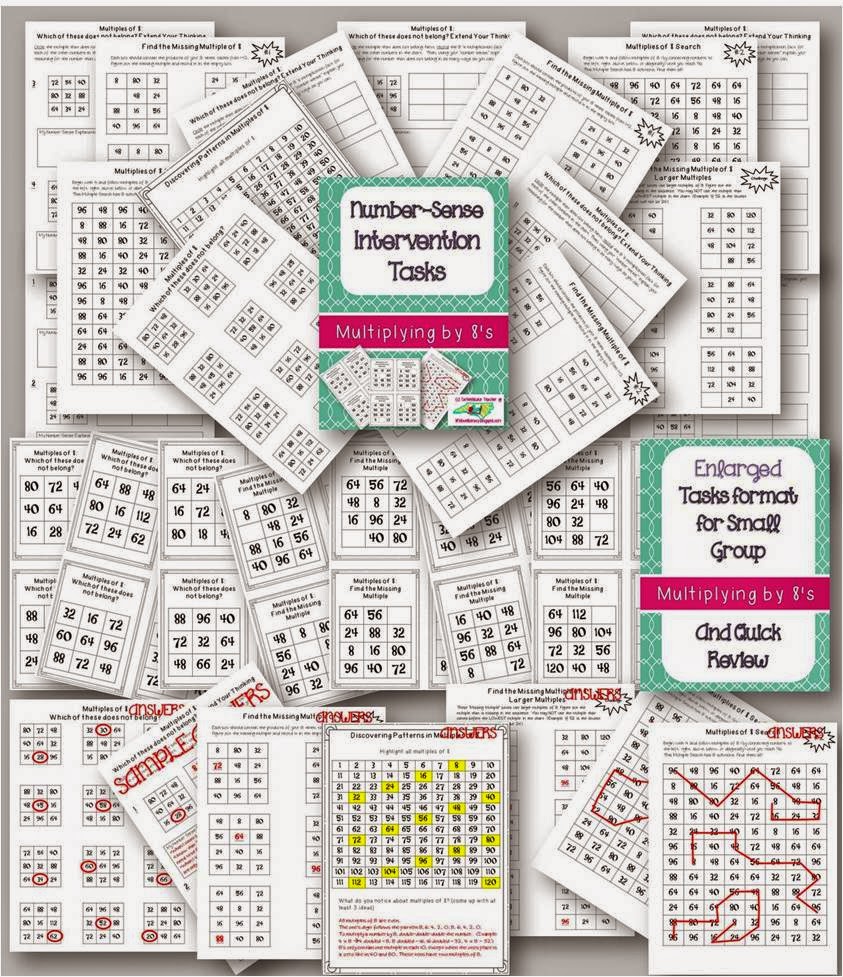
I realized that a handful of my students need a separate intervention that is a few steps back from the fact memorization I'm aiming for. These students need extra time working with "count-bys" and looking for patterns in their fact families. Out of this realization, grew my Number Sense Intervention Tasks, fun ways for students to look for number patterns and practice "count-by's" so that they become more efficient. I have finished all of the sets and made Multiplying by 2's and 7's FREEBIES.

In every set, you will find the following activities:
Which of these Does Not Belong? Students use number sense to figure out which number does not make sense for that multiple, maybe it is too close to a multiple students know, maybe it is odd and should be even, maybe it does not have the correct number in the ones place, etc.
Which of these Does Not Belong~Extension Pages
Find the Missing Multiple-forces students to "count-by" for a purpose and to become more efficient doing so by noticing whether or not the next multiple is in the chart. Use these cards a lot and hopefully it will break students from counting up to the next multiple one-number-at-a-time.
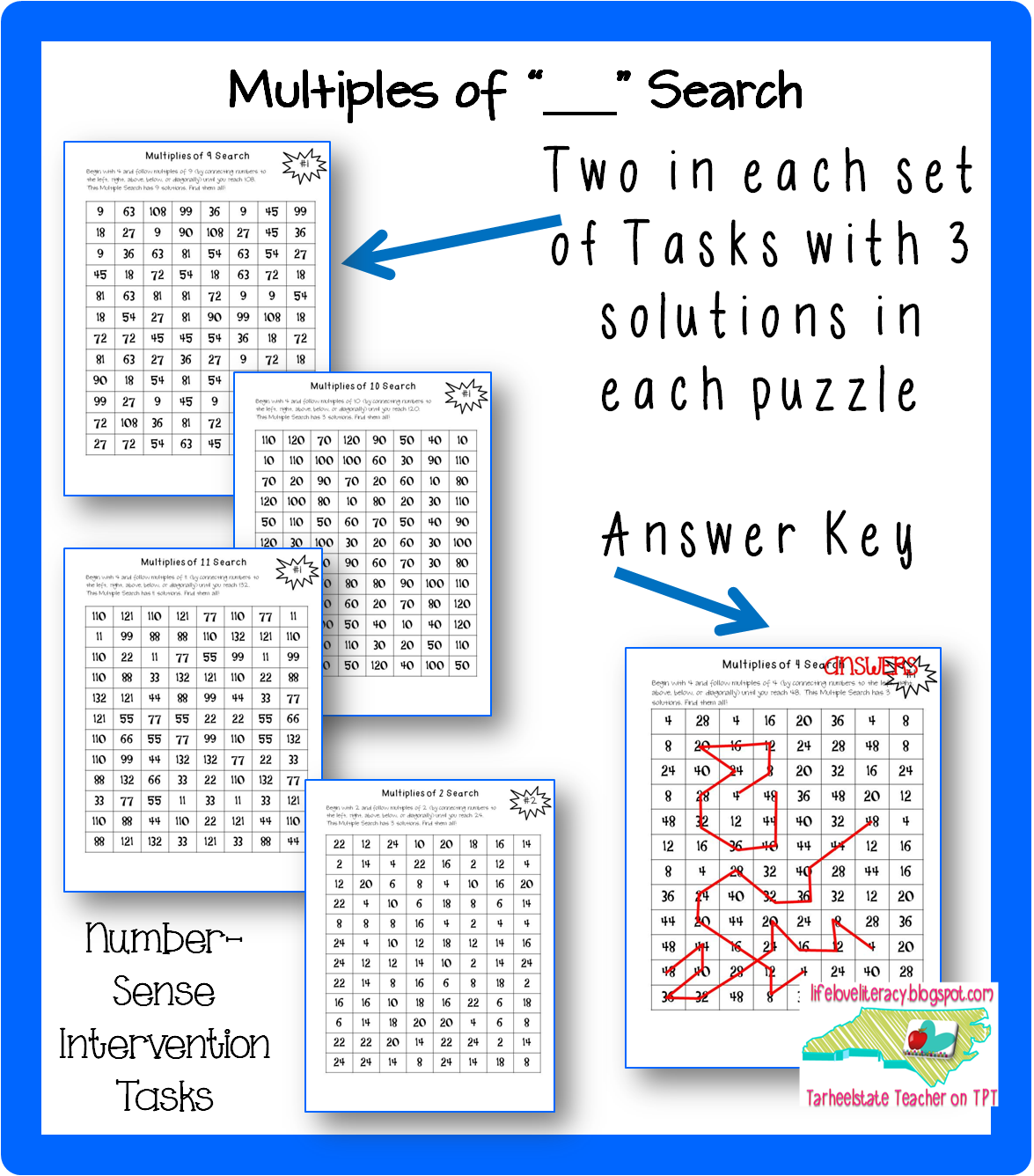
Multiple Search: another fun reason to "count-by" to find three strings of multiples from the 1st multiple all the way to 12th.
120's boards for analyzing patterns and having aha moments (like all multiples of 4 are even!)

I hope you take the time to check out these Number Sense Intervention Tasks:
Multiplying by 2's TRY IT FREE
Multiplying by 3's
Multiplying by 4's
Multiplying by 5's
Multiplying by 6's
Multiplying by 7's TRY IT FREE!
Multiplying by 8's
Multiplying by 9's
Multiplying by 10's
Multiplying by 11's
Multiplying by 12's
Number Sense Intervention Bundle

In my next post, I will go through a format for using these tasks {with repetition} in a small group intervention setting. Happy New Year to you!


Tuesday, January 14, 2014

Multiplying and Dividing Fractions Plans

You might recall that going into this quarter, I figured out a planning routine for differentiation that I think is AWESOME applesauce! I take all of the materials I have (task cards, worksheets, etc) and place them on a continuum of difficulty. (If I need to fill in holes for lower levels or higher levels, I begin searching for resources or create my own). In addition, I outlined the quarter with FOCUS CONCEPTS (new material) and REVIEW CONCEPTS (1 day/wk).

I outlined my fractions unit {loosely} before the quarter began, and of course, things have already changed a bit. Mainly, I realized that it would be okay to push a few things to next quarter (like coordinate planes) and spend an extra week on multiplying and dividing fractions. {Keep in mind that I do not suggest only teaching fractions for 4 weeks. We already spent a large chunk of 2nd quarter on fractions--adding, subtracting, and a little intro to multiplying. Can you tell I could literally spend ALL year on fractions and be in MATH~nerd~HEAVEN?}.

I thought I was differentiated to the max already, but as I began to teach my three classes, I understood that what I had considered lower-level needed to be even more straightforward or scaffolded for one of my classes (for this group, I have went back to my old math workbooks). Now, don't get me wrong, these kiddos that I have to drop back to the worksheet for CAN get it and have done so, but I found that they need a more straightforward approach first and then they move into the task card sets. With a worksheet, they seem to get more accomplished and grow more in their confidence that they CAN solve the problems--and they know they will be moving on to task cards, which they have a positive attitude about.

Here's my fraction outline in a continuum format. The first icon will be the easiest/basic entry level, with the activities/practice work moving into increasing levels of difficulty. Also, it is important to note that some of the individual sets of task cards (like the Chili Math Multiplying Fractions) already include questions in increasing level of difficulty. This pack of task cards has 60 cards that I broke into sets. Some of the first questions are straightforward multiplying fractions problems, while some of the later task cards make students think backwards to figure out the factors that were multiplied instead of just the product. Needless to say, these cards have kept us busy busy for a week (with whole group minilessons also included at the beginning of each math class). The extension column includes materials for those students who finish the tasks above and beyond and are ready to move on to other concepts or look at the focus concept in a new way.
Based on my routine math schedule that I brainstormed before the quarter began: 

Mon-Wed: Practice with Focus Concepts (new material we are trying to master, students work through the continuum)
Thurs: 1/2 time Data Day (charting our exit slips performance and assessing on an OLD skill); 1/2 time: Algebraic Thinking Day
Friday: 1/2 time remediation on old skill (based loosely on assessment performance) and 1/2 time continued work on Focus Concept (some students may be working on extensions while others are 'secretly' being remediated, and others are completing work from the week that they understand but just need more time to work on). Some students may also use mobymax.com as a differentiated spiral review/to fill in some unmastered skills.

I will say that in getting the quarter started last week and getting to know my new students, I decided not to implement the Thursday/Friday schedule until our second week back. We will definitely have assessment/data/algebra on Thursday and Remediation/Review on Friday this week.

By the time I teach math for the third hour, I am burned out...and worried that I can't fix everyone's issues and misunderstandings. But, after having a little lunch and getting to my planning time to further differentiate and plan for the next day, I get really excited and LOVE the ability to focus on only a few subjects (I'm also teaching reading/social studies integrated into an hour and 20 minute block).
I hope your teaching life is happy, and please comment with questions as I am hoping that I am able to explain what I am doing clearly, but I am not always sure it is!


Sunday, January 12, 2014

Pre-Assessment: Multiplying and Dividing Fractions

This past week, our run at departmentalizing our grade level began. If you have been checking in to the blog, you know that I was lucky enough to be the one who gets to teach math! I see the other two classes first, then my class returns to me for math. I was initially worried about behavior, routines, etc. but I really think behavior has improved dramatically because I am a new teacher to these kiddos and they get the impression that I am not going to put up with any mess. I love math and my main goals are to help them feel confident, learn to persevere, and to teach them what they need to know. I recently shared my math outline for the quarter which {of course!} changed a little once this week began.

Since I'm teaching two groups of students that I don't know, it was important to me to get to know them as math students as quickly as possible and to be ready to differentiate for them immediately. To prepare, I had each teacher group students into the following descriptors:
* Needs extra support
* Understands/Average
* Quickly Understands (Above Average)
* First to Finish (will always need something more)

These groups were recorded in a chart in google docs and I printed off multiple copies of it to help me learn student names, know how to group them for lessons, and to take notes on how they were doing with concepts during the week.

Since classes are at different levels and each of us got to different points in teaching multiplying and dividing fractions, I started on Monday with a low-pressure assessment that was also leveled in depth of knowledge demonstration. My students who easily know how to solve fraction equations had to write steps for solving the problem and then explain why they did certain steps. Why do we multiply fractions straight across and not have to find common denominators? :)
This assessment was more interesting than I expected and truly did what a pre-assessment is supposed to do. With the first class, many students completed the first problem by multiplying the numerators and keeping the denominators the same. Then for the second problem, some students began trying to find a common denominator. It was interesting (and nice) to be able to tell them that they were remembering how to add and subtract fractions and I was very proud of them for that. I explained that it is important to have a common denominator when adding/subtracting fractions, but you don't have to have one when multiplying. I tried to convince them that they would love multiplying fractions more because you don't have to have common denominators...they had already learned the harder concept last quarter! For students who knew how to multiply, I was able to see if they would simplify the final answers and turn improper fractions into mixed numbers. 

I hope this assessment was able to help students feel confident, rather than like they didn't have any idea what to do. (I was afraid some of them would shut down and not try anything, so I know I'm repeating myself, but I was really glad to be able to say "This is what you do know! I'm so glad you remembered that.")

I also have the same type of worksheet ready for dividing fractions, although I may use it differently with different classes. I haven't talked to my students about dividing fractions yet, so we may use this together to think about WHY flipping the second fraction makes sense. (If you want these, click on the images. I have put the file in my google drive for sharing with you.)
In my next post, I'm going to share with you how my plans {really} worked out and the modifications/change in pace that I already made this past week. 

You can catch up on other posts from my Departmentalizing Math Journey by clicking the icon below!
Happy Sunday Funday :) I hope you are looking forward to the workweek ahead!


Sunday, December 29, 2013

3rd Quarter 5th Grade Common Core Math Outline

I'm ready to share my outline for math for 3rd quarter. These plans show the standards we will learn each week, the review standards I will focus on on Fridays, and the materials that I have to work with so far. Some of the weeks may seem a little slim, but I'm still working on planning out the specifics of those. I also plan to do a Week-By-Week "Peek at My Week" for math where I will outline the gist of my daily plans. Hopefully, this will help me plan better and you can enjoy the specifics. Did you already read about my math routine?                                                              
These plans are in a PDF with clickable links. Click on the image to go to the PDF. Poke around and see what you find. I have linked a few freebies that go straight to google doc files, so you might find something useful and free.

Modeling Multiplication of Fractions

It sure feels like I have been writing about fractions like CRAZY~CRAZY, but we spend almost all of 2nd quarter and part of 3rd quarter learning fraction concepts. Are you looking for a way to launch your unit on multiplying fractions (read-elicit some prior knowledge and a reality check on where students are in their fraction understanding?) I created these task cards to do just that with my students. I wanted to focus on representing situations/word problems with models and equations. I also incorporated the opposite--representing models and creating word problems. It was interesting to see my students try to color the fraction models to represent the word problems.

Did I mention that these cards grew from the fact that I was pretty sure that many of my high-achieving students could solve the equations for multiplying fractions, but I was not sure that they truly understood what they were doing or why you would multiply a fraction by a fraction or a fraction by a whole number. With these cards, students were exposed to examples, had to represent what it meant on a picture, and had to create their own situations/word problems.

I included 16 task cards each for multiplying fractions times a whole number and fractions times a fraction. 8 of the cards in each set focus on modeling a word problem and 8 of the cards focus on writing a word problem and equation to represent a model.
 Multiplying Fractions with Models Task Cards 5NF
 Multiplying Fractions by Fractions and Fractions by Whole Number Task Cards
The student answer sheets for these task cards include all parts students are to complete (IE-models, equations, written word problems, etc).
I also made a version of the task cards that are one to a page so that you can show them on the smart board. This is actually how I used the problems to launch the lesson (students had their recording sheets and I displayed the cards on the board so that we could "math talk" about what we were thinking and share our representations.) After day 1, students worked on the task cards independently. These task cards fit 4th and 5th grade Common Core standards for fractions.
Have you checked out my other recent math posts? Here's a run-down: 
Fractions Fractions Fractions  (differentiation strategies and subtracting fractions with regrouping)
Division with Fractional Parts (Multistep and CHALLENGING!)

You can check out all of my fractions products HERE @ TPT

Oh yeah, I also made an "Everything Fractions" pinterest board, if you want to follow along. I've already pinned some goodies, especially websites for integrating technology in math, but I will keep pinning every time I see a great fraction idea.

I'm cooking up one more idea for an interactive fraction lesson that I hope I can make work...

Thanks for stopping by!


Saturday, December 21, 2013

Math Routine: Exit Slips and Data Tracking

To catch up on previous math posts, check out My Math Schedule/Routine and Departmentalizing 3rd Quarter.

Once my team made the decision to departmentalize and I became "the" math teacher for my grade level, I knew that I had to step it up. I relish in the opportunity to do an even better job teaching math and in the fact that all energy I put into teaching math next quarter will benefit not just one class of students, but an entire grade level. I also love the fact that this opportunity means that I don't have to plan for science or writing. While I'm focusing lots of my attention on math, I don't have to worry that another subject area is not getting planned. I felt stingy stealing math because I know we all love to teach math, but my team so graciously let me take it. So, I made a few promises to them and myself:

* I will differentiate math for students to the highest level of my abilities
* I will do a better job of tracking data
* We will implement assessments more regularly (I've only given 2 math tests this year!)
* I will further analyze our state test samples and align parts of my instruction with the way questions are presented
* I will not only focus on students who need extra challenge, but implement a structure that allows for remediation and extra support for those who need it (see yesterday's post)

With these goals in mind, I needed some new materials. I made two fantastic purchases from TPT, including One Stop Teacher Shop's Spiral Math Homework and Math Mojo's Math Exit Slips.

I'll talk about homework in another post, but today, I'm going to focus on Exit Slips and Data Tracking.
http://www.teacherspayteachers.com/Product/Math-Exit-Slips-5th-Grade-Common-Core-All-Standards-Mega-Bundle-937921
Math Mojo's Math Exit Slips contain 5 to 10 problems for each of the 5th Grade common core math standards. (She has also created exit slips for 3rd and 4th grade). When I saw these at such a good price, I new it was exactly what I needed for a quick morning work assignment for all grade levels. (Now, these were created as "exit slips" but I am using them as review/entry slips.)

On our workday, I got right at "getting ahead." I copied the exit slips for Numbers and Operations in Base 10 with two sets to a page to save on paper. Then I cut all the sets, paper clipped them,
and organized them into bags by concept.
Since the slips are so well organized by standard (and a dependable 5-10 practice problems for each concept), I also knew that I wanted students to be aware of their performance in each area and track their data. I created "Bar Graphs for Tracking Student Success" to go along with the exit slips.
http://www.teacherspayteachers.com/Product/5th-Grade-CC-Math-Bar-Graphs-for-Tracking-Student-Success-1026674
I got carried away with my designs and ended up making 5 options. With Math Mojo's blessing, I uploaded this data tracking system to TPT.
 
How do I plan to use the exit slips?

1) Students receive 5 exit slips on Friday or Monday to glue into their math journals to prepare for the upcoming week. Students glue 2 exit slips on each page, leaving 1/2 of the page available to show their work or write a written response. (If you print the exit slips 4 to a page instead of 8 to a page like I did, students should have enough space to complete the problems on the slip).
2) Students complete one slip each morning for morning work and get it checked by the classroom teacher.
3) Since I am starting with exit slips mid-year, I will give students a mix of standards each week to allow for review and practice of previously taught concepts.
4) On data day, students color in their data bar graphs to show how they did on the week’s problems.

How do students fill out the bar graphs? Here's one possibility:
I'm so excited to use these math exit slips, and I think it will be exactly what my students need, no matter where they are on the continuum. (I have students who need review/remediation and then I have students who simply need to gain control of their accuracy with computations.) Next up, I will talk about my plans for "Algebraic Thinking Day."

Sunday, December 1, 2013

Cyber Monday and Tuesday~SAVE 28% on TPT and FLASH Fractions FREEBIE!

http://www.teacherspayteachers.com/Store/Tarheelstate-Teacher
Cute clip art from Ink n Little Things 
Time for a sitewide TPT sale! These only happen a few times a year! You can grab everything in my store for 28% off by using the code CYBER!

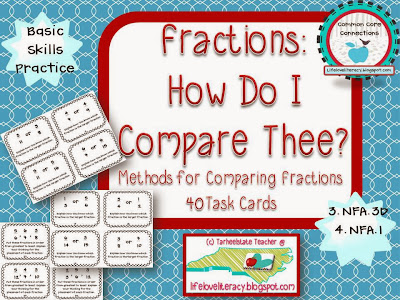
I just uploaded a new Fractions Skills product~Methods for Comparing and Ordering Fractions. This is a freebie through the CYBER Monday/Tuesday sale, so grab it now! It goes up to 2.25 on Wednesday!
http://www.teacherspayteachers.com/Product/Methods-for-Comparing-and-Ordering-Fractions-Task-Cards-3NFA3D-4NFA1-1003661

http://www.teacherspayteachers.com/Product/Methods-for-Comparing-and-Ordering-Fractions-Task-Cards-3NFA3D-4NFA1-1003661

Wednesday, November 27, 2013

Fractions, Fractions, Fractions! ~Differentiation at its Best!


Hi All,
This post is going to be about FRACTIONS! And, DIFFERENTIATION (don't you love it when it just works out?) We have been working on adding and subtracting fractions with unlike denominators in my class. I started with Jennifer Findley's Winter Themed Fraction Centers, specifically I used the snow globes addition and subtraction of fractions task cards. (These were simple problems with unlike denominators that were easy to make common, no word problems, just equations, so a good first step for practice).

Once students understand finding common denominators, I always move to subtracting fractions with unlike denominators where you must "borrow" or "regroup." I decided to make my own problems for this concept, breaking the different types of borrowing problems down instead of using my old worksheets that had everything all mixed up.

I came up with three types of problems:
* Whole Number Start
* Mixed Numbers with Like Denominators (provides a scaffolding/easier set of problems for students who have difficulty moving to multi-step problems; they can get the hang of borrowing without having to worry about finding like denominators, then move on to putting it all together with the next set of task cards).
* Mixed Numbers with Unlike Denominators

For whole number start, I taught students to use the "add up to start" strategy:
I hoped to develop some mental math skills, and students loved it because they found this method to be simple to understand.

Now, did I mention that part of this post was about "differentiation at its best?" Well, this set of task cards (and a few others that I have) allowed me to differentiate for the different needs in my classroom. I copied each of the three sets on different colored card stock. (The three types of subtraction problems come with 16 questions, with two of the sets having 8 equations and 8 word problems).

Most of my students were able to complete all of the "whole number start" problems on the day I introduced it. (I am not always concerned that students finish all of a set of task cards, but that they get enough practice, so often, a handful of students don't end up finishing them.)

On the following day, I explained to students how to borrow 1 whole and convert it to the fractional parts that they needed in order to be able to subtract. I then explained that I had two sets of cards (one with like denominators and one with unlike) and allowed them to choose where to start. I also told them that if they weren't sure which would be best for them to start on, just ask me! (I held my breath hoping that students who needed to start on the easier problems--like denominators--would choose to do so...and they did!) Students who started with the like denominator problems (orange cards) moved on to the unlike denominators (green cards) later in the week.
Once students completed the green set of cards, they worked on my Candy Shop Task Cards (a mix of adding and subtracting fractions with unlike denominators, including problems where students have to borrow.)
http://www.teacherspayteachers.com/Product/Add-Sub-Fractions-w-Unlike-Denominators-Word-Problems-Candy-Shop-5NFA1-5NFA2-464987

 Subtracting Fractions with Unlike denominators task cards word problems

 Adding Subtracting Fractions Unlike Denominators Task Cards Word Problems Models
This is our second year teaching the Common Core State Standards, and I believe that I am finally getting my resources for math stocked so that I can better differentiate for my kiddos. I have a group of about 7 students that always need reinforcement of a lesson and move a lot slower than the rest of my class. Most of the rest of my students are "gifted" and just catch on to math concepts very quickly. What to do, what to do with all of these different levels of math students? Often, I introduce something quickly and allow my gifted students to ask questions as they are working, instead of trying to hit all of the ways they might see the problem. I have also developed the strategy of explaining a common question that pops up to one or two students and then asking them to teach others when they come to me with questions. It works out pretty well for us!

My group that moves a little slower gets a reteaching lesson, perhaps explained in a different way, and some extra practice with me before they head to working on task cards. They worked at the kidney table this week and I sat with  them for the most part. This group also benefits from immediate reinforcement, so I am sure to check their work regularly during task card work. (This also helps me catch them before they make a pattern of mistakes too many times.)

You know what else helped my differentiation the past two weeks? I was able to fit TWO large carpets in my room! I have one in front of my reader's workshop white board and one in front of my smartboard. I also have a kidney table, so I was able to send students to different carpets to work on the different levels of task cards. When students finished one set and got their answers checked, they are able to move on to the next carpet and set of questions. It worked like a well-oiled machine!

Next, we move on to multiplying and dividing fractions, so I have to assess what materials I already have for this and get to work on anything new that I need. You can check out all of my fractions products HERE as I reorganized and labeled some of my TPT store this week!

After a successful week of differentiation in math, I feel like "Genius teacher"~said with sarcasm! Will I ever perfect this machine? Sometimes I find myself relearning lessons that I thought I learned years ago (with 8.5 years under my belt); sometimes I find it hard to carry what I thought I learned from one group of students to another group, but then they show me that they need the same basic structure!
PS~When differentiating with a number of different task cards, worksheets, or problem sets, PREPARED ANSWER KEYS are a MUST for my sanity! All of my task card sets come with answer keys and I fully appreciate it when I buy a product that has provided a key!!! (Often, I let my students check themselves...they don't cheat and help themselves confirm answers!)

LinkWithin

Related Posts Plugin for WordPress, Blogger...