My principal has decided to focus on the "4 C's" this year. The 4 C's stand for Collaboration, Creativity, Communication, and Critical Thinking.
As I looked at this list of words, I thought, "Wow, it would be nice for creativity to be more important in our day, but...." I am a pretty literal person when it comes to making changes or setting goals. If you say we should increase creativity in the classroom, I see this huge goal of immediately trying to be more creative in every subject. However, you know as well as I do that creativity often gets pushed out of the classroom to focus on skills, mastery, content, etc. and to make sure we are moving along at a break-neck pace to hit all of our objectives. (All of that makes me feel like I sound like a bad teacher--I promise, I think I'm pretty awesome at this job, but let's be real.)
So, as I sat through our meeting, I thought, "How can I at least incorporate a little more creativity to make an effort towards this ambitious goal?" Writing stands out to me as the time of day where I could surely aim for more creativity (and choice, and student-centeredness). Writing is like art--a creative outlet and process--it's messy, it takes time, and it could definitely be more creative than we allow it to be when we teach students through genres all year. (I now feel like genre-based teaching in writing is what keeps me from allowing students to develop more creativity. Writer's have choices, not only in topic, but also in format, so why shouldn't my students? I'll get to more about this later:)
I came up with a scary idea, but now that I have launched it (about 3 days in), I am SOOOOOO excited about the potential I see for amazing writing and for inspiring students to see themselves as writers with worthwhile things to say.
What if students could choose their genre AND format for (almost) EVERY writing project? At my grade level, we have realized how super-awesome it is to have our reading and writing units connected, at least by a thread. You get so much bang for your buck with this approach (like we did last year with our Holocaust Book Clubs/Literature-Based Essays).
We really want our reading and writing to be highly connected. We are reading Wonder by RJ Palacio as our beginning of the year read aloud, so I started listing all of the ideas I could come up with for ways to write with Wonder as an umbrella. Then, I decided I needed a graphic organizer with categories to help me launch this with students. I came up with: questions, real-life connections, imagine, and reactions. I thought these categories would encompass just about every thought, genre, and topic we could come up with.
This is what we came up with when I introduced this format for "thinking" during a reading minilesson. As students provided ideas, I did my best to make sure I turned them into more generalized topics. (So, if someone said, "Auggie got made fun of and I have too," I turned it into "getting made fun of." (The only place this didn't work--and it's going to be okay--was in the IMAGINE category. I definitely wanted students to imagine re-writing and adding to the story with this category.) To lead the minilesson, we focused on one category at a time. I provided students with one example and then asked for their ideas.
Keep in mind that we are only on pg 80+ in the book and were able to
come up with all of these ideas. After reading more of the story, I know
students will have more ideas. (After today's lesson, I decided this would be our focus in writing for the quarter--SO EXCITING!)
On Friday, I moved the lessons into writer's workshop. I gave students the typed list of their ideas and asked them to highlight ones that really stood out to them as something they would be excited to "spend a little more time thinking about." Notice, I didn't say WRITING. I didn't want to focus them (or turn them off) just yet. I wanted them to be completely open to just identify topics they were interested in. Next, I had them put star their top topic...and it was time for writers' workshop to be over :)
Today, we created a poster listing "Ways Writers Can Choose to Write."
We then chose one idea from the brainstorming chart for Wonder and thought about all of the ways we could address that topic through writing.
I was BLOWN away at my students' ideas and creativity (and we only had 10 minutes to make this brainstorm). Remember my first chart (scroll to top :)? The one where I identified the types of writing each section would lend itself to? My students were able to totally see through that. (BTW, I never shared the kinds of writing I thought the category would lead too--I didn't want to limit their ideas). I told them that with "Why is it challenging for most kids to accept someone who is different?" as the topic, most teachers would immediately choose essay as the format. They didn't include essay in their ideas at all! (Although, I know the skills of essay writing will come in handy if they choose to write a blog post or letter). I am totally getting buy-in for all the lessons I want to teach--making those lessons more necessary because students are CHOOSING their format and writing topic.
Why I love this new approach and why I think it will work is because I believe that almost all lessons we aim to teach in "writing class" can apply to all genres of writing. Nonfiction authors use narrative (I just wrote a blog post; I think I've also told you some story.). How to use commas, show-don't-tell, support your ideas with evidence and examples, use narrative to get your point across--I think I've got plenty of lessons to choose from that will be beneficial, no matter the type of writing students CHOOSE to work on.
CREATIVITY and CHOICE. What do you think? It feels great to slowly be chipping away at their list of when "WRITING is the WORST..." :)
Showing posts with label write about reading. Show all posts
Tuesday, July 30, 2013
Sunday, November 4, 2012
Write about Reading Rubric Sort
Hi bloggy friends,
I wanted to share something I recently made for my readers' workshop. We have been focusing on "write about reading" heavily this quarter. To help students understand the expectations and goals of write about reading, I made a sort of the characteristics and behaviors I am seeing (and want to see) in my classroom. Students completed the sort by deciding if the description was a level 4, 3, or 2. Students sorted the descriptions in partners and were required to discuss why they would place the descriptions in a certain level. See the pics below:

Wednesday, October 31, 2012
Archetypes: the Roles Characters Play~Minilesson Magic!
Minilesson Magic on a Wednesday? I must be ready for a break :) Good thing I held out though because I have a great reading minilesson to share with a freebie handout.
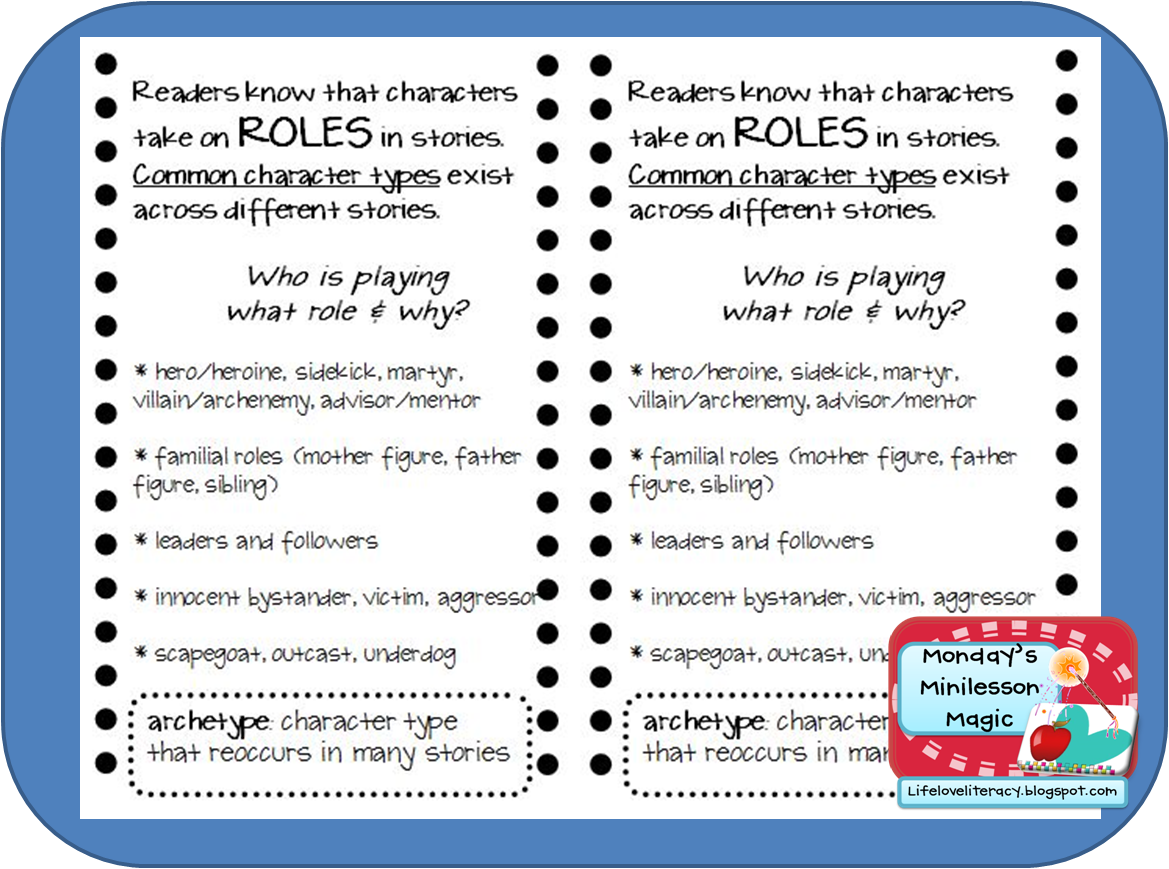
This week I want to share a lesson I did on archetypes. I am defining an archetype (on a 5th grade level) as a "character type that reoccurs in many stories." My students and I had already talked about archetypes last year, so this lesson was a review to remind them that it is a really good idea to be thinking about the roles that characters are playing. We are still on our journey of reading and analyzing holocaust-related historical fiction. (We took the time to read two book club books on this topic in order to target the Common Core anchor standard for comparing and contrasting). Although we will wrap this study up this week, I will come back to this lesson later in the quarter when we are in our realistic fiction book clubs.
To start this lesson, I reminded students that we know characters play roles in stories. We looked at Number the Stars and discussed how Peter played the role of the hero (and could also be called a martyr). Peter worked for the resistance and fought against the Nazi regime to help many Jewish people escape to Sweden for safety. In the end, we find out that Peter ended up dying because of his work with the resistance movement. You could also say that Anne-Marie, the main character is a heroine. (Then you could generalize that there were opportunities for many people to be a hero in their own way during the Holocaust--but save this for another minilesson or you will end up with a MAXILESSON. :) I then pointed students to their handout and the list of roles I had identified. I made sure they understood what each one meant (mainly martyr, scapegoat, and outcast were new vocabulary for them).
Next, students listed the important characters from their books and tried to decide which role those characters played. I explained to students that they really shouldn't try to force a role on a character, but now that we are taking the time to think about the roles characters play in our books, the roles should be pretty obvious. If a character doesn't have an obvious role, maybe they don't have one but were still in the book for a reason. Again, we shouldn't force a role on a character just to label them.
I seriously had a kid ask "Is it okay if the character's role changes in the book?" Wow!!! That is minilesson magical! :) This student was focused on Milkweed by Jerry Spinelli. Misha definitely plays a few of roles in the story. He is a hero in many ways for Janina, he is also a brother-figure, and to me, he is an underdog that we are rooting for through the whole book. In the beginning of the book, maybe he would be considered an innocent bystander because he is watching everything happen around him and not really understanding. (Have you read this book? It is one of my new favorites! :) Anything Jerry Spinelli PLEASE! <3)
For active engagement, I had students choose one of the characters and roles from their list and write about how the character was playing that role. Our grade level is REALLY focusing on Writing About Reading (or writing our thoughts about reading). Students wrote for about 10 minutes. For weeks, I have been encouraging students to use examples from the text and to try to elaborate on one idea instead of skipping from idea to idea and ending up with a list of ideas instead of a solid, elaborated idea.
I hope to take this lesson further by discussing how thinking about the roles characters play allow us to compare and contrast characters who played similar roles across different books. For example, how does Misha (Milkweed) being a hero compare to Bruno's (Boy in the Striped Pajamas) lack of heroism? We could also discuss why main characters need sidekicks and analyze how different sidekicks in different stories have supported the main character. So many exciting places to go with this lesson! I hope I have time to do it all :)
Click on the picture above for the student handout freebie. If you read about my Reader Response Journals, this sheet would go behind "Coach's Huddle" in our notebooks because it's a handout from me, the "Coach."
RL4.3: Describe in depth a character drawing on specific details in the text (e.g. a character's thoughts, words, or actions).
RL4.9: Compare and contrast the treatment of similar themes and topics and patterns of events (I think this objective fits because identifying archetypes allows you to compare/contrast and the archetype is highly connected to the themes of the story).
RL5.1: Quote accurately from the text when explaining what the text says explicitly and when drawing inferences from the text.
RL5.3: Compare and contrast two or more characters drawing on specific details in the text.
RL5.9: Compare and contrast stories in the same genre on their approaches to similar themes and topics.
You might not be reading Holocaust related books, but I hope your students can use a minilesson on the roles that characters play in books. If this is the first time you are teaching this lesson, you might start with the basics and just offer victim, innocent bystander, and agressor and maybe hero, sidekick, villain, and advisor/mentor as choices to discuss and apply to their own books.
I have used the roles of victim, bystander, and agressor with the book The Hundred Dresses by Eleanor Estes. I have applied the roles of heroine, archenemy, sidekick, and advisor to A Friendship for Today by Patricia C. McKissack. You can also use the same roles with biographies as most biographies write the famous person as a hero (or an underdog) that has overcome obstacles, including "villains" or people that were against them. I came up with the idea of underdog as an archetype by thinking about Wilma Unlimited by Kathlene Krull. Wilma is an underdog because we don't expect her to be so successful and we are rooting for her the whole time.
Friday, October 5, 2012
Reader Response Set Up: Coaching Our Own Reading Lives
Today I want to share snapshots of my reader response journals. This year, I set them up with sections for the first time and am loving the sections I used. I have to admit, I was super-scared to create sections--how do you know how many pages to leave for each--and what if the kids run out of space---arrrghhh. I just decided to GO FOR IT!!!
Last year in 4th grade, my students and I spent a large portion of our 1st 9 weeks talking about "Building a Reading Life."
Based on the theme of "Coaching Your Own Reading Life," I thought about the sections I wanted to have in my notebooks. I thought it was important to have a place that was about the reading life (especially for beginning of the year reflections), a place for information from minilesssons that can be used again and again--handouts, reader statements, etc, a place for students to practice what we are learning in the minilesson and responses to our read alouds, and a place for work they do with their own book. I really wanted to keep the sports/coaching theme going, so I decided to break the reader's response into the following sections:
To make the sections cutesy (and to mark them), I had a parent make circles, stars, and hearts out of scrapbook paper. I typed up the titles for each section and had students glue them on the pages listed above. Numbering the notebook was quite an ordeal. We did it in chunks of 20 and I had students partner up to check each other's numbering to catch each other's mistakes. After a partner had checked the 20, they could move on to numbering the next 20. Another thing I learned is that marble notebooks aren't standardized. I thought they all would have 100 sheets, but apparently the more decorative notebooks short on notebook pages :( I will be specifying this on next year's supply list now that I know!
I got many of my ideas for what to have students do in the "Reading Life" section from Julie Ballew's Website. Sadly, we didn't get to many of these great ideas, but we did complete the "I read because..." brainstorm.
We also reflected with a list of "Reading is the Best for Me When..." characteristics.
I would have spent the time to do more of the activities if I felt my students were still "building" their reading life (which really means buying into how great reading is and making sure that we are committed to it in our lives), but since I had already spent a quarter the year before building the reading life, they already loved to read and were ready for more--and I was surely ready to get into teaching them how to be their own coach. Saving space at the beginning of the notebook is also great for reflecting at the end of our units. For example, when we finish our historical fiction unit, I can have the students reflect on what they learned about reading historical fiction or I could make it more creative and have them make a list of tips for another student who is about to read historical fiction, etc.
I hope you enjoyed a look at my reader response notebooks. Hopefully I will get to let you peak inside more during Monday's Minilesson Magic! Do you use reader response notebooks? Do you set up your notebooks with different sections?
PS-I am SUPER excited to see that I have 100 followers on my blog! I just broke that 100 mark last night. Thank you so much for following and I hope you are able to pick up ideas. Feel free to comment on my blog at anytime. You can even tell us about posts you have written on the same topic. I would love to hear from you!
Monday, September 24, 2012
Monday's Minilesson Magic: Thinking about Theme Strategy
Drumroll please...Today I am announcing my new weekly blog post topic: Monday's Minilesson Magic!!!!! I
really want to dedicate myself to posting about something each week and I think minilessons will be such a useful topic for other teachers, for me to document what I am doing and reflect on how it went, and to push me to seek out new ideas---I hope you think so too and will plan to tune in every Monday to catch the newest Minilesson Magic focus and grab some ideas.
I have been horrible at my weekly poetry post (uh-hem, please forgive me!). I can't seem to get the writing/idea/creative teacher muse inspired on my Love of Language Post so I thought trying something more general might work better: MINILESSONS :) I teach those everyday right? So, surely I can work up some magic once a week to come up with good ideas to share with you for Monday's Minilesson Magic.
I thought for my first post, I would focus on a new strategy I used this year for thinking about theme. I am always, always, always trying to push students' thinking about reading and trying to give them ways to push themselves that are tangible. I came up with the "It's About..." strategy. When I say "It's about" now my students know what I'm talking about.
I first introduced the "It's About" strategy in our first reading unit that I call "Coaching Your Own Reading Life." For this unit, I chose Pictures of Hollis Woods by Patricia Reilly Giff as our main read aloud. Before this lesson, I brainstormed my own ideas for "It's About" and chose to model for students the ideas I came up with instead of letting them share their own. I wanted to ensure that they understood what I meant by "It's About" and I explained that I wanted us to get at what the book is really about. I wouldn't say "It's about a girl named Hollis Woods who is a foster child that always runs away from the families she is assigned to." This is a summary statement, and I want to get at what the book is REALLY about. (During this discussion, I never mentioned that I was talking about THEME because I wanted our thinking to be unlimited. I introduced these students to theme last year and did not want us to only be thinking about themes the way we had before.) This strategy also gets at author's message, what the author might be noticing in the world and trying to make a statement about, and lessons we could learn. Here's what I came up with:
As I continued this lesson, I told students "I keep having to stop myself from explaining why I think it's about this or that." I think holding myself back from discussing why I put it on the poster made students really eager to think about why that would be on the list. My next step in the lesson was to ask students to choose one of the it's about from my poster, list it on the top of their next clean Reader Response page, and start explain why they think it's about that idea. Of course, we closed the lesson by sharing some of our writing.
How did we take this brainstorm to the next level? In the next lesson, we discussed how we could use this to push our thinking and I modeled for students how I could plan for my written response by thinking about the examples and evidence from the text that make us think "It's About..." The "It's about" that stood out to me the most that I really wanted students to write and think about was "It's about Wishes and Wants." I modeled how we could list this idea at the top of our page and list the reasons/examples from the book that make us think it's about that. I also told them that my list could include some of my own thinking, like "Every child wants/needs a family." I told them this is my thought because this is what I know and think is true about the world.
This strategy has already started to spiral through our reading curriculum and I know it was so easy and tangible for students that I will continue to use it throughout the year. Recently, I posted about our Holocaust book clubs (our second reading unit was "Coaching Ourselves Through Historical Fiction.") We used the "It's About..." strategy to brainstorm ideas for what themes show up in our Holocaust books. Here's my "It's About" model for Rose Blanche (Roberto Innocenti) and Irena's Jar of Secrets (Marcia Vaughan), two picturebook read alouds I used during the Holocaust unit.
Sorry this chart is messy! Once we got going with our ideas, I quickly realized I should not have separated the chart for the two books because most of the themes/It's About ideas we had fit for both books. The beauty of this "It's About" chart and lesson was that I was really giving students ideas for their holocaust book club books because most of the themes show up in other books about the Holocaust. For active engagement, students began to brainstorm an "It's About" for their book club books and then used this in their book club discussions.
I hope you can use "It's About" in your classroom (although now that I have said "It's about" about a thousand times in this post...you can choose to call it something else :)
Oh and, second drumroll please! :) My Monday Minilesson Magic will always include a list of Common Core Connections at the end that correlates the lesson ideas with the common core standards for those of you who are teaching through the common core.
RL3.2 Determine the central message, lesson, or moral in the story and explain how it is conveyed through key details in the text.
RL4.1 Refer to details and examples in a text when explaining what the text says explicitly and when drawing inferences from the text.
RL4.2 Determine a theme of a story, drama, or poem from details in the text; summarize the text.
RL5.1 Quote accurately from a text when explaining what the text says explicitly and when drawing inferences from the text.
RL5.2 Determine a theme of a story, drama, or poem from details in the text.
What minilessons topics are you currently working on? What minilesson topics would you like FRESH ideas for? Let me know in the comments :)
See you again next Monday for more Minilesson Magic!
I have been horrible at my weekly poetry post (uh-hem, please forgive me!). I can't seem to get the writing/idea/creative teacher muse inspired on my Love of Language Post so I thought trying something more general might work better: MINILESSONS :) I teach those everyday right? So, surely I can work up some magic once a week to come up with good ideas to share with you for Monday's Minilesson Magic.
I thought for my first post, I would focus on a new strategy I used this year for thinking about theme. I am always, always, always trying to push students' thinking about reading and trying to give them ways to push themselves that are tangible. I came up with the "It's About..." strategy. When I say "It's about" now my students know what I'm talking about.
I first introduced the "It's About" strategy in our first reading unit that I call "Coaching Your Own Reading Life." For this unit, I chose Pictures of Hollis Woods by Patricia Reilly Giff as our main read aloud. Before this lesson, I brainstormed my own ideas for "It's About" and chose to model for students the ideas I came up with instead of letting them share their own. I wanted to ensure that they understood what I meant by "It's About" and I explained that I wanted us to get at what the book is really about. I wouldn't say "It's about a girl named Hollis Woods who is a foster child that always runs away from the families she is assigned to." This is a summary statement, and I want to get at what the book is REALLY about. (During this discussion, I never mentioned that I was talking about THEME because I wanted our thinking to be unlimited. I introduced these students to theme last year and did not want us to only be thinking about themes the way we had before.) This strategy also gets at author's message, what the author might be noticing in the world and trying to make a statement about, and lessons we could learn. Here's what I came up with:
As I continued this lesson, I told students "I keep having to stop myself from explaining why I think it's about this or that." I think holding myself back from discussing why I put it on the poster made students really eager to think about why that would be on the list. My next step in the lesson was to ask students to choose one of the it's about from my poster, list it on the top of their next clean Reader Response page, and start explain why they think it's about that idea. Of course, we closed the lesson by sharing some of our writing.
How did we take this brainstorm to the next level? In the next lesson, we discussed how we could use this to push our thinking and I modeled for students how I could plan for my written response by thinking about the examples and evidence from the text that make us think "It's About..." The "It's about" that stood out to me the most that I really wanted students to write and think about was "It's about Wishes and Wants." I modeled how we could list this idea at the top of our page and list the reasons/examples from the book that make us think it's about that. I also told them that my list could include some of my own thinking, like "Every child wants/needs a family." I told them this is my thought because this is what I know and think is true about the world.
This strategy has already started to spiral through our reading curriculum and I know it was so easy and tangible for students that I will continue to use it throughout the year. Recently, I posted about our Holocaust book clubs (our second reading unit was "Coaching Ourselves Through Historical Fiction.") We used the "It's About..." strategy to brainstorm ideas for what themes show up in our Holocaust books. Here's my "It's About" model for Rose Blanche (Roberto Innocenti) and Irena's Jar of Secrets (Marcia Vaughan), two picturebook read alouds I used during the Holocaust unit.
Sorry this chart is messy! Once we got going with our ideas, I quickly realized I should not have separated the chart for the two books because most of the themes/It's About ideas we had fit for both books. The beauty of this "It's About" chart and lesson was that I was really giving students ideas for their holocaust book club books because most of the themes show up in other books about the Holocaust. For active engagement, students began to brainstorm an "It's About" for their book club books and then used this in their book club discussions.
I hope you can use "It's About" in your classroom (although now that I have said "It's about" about a thousand times in this post...you can choose to call it something else :)
Oh and, second drumroll please! :) My Monday Minilesson Magic will always include a list of Common Core Connections at the end that correlates the lesson ideas with the common core standards for those of you who are teaching through the common core.
RL3.2 Determine the central message, lesson, or moral in the story and explain how it is conveyed through key details in the text.RL4.1 Refer to details and examples in a text when explaining what the text says explicitly and when drawing inferences from the text.
RL4.2 Determine a theme of a story, drama, or poem from details in the text; summarize the text.
RL5.1 Quote accurately from a text when explaining what the text says explicitly and when drawing inferences from the text.
RL5.2 Determine a theme of a story, drama, or poem from details in the text.
What minilessons topics are you currently working on? What minilesson topics would you like FRESH ideas for? Let me know in the comments :)
See you again next Monday for more Minilesson Magic!
Subscribe to:
Posts (Atom)