Showing posts with label common core. Show all posts

Tuesday, February 24, 2015

Multiplication, Factors, and Multiples for Number Sense Intervention Group

I finally had time to take pictures of my Number Sense Intervention tasks and wanted to share with you today. In an earlier post, I told you guys:
I have been on a journey this year to ensure that my 4th graders master their multiplication facts. When I use the term "master," I mean with fluency and automaticity--no tricks, no fingers, no count-by's down the side of their page--just automatic fact recall.
Back to the cards, I took all of the "Find the Missing Multiples" and "Which Multiple Does Not Belong" activity cards, printed them on a different color of cardstock for each number set, and put them each on a ring. I try to meet with my Multiplication Intervention group for 20 minutes 3 or more times a week. I meet with them during one of their stations or while other students are completing task cards. I prioritize this group because I know that their math success and confidence lies in gaining better number sense. {I'm even thinking about starting a math/multiplication club during lunch once a week to move some of our practice time out of math class time}.

I love having these cards on a ring because they are ready to grab at any time that we have an extra minute to go over multiples and factors, and multiplication facts. (Think--lining up for specials, lunch, whole-class bathroom break times, end of the day, etc.) Just show one of the cards to your kiddos and teach them to allow others "wait time" before they shout out the answers. You can even have them give you a thumbs up when they are ready with an answer.
Let's take a look at a week with one set of these number sense intervention tasks:

Day 1:
Pre-Assess the Group using 1 to 4 of the "Which of These Does not Belong" puzzles. (I'd use the student notebook pages rather than the task cards for now because it gives them a place to write how they know the number does not belong.) Allow students to share their ideas to provide space for you to gauge misunderstandings and depth of understandings. {Some students have really great insights although they may have trouble with fact memorization}.

Day 2:
Work together using Discovering Patterns to find patterns and rules for "multiples of..." the number you are working/intervening on. Continue getting students to verbalize the patterns they see. (For example, have you realized that some of your students may not realize that a multiple of 4 or 6 must ALWAYS be an even number? When I saw a student write 4 x 9 = 37, that's when I had my AH-ha! about number sense and multiplication facts.) I've included some of the ideas students should come up with in most of the downloads. This is the time to allow students to discover their own ideas, but also to hit home ones like when the multiples alternate even-odd-even-odd, or when all multiples are even.

Day 3-4: Go back to the "Which of these Does Not Belong" cards (for fun, game-like use in small group--I like to have students use a white board to jot down, rather than call out, their answer.) Use student notebook pages to have them explain how they know the number does not belong. Students can share in pairs or in the small group. Expect individual students to begin being able to explain deeper number sense as they pick up ideas from your teaching and other students' insights.

Day 5 and on...Practice with reciting multiples using the "Find the Missing Multiple" and the Number Searches (like word searches). Students can complete these for morning work or in a quiet center/station. Encourage students to recite their multiples even if they know the answer to the puzzles. Multiples recitation is one of the building blocks to multiplication fact memorization. And dang, if they can't memorize a fact for whatever reason, I surely want them to be able to accurately and rapidly recite multiples WITHOUT finger-counting.

Other Ideas for Using the activity cards: 
1) These intervention tasks are perfect for having a volunteer work with a child as an intervention. While I like to use these in a small group (to meet more students' needs), a volunteer could pull one child at a time and work more closely on the multiplication set that student needs. These resources and activities could even be used by an eager parent who wants to help their child master multiplication facts more quickly.

2) Based on where students are with mastering multiplication facts, create student groups. Once or twice a week, you can give students practice time in their small groups with the activity cards.

3) Using all of the multiplication intervention activity card sets (or combinations of sets) have students deal cards equally to one another (2-3 players) and play War or other type of game where students compare the answer they get when solving the puzzle and then whomever has the highest result (factor/multiple) gets to keep the cards.

4) Display problems on interactive whiteboard for "bell-ringers" or when you have extra time. Have students show their answers on a white board

I designed these intervention activities on the basis that many of my students who are not mastering their multiplication facts need to develop greater number sense and to increase their "count by" speed and ability. The more practice you can allow students, the better. They can complete the same activities again and again until they are comfortable with the multiples of a specific fact family. If you want to check these out on TPT, here's links to the BUNDLE pack and the individual sets. (Note that you can grab two right away for free!)

Multiplying by 2's TRY IT FREE
Multiplying by 3's
Multiplying by 4's
Multiplying by 5's
Multiplying by 6's
Multiplying by 7's
Multiplying by 8's
Multiplying by 9's
Multiplying by 10's
Multiplying by 11's
Multiplying by 12's

All of the Facts: Number Sense Intervention Bundle

And don't forget, the Teachers are Heroes sale is on {in about 10 minutes here!} and you can get many products up to 28% off. My store is on sale for ya and my cart is full!! It's a great time to re-stock since we are mid-year or pick up some bundles to save even more!
Happy night yall!


Wednesday, April 16, 2014

Getting Ready for Reading Tests!


This post is a compilation of my reading test minilessons from last year. I'm starting this next week and wanted to share...for some reason people keep purchasing this set of materials from my teacherspayteachers store ;) Tis the season!


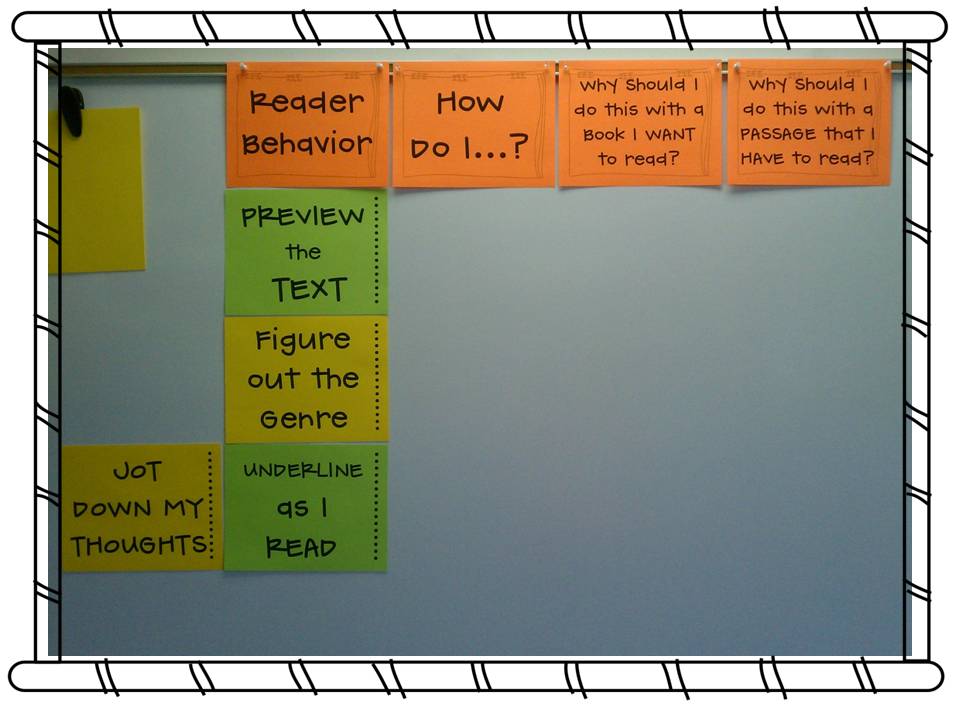
I have created a "Test-Prep" Minilessons Bulletin Board that I use to review strategies for reading comprehension that I have taught students all year long, but with a "this is what it looks like on the test" spin. This board allows me to move from what students KNOW about reading in general to how that applies to reading for a reading test.

This method considers “test prep passages” as another reading genre that students develop an understanding of how the test/passages are designed. (I’m sure you have done this all year with poetry, nonfiction, realistic fiction, science fiction, fantasy, opinion-based articles, etc.) Together, you and your students discover how a test is put together AND how what you have taught them to do all year as intelligent readers still applies in the setting of “test reading.”


My version of Question-Answer-Relationship is based off of the types of questions on our Reading EOG. All questions can be classified as "Right There"/"There and There," "Inferencing," "Overalls," and "Apply Prior Knowledge." Once studnets realize what question type they are working with, they can then go about the appropriate steps to figure out the right answer. I love these four types because it helps me remind my students that there are questions that ARE NOT directly answered by the text. The test will require them to THINK (at least a little) for themselves and use the knowledge they have learned.
I use a 4 step method to help students when they are finally answering questions. (WE do ALOT of work before we ever touch the questions!) I guide them through learning how to reword the questions (when necessary), mark out the obviously wrong answer (or 2), collect clues for the other answer choices, then make an educated decision (not a guess!) based on the information they have collected. Students are also required to write evidence (for or against) for each of the 4 answer choices. By the time they do this, they have typically figured out the right answer. You may decide to only use one of these questioning strategies (as I have in the past).

We are still in the beginning stages of our test prep because I know what my kiddos were capable of last year. We are still reading our independent books and I am conferring with students during our independent time. I'm sure we will dabble in reading and answering some of the passages this week, but I didn't want to get them started to soon (as 5th graders) and then have them burn out closer and closer to the test. Our first few lessons this week will be analyzing the types of questions they will be asked and talking about how we should think to answer those types of questions. I have typed up all of the Reading EOG questions from 3rd-8th grades for a student sorting lesson. This is included in the test prep download, but I have also uploaded it as a freebie (since I didn't write the questions myself, but made the sort so that we could use the questions in a different way). You may want to check out the grade levels before and after you as you work with students. I was uber surprised that 5th grade had no text-based features types of questions (we have NO NO NO graphics in our released set at all), but looking at 3rd or 4th (can't remember), they did have some text-feature based questions. Of course, I don't want my kiddos to be surprised by anything.


Although I am preparing my students for testing, I have lived by this ALL (of-my-teaching-career) YEAR!


Reading Tests: Questioning Lessons


What’s the purpose of having students sort questions independent of reading the text?

Allowing students to closely analyze questions helps them to make generalizations about the types of questions they can predict will be on the test and that they can expect for specific genres. Yes, you can do the sort for them and hand them a list of questions, but allowing them to come up with generalizations about the test questions takes your “test prep” from teacher-centered to student centered and considers testing a “genre” or “type of text” rather than an unpredictable “test.”

Today I wanted to share how our questioning lessons are going.

Day 1: I had students work in partners to sort the questions into categories that made sense to them. It was interesting (and telling) to see what kind of categories students came up with on their own. I went around from group to group listening to their ideas and pushing them to reconsider some of the questions they had placed in different categories. (We completed this sort prior to the kids reading the text--based on my experience, you can decide what kind of question MOST of them are without reading the text yet.)


Day 2: I gave students a copy of my Question-Answer-Relationship handout. I went through each type of question (which was review from last year) and then had them meet with their partner again to sort the questions into these four categories. Now, not having read the text, there are a few questions that fall between two of the types of questions.


Day 3: During minilesson, I gave each student two of the question cards and decided to start the lesson with the ones I had leftover. (Totally random, no strategic planning here). I called out one of my questions and we discussed where we would place it~"Right There/There and There," "Inferencing," "Overalls," or "Apply Prior Knowledge." Then, I asked students to raise their hands and share if they had a question like the one we had just categorized. Students read their questions one-by-one and we decided as a class if it fit the category. We continued until we had grouped and classified all questions. You can see our findings in the picture below. Each of these categories helps students tap into what skills and strategies they should use to answer the questions given. For example, if I have an overall question, I am going to pull from the beginning, middle, and end of the text (or a specific paragraph).


Here's how our questions fell into the categories:

"Right There/There and There"

* Literal Questions-We can go right back to the text and put our fingers on these.

Example: "Based on the selection, how did Roberto get to see the game?"

* Compare/Contrast Questions (need us to use information in two different places in the text)

Example: "How are butterflies and mosquitoes different?"; "Which statement shows a way some insects are similar to spiders?"

"Inferencing"

* Interpreting Figurative Language questions, using context clues for unknown words, and comprehension questions that go beyond the literal

Examples: "In paragraph 19, what is meant by 'Roberto's heart was in his stomach"?; "In the selection, what can be inferred about how the people viewed the old man?"; "What does the word shabbily mean as it is used in the text?"

"Overalls"

* Main idea, summary, theme, generalizing, author's point of view, etc.

Examples: "Which statement summarizes the theme of the selection?"; "What main ideas are supported by the selection?"

"Apply Prior Knowledge"

NONE!

***We talked about how none of the questions on our test would be true "prior knowledge" questions and that all of the questions were text-dependent. Now, when we take our SCIENCE EOG, ALLLLLLLLLLLL of the questions will fall under "prior knowledge." Interesting findings!

What are some ways I can use the questions for sorting?

• I think all sorts should be completed with partners or in small groups to encourage students to discuss what they are noticing and negotiate the categories.

• Allow students to sort the questions into any categories they see and then discuss as a group. (This would work well before you have introduced any of your Question-Answer-Relationship lessons and your “how to answer questions” lessons)

•After teaching your QAR lesson, have students re-sort the questions into the 4 categories (“Right There/There and There,” “Inferencing,” “Overall,” and “Apply Prior Knowledge.”) Within the 4 categories for QAR, see if you can come up with different types of each category. For example, “overall” questions include main idea, summarizing, theme, etc. while “inferencing” questions also include context clue questions because you use the text and your mind to infer word meaning.


My full Thinking Through Reading Questions Bulletin Board/Minilesson/Questioning Strategy Materials can be found here!

Sunday, May 5, 2013

Thinking through Reading Tests~FINALLY!

 My test prep product is finally ready to share. I have created a "Test-Prep" Minilessons Bulletin Board that I use to review strategies for reading comprehension that I have taught students all year long. This board allows me to move from what students KNOW about reading in general to how that applies to reading for a reading test.

This method considers “test prep passages” as another reading genre that students develop an understanding of how the test/passages are designed. (I’m sure you have done this all year with poetry, nonfiction, realistic fiction, science fiction, fantasy, opinion-based articles, etc.) Together, you and your students discover how a test is put together AND how what you have taught them to do all year as intelligent readers still applies in the setting of “test reading.”
My version of Question-Answer-Relationship is based off of the types of questions on our Reading EOG. All questions can be classified as "Right There"/"There and There," "Inferencing," "Overalls," and "Apply Prior Knowledge." Once studnets realize what question type they are working with, they can then go about the appropriate steps to figure out the right answer. I love these four types because it helps me remind my students that there are questions that ARE NOT directly answered by the text. The test will require them to THINK (at least a little) for themselves and use the knowledge they have learned.
I use a 4 step method to help students when they are finally answering questions. (WE do ALOT of work before we ever touch the questions!) I guide them through learning how to reword the questions (when necessary), mark out the obviously wrong answer (or 2), collect clues for the other answer choices, then make an educated decision (not a guess!) based on the information they have collected. Students are also required to write evidence (for or against) for each of the 4 answer choices. By the time they do this, they have typically figured out the right answer. You may decide to only use one of these questioning strategies (as I have in the past).

We are still in the beginning stages of our test prep because I know what my kiddos were capable of last year. We are still reading our independent books and I am conferring with students during our independent time. I'm sure we will dabble in reading and answering some of the passages this week, but I didn't want to get them started to soon (as 5th graders) and then have them burn out closer and closer to the test. Our first few lessons this week will be analyzing the types of questions they will be asked and talking about how we should think to answer those types of questions. I have typed up all of the Reading EOG questions from 3rd-8th grades for a student sorting lesson. This is included in the test prep download, but I have also uploaded it as a freebie (since I didn't write the questions myself, but made the sort so that we could use the questions in a different way). You may want to check out the grade levels before and after you as you work with students. I was uber surprised that 5th grade had no text-based features types of questions (we have NO NO NO graphics in our released set at all), but looking at 3rd or 4th (can't remember), they did have some text-feature based questions. Of course, I don't want my kiddos to be surprised by anything.


Although I am preparing my students for testing (3 weeks away), I have lived by this ALL (of-my-teaching-career) YEAR!
Sorry if this post is choppy or less-than-explained! But, I spent almost~the~whole~day trying to get this product together (and ready for me to use this week!) so I really wanted to get it shared with you all!

Monday, March 25, 2013

~FREE Planning Template~Standards for Math Practices

Looking for a way to plan your math lessons through the Common Core Standards for Mathematical practices?

The Standards for Mathematical Practices "describe the varieties of expertise that mathematics educators at all levels should be developing" in our students. The Standards for Mathematical Practices might seem like the 'unnecessary' icing on the Common Core cake, but I think they are so important.

Because the standards often overlap in a given activity, I wanted to be able to describe one aspect of my math plan and check off multiple practices. This editable template allows you to draft related lessons or units and document the mathematical practices students are engaging in.
The document also includes one math lesson as an example of how you can use the template. (a 5th grade measurement conversion question)

If you have not yet started planning through the mathematical practices, I encourage you to start small. Take a look at the practices. Which ones do you already feel you implement regularly in your classroom? Which math practices do you think 'I know how to do that' or 'I do that in unit xyz"? Which math practices have you perhaps never placed too much of an importance on in your classroom? Of the practices you have rated yourself lower on, which are you most excited about delving more into?

I ask these questions because these are the questions my team has been asking ourselves all year. We knew that our Common Core math conversations had to be different and that a focus on relevancy and the mathematical practices would push us outside of our regular math teaching habits. One of our biggest focuses this year was "Modeling with Mathematics." We have pushed ourselves to consider models in all of our teaching units. (I am not professing that we have hit the mark with our practices, but for a first year implementation of the Common Core, I think we have really prioritized these practices and our students have an idea of what they are...next year can only be better!)

I would love to hear your thoughts, questions, and musings about the mathematical practices. And, if you haven't yet picked up my free Mathematical Practices Summary Document, head on over.


Thursday, February 7, 2013

Math Practices Made Easy # 2

This is the second math practices made easy. If you missed the first one, you can find it here.

Today's teaching technique is one I found on the the teachingchannel.org. The teaching technique (routine graphic organizer) is called "Choose 3 Ways."

You can download the Choose 3 Ways word document from the teaching channel website. Check out the whole video below. This video is a solid example of how you could use the workshop model in math and I'm sure you will pick up on other useful techniques as you watch. Definitely worth the 5 minutes!


Monday, February 4, 2013

Why I LOVE Task Cards in Math: Top 10

Have you embraced task cards in your classroom? This year, I definitely have used task cards as one way to revolutionize my math classroom. Here is my Top 10 List of why I LOVE task cards in math.


10. Students think we are doing something fun because they get to move around the room. We are, but you'd think we were having a party sometimes. 
9. Students seem more willing to ask for help (maybe because the room is in action with everyone moving around and it feels safer than when they are only sitting at their desk).

8. ANSWER KEYS: easy checking! Immediate feedback!

7. If I am using them for two days, I can use the first day's results to create a small group for the following day.

6. My task cards usually provide two days worth of practice--easy, engaging, and effective lesson plans! I make more than enough task cards so that no one is able to complete them all in one session.

 Multiplying and Dividing Fractions 5th grade common core5. After using task cards in a whole group lesson, they are EASY PEASY to move to a station for more practice or review, use in an intervention group, or to differentiate for students who still need to work on the concept.

4.  Students seem more willing to persevere!
 Multiply Divide Fractions Task Cards 5th grade common core

3. Self-motivated students have the opportunity to push themselves. (They often are less likely to do this when the instructional mode is...textbook pg...wait...discuss...next textbook pg...wait...discuss. Anyone else use Math Expressions and have this problem?) 
2. After I explain how to work a problem to one student, I can ask that student to be the expert on that problem.

1. When it's time to go to recess, the kids yell "No. I don't want math to be over!" So rewarding! I would love to skip recess and keep doing math, but they never agree to this trade-off :)

Click here to check out my engaging task cards (each on a theme that you can use all year long). Although task cards are great for centers and stations, I always use them in whole-group instruction first.

Tammy

Tuesday, January 22, 2013

Everything's 10% off: Top 2 for Tuesday

You read it right! Since I haven't throw a sale (pre-winter break), I thought I would get back into the swing of offering two products at 10% off by having an "everything is 10% off sale TODAY and TOMORROW.

Top Two for Tuesday. Everything is 10 % off TODAY and TOMORROW. That's a mouthful of t's :)


During this sale, you might want to check out some new things I have worked on in the past month. (All Common Core Math Products).

(includes 24 multi-step word problems (on task cards), house plan "area" activity, and 4 multi-step extension problems)
  
(8 basic capacity conversion task cards, 24 multi-step task cards, list of Farmer Wayne and Jane's goods and how they packaged them, 8 multi-step task cards that require students to use addition, subtraction, multiplication and/or division to solve
 
(32 multiplying and dividing fractions task cards, Cupcake Shoppe Payroll problems (multiplying whole number/decimal), 4 Cupcake Shoppe Boxed Order Questions-modeling multiplication)

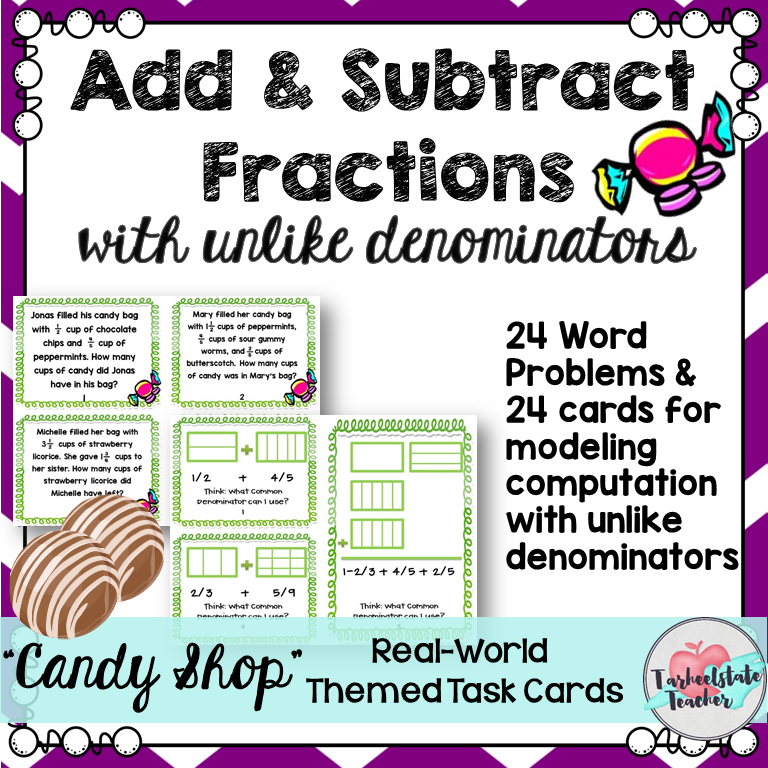
(16 adding and subtracting fractions (unlike denoms) task cards, 16 adding and subtracting fractions representational model problem)
 
All task card products include information for the teacher, student recording sheets, and answer keys. 


I hope you get to pick up some goodies at this sale! My kiddos are using the House Plan task cards right now in our real-world station and we used the Farmers' Market task cards this week to learn about Capacity and Weight.


LinkWithin

Related Posts Plugin for WordPress, Blogger...