Showing posts with label science. Show all posts

Wednesday, August 5, 2015

2014-2015 Top 10 Classroom Highlights

{I've fully transitioned my brain to blog at Tarheelstate Teacher but I'll be maintaining Life, Love, Literacy and cross-posting things from time to time. I'm so appreciative of my loyal followers and everyone who comes across this blog. I hope you continue to find useful posts here in the archives and that you follow me over @ Tarheelstate Teacher where it's only going to keep getting better and better :)}

I wanted to make sure you saw my 2014-2015 highlights posts. This post serves as a summary of my Top 10 Highlights from last year, including my bonus post of my favorite Math Highlights. Oh, and don't miss my "Stop Comparing Yourself to the Highlights Reel." It's perfect for back to school inspiration and helping calm your mind.


2014-2015 is a wrap! Personally, my brain starts transitioning to the next school year around March. Call it spring fever, but we're at the 300 yard mark in a 400 yard dash. Routines and procedures are {mostly} running smoothly, and I have some brain space available for thinking about next year.

Never in my career have I reflected on the school year as in depth as I have this past month. Making a Top 10 Highlights list forced me to reflect on the best parts of the 2014-2015 school year. As I shared many resources and project ideas, I documented my school year and cataloged some of my favorite classroom projects and experiences, most of them brand-new this year.

I'd like to impart to you that this reflective documentation of my work was a priceless teacher experience. During my New Year's goal setting period, I realized that I had become the kind of teacher who throws her planbook away each year {not literally} and starts from scratch {not all the time, but way too often}. This is not very efficient and often leaves me feeling like a first year teacher. This is unnecessary and I made a commitment to myself to stop reinventing the wheel ALL the time. This is not to say that I am unwilling to develop new lessons and materials, but that I should begin with considering what I have done in the past more often. My time is very important now that I have a family to love and take care of. Teaching should be manageable and falling back on what worked in the past is critical to managing this career. {I know your district probably won't say that to you, but take it from my 10 years of experience. Promise!}

Taking the time to announce what I loved @tarheelstateteacher.com will help me remember all that I did this year AND will help me choose to use some of these classroom activities again and again. If you can't tell, I highly recommend taking the time to reflect on this year's highlights--for now, stay away from all the stuff you want to change, and focus on the good stuff, what you and your students loved and why you loved it. Reignite the fire as you rejuvenate for next year!

I hope you found something that piqued your interest and inspired you as you plan for your 2015-2016 school year. {I'd love to hear more about your thoughts in the comments.} If you missed any of my highlights, you can click through here.

#10 Transitioning to a New School
#9 Spiral Math Homework
#8 "One Thing" Goal Setting Strategy
#7 School Budget {Govt} Project
#6 Bill Peet Author Study Projects
#5 Poetry Workshop
#4 {State} Travel Brochure Projects
#3 Classroom Read Alouds {Chapter Books}
#2 Ecosystems Museum Projects
#1 "Teach Me How to Teach" Projects

BONUS: Top Math Highlights

Don't be disappointed that this series has ended. I have re-envisioned my blog to really focus on reflection and documentation. My brain REALLY needs to reflect in a productive way and write. In truth, I am still reflecting on the school year. My "highlights" series focused on the positives from this year, but you will surely hear more about what I plan to continue doing and what I plan to change for 2015-2016. I look forward to sharing this love of teaching with you. Reignite your passion this summer!

Monday, March 16, 2015

Mobile Museum Ecosystems Exhibits~PBL~

Project-based learning has been in full swing for my 4th graders for the past month or so. I'm so excited to share the process and the results with you. My principal {requires} at least one project based unit each year. In our first "project" earlier this year, students negotiated and presented a $20,000 budget to the principal {for our government/economics unit}. If you are not familiar with project-based learning, the Buck Institute is a great place to start poking around. We were also strongly encouraged to figure out ways to incorporate the arts into our project because we are working to be recognized as a STEAM school. I decided to focus my PBL unit on Ecosystems/Organisms through an Ecosystems Mobile Museum Project--Project based learning? Check! Art...Oh yeah baby! {If you didn't catch my last post about my Ecosystems Research unit, you may want to go back and read that first.}

I dare say this project was more fun and meaningful AND allowed me to incorporate lots of Language Arts and technology goals into a science-based unit. I'm going to share what we did {and if you are a PROJECT BASED whiz, please forgive me for coming late to the game AND I  will admit that I do feel this is more INTEGRATED, INTERDISCIPLINARY than PBL, but it's a great start for this year}.

One note to keep in mind as you read, I collaborated with the 5th grade teacher for this unit, so anything I did focused on Organisms and Ecosystems of NC, she applied to world biomes to meet the 5th grade standards.

To launch our project, we planned a field trip to a local Natural Sciences museum. Before our visit to the museum, students received a "letter" from the museum challenging them to create a mobile museum to help the museum educate more children about ecosystems and organisms of North Carolina. The letter started with "You have been hired by the Museum of Natural Sciences to help create a mobile museum exhibit. A mobile museum exhibit is one that can be moved around from place to place. We believe that mobile museums are important for helping us educate more students beyond the walls of the museum."

Driving Question:
Project-based learning is supposed to start with a driving question. Our driving question was "How can we create a museum that educates children and adults of all ages about our state ecosystems and wildlife?"
In 4th grade, Students chose an organism local to NC’s coastal plain or the mountain region (also included temperate deciduous forest animals). 5th grade students focused on organisms from specific biomes. All students used the research pages provided to learn about their organism in-depth. The journal pages provided a focus for students’ research and the 5th grade teacher and I each chose the sheets that matched our standards.
After researching their organism, students wrote research papers AND turned those papers into Google slide shows (or other presentations) to be shown as interactive learning stations during the mobile museum. I also had plans for us to pull sentences and paragraphs from students’ articles to create informational posters for our mobile museum displays, but we didn't get the time to include this in our exhibit. {Can you say "SNOW DAYS"?}

After students completed their slideshows, I had them pair up with another student who studied a similar organism and they completed the venn diagram from my Ecosystems research booklet materials. I thought this was a great way for students to experience one another's projects, but then I also realized it was a great way for them to get feedback and a motivator for revision. So, after doing the comparison activity, I copied the niche, behavioral adaptations, and physical adaptations sheets and paired students again. This time, students had to try to fill in the niche and adaptations sheets using only the information their partner provided in the slideshow. (I call this "backwards mapping" as students were kind of trying to work backwards from the slideshow to the research template.) This activity created a lot of motivation to revise their projects and to include missing information. (Constructive feedback for 21 kids given by other classmates? PERFECTO!)
Simultaneously with our in-class research, students created a 3-D model of their organism with either clay or by felting in art class.
After getting a good grip on our research and slide shows, I divided students into groups based on their specific ecosystem (Mountains/Forest in Mountains, by the Riverside, in a Forest by the coast, etc) and they worked together to design ecosystem murals to serve as backdrops for our Mobile Museum Exhibits. {Mural design and painting happened mostly in my classroom! I was so scared to take on "real" art happening in my classroom, but now I'm so glad I did it!} I cut butcher paper fit to the size of tri-fold boards. Groups figured out how one backdrop would flow into the next so that we had a “mountains to sea” display.
When the mobile museum was ready, we opened in the cafeteria and invited parents and all classes to attend. In case you can't tell by the pictures below, it was AH~mazing!
As grade levels came to visit, my students grabbed one student and led them around the museum. (I made a little checklist/scavenger hunt of all the organisms in our museum so that they would have a little something to engage them at the museum.) I spent the morning watching my students share their slideshows and what they had learned with students in other grades. It was so cool to see a culmination of all their hard work!

I do have some wishes for what I wish we had time to add to these projects:
* I wanted a key of the organisms (instead of using the labels you see) where students create a simple illustration of the environment and use numbers and a key to identify each organism. (This is how it's done at our local museum's exhibits)
* I wanted foreground environmental stuff (you see those bare tables? I would have loved for students to have had time to add sticks, leaves, grass, moss, etc. to the displays)
* the DECOMPOSERS in the ecosystem are missing! (Whoops!!! Something else that needed to be added to the foreground)
* Using information from students' slideshows and research to add displays and info boxes to the exhibit (like at a real museum--you have info to read as you move through the exhibits)
* And lastly, I truly had the goal of having students create one hands-on learning tool in partners. This would have helped us better meet our "Driving Question" and would have required more critical thinking as students become teachers. The 5th graders were able to pull this off. Here's two examples from their projects:
You might ask how much time this took. We began our projects in January and wrapped up at the beginning of March. We also had nearly two weeks of snow days in there. I would estimate that we spent 2 weeks on research, 2 weeks on typing drafts, one week on slideshow creation and mural creation (same week), and that the art teacher used 5 or so art classes to help students get their 3D organisms completed. Keep in mind all of the standards I included with this one project--research and reading informational texts, writing informational texts, creating slideshows/utilizing technology, art, communicating and collaborating (to design a cohesive mural together), all of my ecosystems science goals, and a better understanding of the regions of North Carolina (social studies). I call this a WIN WIN! and my students are excited to do it again in 5th grade for their biomes unit!

I'll be reflecting on my {first} project-based learning unit  using this Project Design Rubric and a PBL Essential Elements Checklist, but for now, I'm going to bask in the glowing light of joy from having my students complete 3D organism models that look amazing, a collaborative mural backdrop that flows from one environment to the next, a final research booklet, research paper, and a google slide show. I can hardly measure the time put into this project, but I dare say it was less than or equal to what it would have taken to teach research, nonfiction writing, slideshow design, and ecosystems separately. And this project surely created memories of 4th grade!

Tuesday, October 29, 2013

Weather and Climate: Meteorology Handbook

http://www.teacherspayteachers.com/Product/Student-Illustrated-Weather-and-Climate-Meteorology-Handbook-46-Words-951147
I just completed another "labor of love." You know when I say that, I really mean "It was a heck of a lot of work to put this together and finalize it." Alas though, we are in the midst of launching our weather unit and I thought since my Human Body Systems Encyclopedia and my Force and Motion Illustrated Dictionary are such a hit with students, why not put all of our Weather and Climate vocabulary into one handbook. I know students will love the opportunity to create illustrations.

The download includes 10 Handbook pages and the nifty coverpage. What concepts are included? Glad you asked :)

Pg 3: Coverpage
Pg 4: Left intentionally blank
Pg 5: Meteorologist Photograph (students can draw themselves as a meteorologist)
Pg 6: “Introduction to Weather” vocabulary words
Pg 7: “Weather Tools”
Pg 8: “The water Cycle”
Pg 9: “Types of Clouds”
Pg 10: “Introduction to Climate”
Pg 11: “Global wind Patterns”
Pg 12: “Weather Phenomena”
Pg 13: “Types of Fronts”
Pg 14: “Describing Weather”
Pg 15: “Reading a Weather Map”
  

I hope to check in later this week to share a few more {free}weather resources and ideas with you. Happy teaching!


Sunday, July 21, 2013

Peek at My Week: Science Genetics Unit and MORE!


Here's to another Sunday spent planning.  The goal for next week is to get a few things planned before the weekend comes! To make this post a little shorter, I am breaking it into two parts. Tomorrow, I will share my reading and writing plans for some Minilesson Magic :)
Science:
This week, we have our mini-unit on genetics scheduled. Our students need to learn the following objectives:
* Explain why organisms differ from or are similar to their parents based on the characterisitcs of the organism.
* Give examples of likenesses that are inherited and some that are not.
For my student journal pgs, click here (free and in a pdf).

Monday: Set up science journals. The label shown above will be pasted into their notebook as a divider for our first unit of study. Complete the "Mice" assessment probe to see what students already think about how traits show up in organisms.
After students think about their own explanations, we will use the explanations above to make a bar graph for how they think offspring's fur color is decided. (This assessment probe comes from Page Keeley, Uncovering Student Ideas in Science).
Use 1st page of heredity video to explain heredity.
Tuesday: Fingerprints Lab (found this gem linked for free online)
Wednesday: Observing Human Traits Lab (free from Tamra Young on TPT); explain dominant and recessive traits and draw conclusions about what traits are dominant/recessive for humans based on classroom data)
Thursday: Complete active sort around the room for Inherited vs Acquired traits and make flipbook (free materials from Jennifer Findley)
Friday: Learn about Punnett Squares with Leprechaun Genetics (free from Making it Teacher

on TPT)
Other Resources that might be thrown in w/ extra time: 
Unit Outline from Moore County (includes a smartboard file to guide the mini-unit)
Peas in a Pod (Mendelian Genetics) online freebie; Questions to go along with the reading selection included (I made these last year)
Heredity (from Brainpop)
DNA (from Brainpop)
Animated Videos that explain DNA, genes, chromosomes, protein, heredity, and traits

Math:
This week in math, I will be getting to know my students better as mathematicians. I'm using some of the journal prompts/explorations from my Math Explorations that focuses on factors. (Not only will we learn about decomposing numbers, but students will be forced to use their multiplication facts). Since my Math Explorations are aligned with the mathematical practices, I thought it would be a good way to introduce concepts like communicating in math, perseverance, using multiple methods for showing work, using different strategies, etc. We are also going to continue working on our Summer Slide questions, which we started on Friday. 
Given time, I will also begin to introduce some of our math stations. For math stations, my team decided that we would have 4 stations this year, MATH SUPERSTARS, CONCEPT FOCUS, ALGEBRAIC, and something computer-based like Moby Max. 


 Morning Meeting:

 We are going to focus on perseverance all week. We have a county-wide assessment that is designed with all tasks focusing on perseverance, so this fits in nicely with morning meeting. The kiddos may not even realize they are being assessed.
Finish Strong
Erik Weihenmayer on Oprah (start at 1:21)


Hope you enjoyed peeking at my week! Tune in tomorrow for my reading/writing minilesson ideas for the week.

Sunday, May 12, 2013

Peek at My Week (this week and last!)

Hello all,
I missed Peek at My Week last week. I had all intentions of getting things shared before the week was up but I spent a lot of time on my Thinking through Reading Tests product and even revised it a little the day after I originally posted it.

If you missed my lessons on sorting question types, check it out. It's three days at least of meaningful test-prep plans with strategies that kids can use forever for all reading-type tests and even for open-ended questions. Heck, I think I will teach my QAR lessons from the beginning of the year next year.
I even had time last week to finish up a new product, Multiplying and Dividing with Decimals Task Cards. These questions are exactly like my Multiplying and Dividing Fractions task cards with the house plans theme, but the kids won't really care, will they? I teach those concepts so far apart, it will be nice for them to see the connections between decimals and fractions with these questions.

What did we do last week? You know, we worked on a lot of questions from released packets in math and used our questioning strategies on a passage a day during reading.

In science, we learned about Gregor Mendel and genetics. I had some good freebie resources I wanted to share with you in case you teach that too.
Peas in a Pod: Mendelian Genetics from Mensa for Kids. It looks like they have A LOT of other good resources that fit my science curriculum, so I will definitely be checking them out for more stuff later.
I made questions to go with the first two lessons from the Mensa for Kids Genetics lessons. You can grab it from my google docs to use with your students.

Finally, peek at my week, visually!
Morning Meeting:
Inspiring Kindness Video (song in video is GREAT!)


Hope you enjoyed peeking at my two weeks. What do you have going on?

Sunday, April 28, 2013

~~Peek at My Week: Lots of Science! and Test Talk~~

It's a busy week. Unlike last week, I might actually get to teach all day long, every day this week! (Except we have our DARE ceremony on Friday.) Otherwise, this week is perfectly intact, which means I should be getting my plans together!

Here's what we have on the agenda this week:

Reading EOG: Test Talk Time! We are starting this week with our Reading EOG prep. This is really a review since I had my babies last year and know what they are capable of. I am proud to say that we only have 4 weeks until testing. I am not stressed and neither should they be. But, we are going to turn our attention to making sure we remember to do what we know how to do. I created the following format/board for our EOG Minilessons. Basically, I want to take what students already know how to do, discuss why they use this strategy/skill with their own reading choices and then why it will be important and helpful on the EOG. The green/yellow signs are a few strategies that I remembered right off. My students have already reminded me of others that I have taught them. I will add those to the board later this week. (I may upload this set to TPT later this week, I'm just not sure it's ready yet!)
 
 
 To review for the science EOG, we are using:

Science Links: 
Matter: Properties and Change Vocabulary Mats
Matter: Properties and Change Vocabulary Activity Pack
Force and Motion Illustrated Dictionaries
Ecosystems Vocabulary Mats
Ecosystems Vocabulary Activity Pack
Weather Vocabulary Mats

I will be using these during my science block, some for morning work, and during some of our word study blocks. Students will also be able to take their vocabulary mats home to study their science vocabulary words. (Those words are make-it-or-break-it for the Science EOG!)

For more science products, click here.

Math Links:
Multiplying/Dividing Fractions
Add/Subtract with Unlike Denominators

Video Links:
A Child With Blindness (for morning meeting)
Check out Cafe Mom Studios for more videos like this (I am going to start using them during morning meeting to teach more about diversity, accepting others, compassion, overcoming our own obstacles, etc.)
Head over to Mrs. Wills for a Peek at everyone's Week. If you are a blogger, you should really start linking up with this linky. I LOVELOVELOVELOVELOVELOVE it! :)
And a teaser for tomorrow's Minilesson Magic (it's set to go live at 6 am so catch it!): Learn about Writing Riddles for Mini Research! :)


Wednesday, April 24, 2013

Purpose Games: Human Body System Links to Matching Games

Have you seen the purposegames.com website? I found it when I was planning for human body systems (but it has a million other concepts on it). Link this website NOW!!!!! I am especially excited about it because we will be 1-1 next year and with all of the concepts included (like 13 colonies), I will surely be able to find things for my students to practice daily. I love the idea of giving them 5 minutes at the beginning or end of each class period and watching them improve in their knowledge.

We are currently in the computer lab working on our Human Body System books. I took the time to link all of the following labeling games on my classroom website. (Lucky for you, if you want them, you should be able to copy them from my blog, paste them into your own website, and the hyperlinks will stay intact.)

Hope this website is a winner for your classroom! My kids are highly motivated to increase their accuracy percentages and reduce the time it takes them to complete the labeling. Happy Wednesday! 

Tuesday, April 23, 2013

Science Day Photo Blast!

Have you checked out my wacky week? It all started Monday with our Science Fun for Everyone Day.
Here are a few pics from our 3 sessions from today. (I have more, but they have kids in them and I just don't share their pics...I may have time to cover their faces later in the week. If so, I will update and share :) Now, I was totally off-focus today, so I'm not sure I can tell you everything they did! I had an IEP meeting for one hour of their sessions, then visited our book fair to choose my books.

Here goes....Sheep parts--see the brain, stomach, intestines, oh wow! I missed this part.
 Salt/Cell Experiment
 Cell goo...they got a little in a cup and put a fuzzy "nucleus" inside of the cell.
 Air pressure experiments: Can you fill the tube (made of grocery-bag-like plastic). You make it look full by applying pressure (pressing in) the ends. I also thought this would have been a great way to demonstrate/test students' lung capacity for Human Body Systems
 Newton's Law: You can hardly tell, but she is spinning a cup of water on a board attached to rope. No water spilled!
We LOOOOOOOOOVE science days at our school! If you are in the NC area, you should really look into these guys for next year. We have 3-70 minute sessions in one day. I am always amazed at how many activities the scientists are able to cram into one session and how engaged the kids are with all of the materials and learning opportunities. It's a great way to anchor future learning or future review. "Remember when you did...on your science day?" Let me explain more about that!

Happy Tuesday!

Sunday, April 14, 2013

Peek at My Week: Math Review, Human Body, Force and Motion

I'm linking up again for a Peek at My Week with  Deedee.
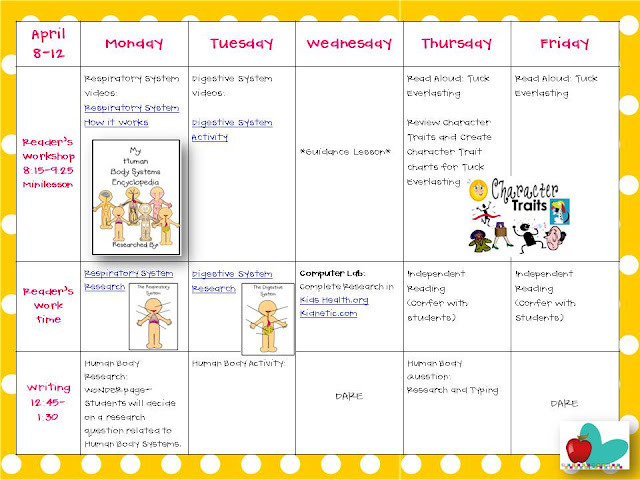
If you already checked out my plans for last week, I have updated them and moved things around to represent what we actually did. (You will notice I made changes with the Human Body Systems lessons and included links for the videos I used during reader's workshop to help students understand the body systems before they researched through reading. I also included what we discussed for morning meeting--this cannot always be planned the week before. Often, our topic comes from what we did the day before).This will probably be an obsession of mine--updating my posts to show my actual plans versus my projected plans. :) There's just never enough time for me to get ahead!


Weblinks:
Ms. Nelson is Missing Video (by Kindergartners found on Deedee's blog)--Too Stinking Cute not to use for Morning Meeting!)
Good Information for the confusing parts of Force and Motion (velocity, speed, and motion)

Bumper Car Physics
Roller Coasters: Build Your Own


Links to Products I am using this week:
Character Traits Definitions/Bulletin Board Posters


Force and Motion Illustrated Dictionary (Tarheelstate Teacher)
Bowling Ball Basics (FREE from Mrs. Kaiser, another NC teacher)
Math Common Core Assessments (Jennifer Findley)
Math Common Core Test Prep Helper (Jennifer Findley)
Cupcake Shoppe Multiply/Divide Fractions Problems (Tarheelstate Teacher)


Multiplying and Dividing Fractions with Area (House Plan Theme) (Tarheelstate Teacher)

Have a great week! I hope to get time to share something else this week too, even if it is just a photo dump! :)

LinkWithin

Related Posts Plugin for WordPress, Blogger...