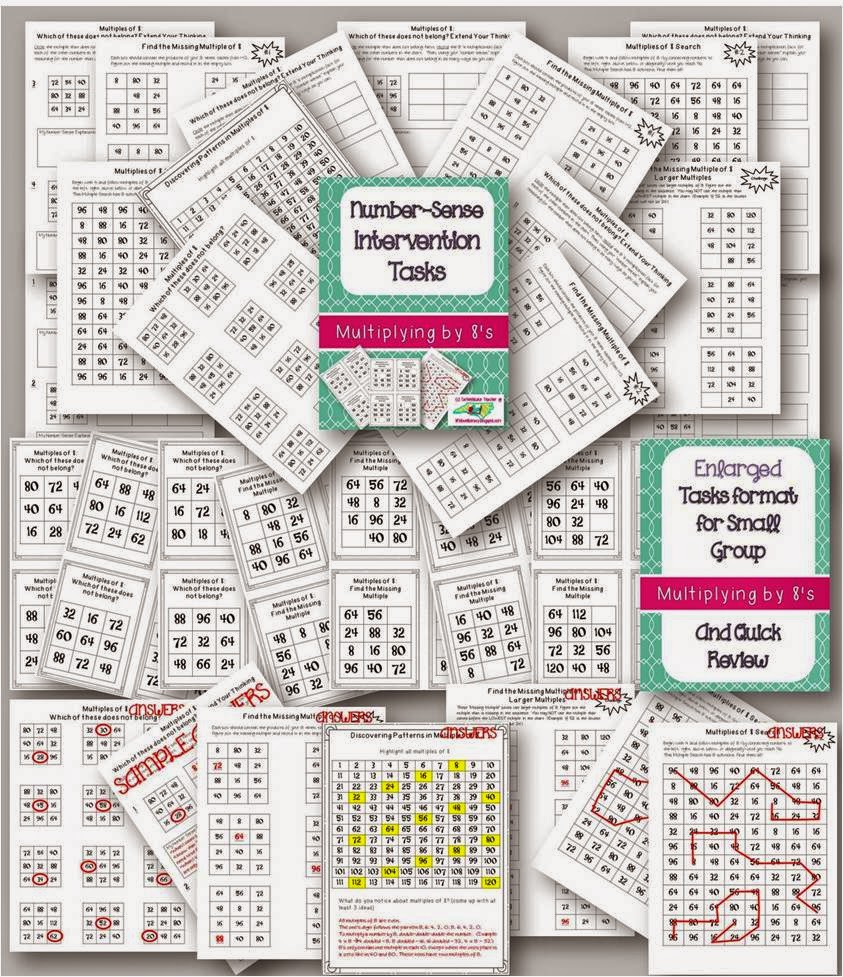
I have been on a journey this year to ensure that my 4th graders master their multiplication facts. When I use the term "master," I mean with fluency and automaticity--no tricks, no fingers, no count-by's down the side of their page--just automatic fact recall.Back to the cards, I took all of the "Find the Missing Multiples" and "Which Multiple Does Not Belong" activity cards, printed them on a different color of cardstock for each number set, and put them each on a ring. I try to meet with my Multiplication Intervention group for 20 minutes 3 or more times a week. I meet with them during one of their stations or while other students are completing task cards. I prioritize this group because I know that their math success and confidence lies in gaining better number sense. {I'm even thinking about starting a math/multiplication club during lunch once a week to move some of our practice time out of math class time}.
I love having these cards on a ring because they are ready to grab at any time that we have an extra minute to go over multiples and factors, and multiplication facts. (Think--lining up for specials, lunch, whole-class bathroom break times, end of the day, etc.) Just show one of the cards to your kiddos and teach them to allow others "wait time" before they shout out the answers. You can even have them give you a thumbs up when they are ready with an answer.

 Day 1:
Pre-Assess the Group using 1 to 4 of the "Which of These Does not Belong" puzzles. (I'd use the student notebook pages rather than the task cards for now because it gives them a place to write how they know the number does not belong.) Allow students to share their ideas to provide space for you to gauge misunderstandings and depth of understandings. {Some students have really great insights although they may have trouble with fact memorization}.
Day 2:
 Work together using Discovering Patterns to find patterns and rules for "multiples of..." the number you are working/intervening on. Continue getting students to verbalize the patterns they see. (For example, have you realized that some of your students may not realize that a multiple of 4 or 6 must ALWAYS be an even number? When I saw a student write 4 x 9 = 37, that's when I had my AH-ha! about number sense and multiplication facts.) I've included some of the ideas students should come up with in most of the downloads. This is the time to allow students to discover their own ideas, but also to hit home ones like when the multiples alternate even-odd-even-odd, or when all multiples are even.
Day 3-4: Go back to the "Which of these Does Not Belong" cards (for fun, game-like use in small group--I like to have students use a white board to jot down, rather than call out, their answer.) Use student notebook pages to have them explain how they know the number does not belong. Students can share in pairs or in the small group. Expect individual students to begin being able to explain deeper number sense as they pick up ideas from your teaching and other students' insights.
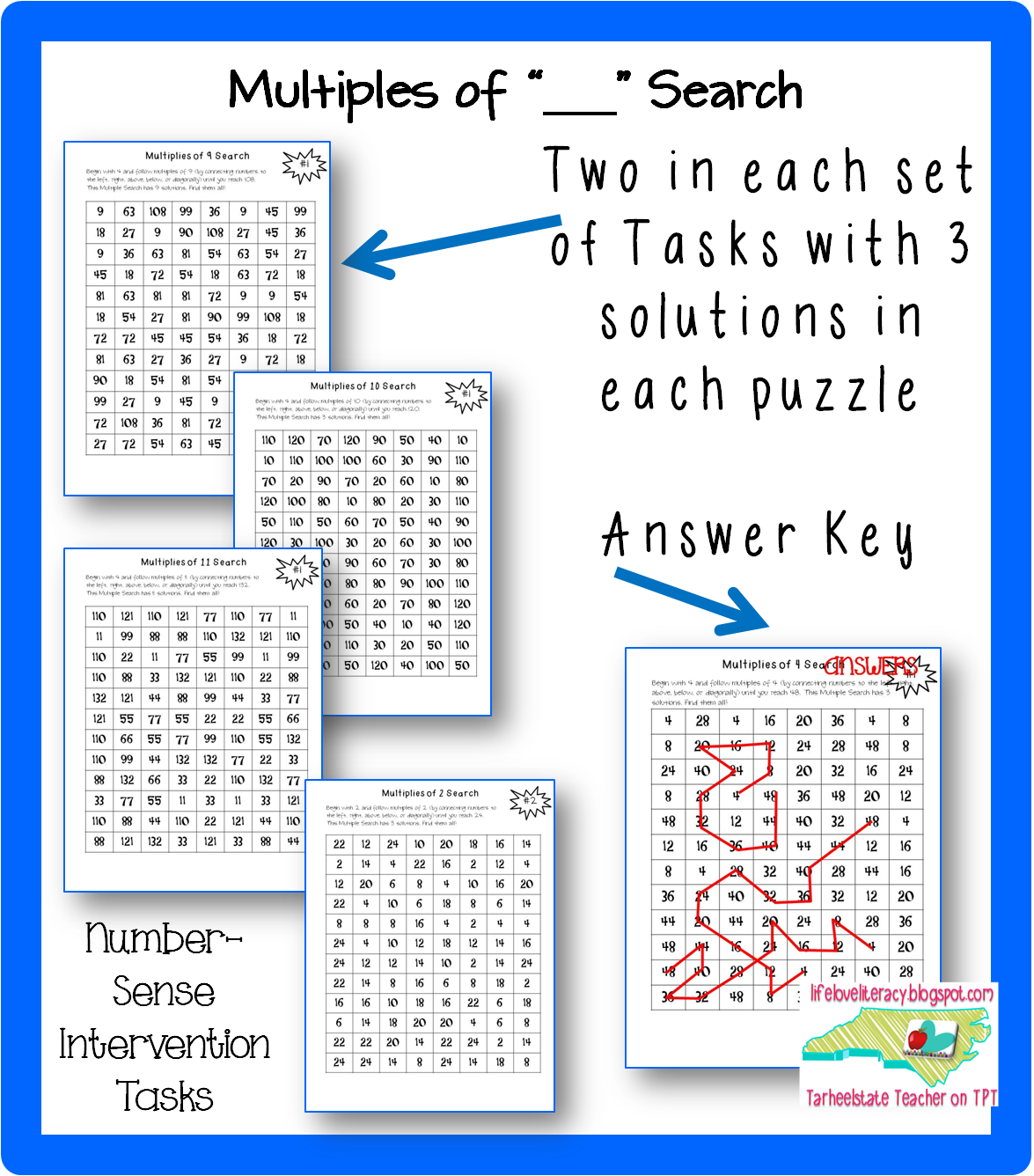
 Day 5 and on...Practice with reciting multiples using the "Find the Missing Multiple" and the Number Searches (like word searches). Students can complete these for morning work or in a quiet center/station. Encourage students to recite their multiples even if they know the answer to the puzzles. Multiples recitation is one of the building blocks to multiplication fact memorization. And dang, if they can't memorize a fact for whatever reason, I surely want them to be able to accurately and rapidly recite multiples WITHOUT finger-counting.
Other Ideas for Using the activity cards:
1) These intervention tasks are perfect for having a volunteer work with a child as an intervention. While I like to use these in a small group (to meet more students' needs), a volunteer could pull one child at a time and work more closely on the multiplication set that student needs. These resources and activities could even be used by an eager parent who wants to help their child master multiplication facts more quickly.
2) Based on where students are with mastering multiplication facts, create student groups. Once or twice a week, you can give students practice time in their small groups with the activity cards.
3) Using all of the multiplication intervention activity card sets (or combinations of sets) have students deal cards equally to one another (2-3 players) and play War or other type of game where students compare the answer they get when solving the puzzle and then whomever has the highest result (factor/multiple) gets to keep the cards.
4) Display problems on interactive whiteboard for "bell-ringers" or when you have extra time. Have students show their answers on a white board
I designed these intervention activities on the basis that many of my students who are not mastering their multiplication facts need to develop greater number sense and to increase their "count by" speed and ability. The more practice you can allow students, the better. They can complete the same activities again and again until they are comfortable with the multiples of a specific fact family. If you want to check these out on TPT, here's links to the BUNDLE pack and the individual sets. (Note that you can grab two right away for free!)
Multiplying by 2's TRY IT FREE
Multiplying by 3's
Multiplying by 4's
Multiplying by 5's
Multiplying by 6's
Multiplying by 7's
Multiplying by 8's
Multiplying by 9's
Multiplying by 10's
Multiplying by 11's
Multiplying by 12's
All of the Facts: Number Sense Intervention Bundle
And don't forget, the Teachers are Heroes sale is on {in about 10 minutes here!} and you can get many products up to 28% off. My store is on sale for ya and my cart is full!! It's a great time to re-stock since we are mid-year or pick up some bundles to save even more!

Happy night yall!