Wednesday, November 27, 2013

Fractions, Fractions, Fractions! ~Differentiation at its Best!


Hi All,
This post is going to be about FRACTIONS! And, DIFFERENTIATION (don't you love it when it just works out?) We have been working on adding and subtracting fractions with unlike denominators in my class. I started with Jennifer Findley's Winter Themed Fraction Centers, specifically I used the snow globes addition and subtraction of fractions task cards. (These were simple problems with unlike denominators that were easy to make common, no word problems, just equations, so a good first step for practice).

Once students understand finding common denominators, I always move to subtracting fractions with unlike denominators where you must "borrow" or "regroup." I decided to make my own problems for this concept, breaking the different types of borrowing problems down instead of using my old worksheets that had everything all mixed up.

I came up with three types of problems:
* Whole Number Start
* Mixed Numbers with Like Denominators (provides a scaffolding/easier set of problems for students who have difficulty moving to multi-step problems; they can get the hang of borrowing without having to worry about finding like denominators, then move on to putting it all together with the next set of task cards).
* Mixed Numbers with Unlike Denominators

For whole number start, I taught students to use the "add up to start" strategy:
I hoped to develop some mental math skills, and students loved it because they found this method to be simple to understand.

Now, did I mention that part of this post was about "differentiation at its best?" Well, this set of task cards (and a few others that I have) allowed me to differentiate for the different needs in my classroom. I copied each of the three sets on different colored card stock. (The three types of subtraction problems come with 16 questions, with two of the sets having 8 equations and 8 word problems).

Most of my students were able to complete all of the "whole number start" problems on the day I introduced it. (I am not always concerned that students finish all of a set of task cards, but that they get enough practice, so often, a handful of students don't end up finishing them.)

On the following day, I explained to students how to borrow 1 whole and convert it to the fractional parts that they needed in order to be able to subtract. I then explained that I had two sets of cards (one with like denominators and one with unlike) and allowed them to choose where to start. I also told them that if they weren't sure which would be best for them to start on, just ask me! (I held my breath hoping that students who needed to start on the easier problems--like denominators--would choose to do so...and they did!) Students who started with the like denominator problems (orange cards) moved on to the unlike denominators (green cards) later in the week.
Once students completed the green set of cards, they worked on my Candy Shop Task Cards (a mix of adding and subtracting fractions with unlike denominators, including problems where students have to borrow.)
http://www.teacherspayteachers.com/Product/Add-Sub-Fractions-w-Unlike-Denominators-Word-Problems-Candy-Shop-5NFA1-5NFA2-464987

 Subtracting Fractions with Unlike denominators task cards word problems

 Adding Subtracting Fractions Unlike Denominators Task Cards Word Problems Models
This is our second year teaching the Common Core State Standards, and I believe that I am finally getting my resources for math stocked so that I can better differentiate for my kiddos. I have a group of about 7 students that always need reinforcement of a lesson and move a lot slower than the rest of my class. Most of the rest of my students are "gifted" and just catch on to math concepts very quickly. What to do, what to do with all of these different levels of math students? Often, I introduce something quickly and allow my gifted students to ask questions as they are working, instead of trying to hit all of the ways they might see the problem. I have also developed the strategy of explaining a common question that pops up to one or two students and then asking them to teach others when they come to me with questions. It works out pretty well for us!

My group that moves a little slower gets a reteaching lesson, perhaps explained in a different way, and some extra practice with me before they head to working on task cards. They worked at the kidney table this week and I sat with  them for the most part. This group also benefits from immediate reinforcement, so I am sure to check their work regularly during task card work. (This also helps me catch them before they make a pattern of mistakes too many times.)

You know what else helped my differentiation the past two weeks? I was able to fit TWO large carpets in my room! I have one in front of my reader's workshop white board and one in front of my smartboard. I also have a kidney table, so I was able to send students to different carpets to work on the different levels of task cards. When students finished one set and got their answers checked, they are able to move on to the next carpet and set of questions. It worked like a well-oiled machine!

Next, we move on to multiplying and dividing fractions, so I have to assess what materials I already have for this and get to work on anything new that I need. You can check out all of my fractions products HERE as I reorganized and labeled some of my TPT store this week!

After a successful week of differentiation in math, I feel like "Genius teacher"~said with sarcasm! Will I ever perfect this machine? Sometimes I find myself relearning lessons that I thought I learned years ago (with 8.5 years under my belt); sometimes I find it hard to carry what I thought I learned from one group of students to another group, but then they show me that they need the same basic structure!
PS~When differentiating with a number of different task cards, worksheets, or problem sets, PREPARED ANSWER KEYS are a MUST for my sanity! All of my task card sets come with answer keys and I fully appreciate it when I buy a product that has provided a key!!! (Often, I let my students check themselves...they don't cheat and help themselves confirm answers!)

Monday, November 11, 2013

Motivate Students with Daily Reflections~FREEBIE

Are you in need of a way to motivate your students and hold them accountable? I am all about intrinsic motivation and doing your best because that is just what you are supposed to do. This quarter, I decided to start a daily reflection.
Each morning, students complete the top half of the reflection (related to homework and materials going to home from school and coming back to school). Throughout the day, students reflect on whether or not they gave "110%" in each of our subjects.

Last, before students pack up, they complete a reflection on what they are really proud of and what they need to work on from the day. Students must have this ready for me when I sign their assignment sheets (this is how they get out of the room to pack up) AND I require that they are thoughtful and write in complete sentences. If it is not completed in an acceptable manner, I send them back to their desks to try again. I also expect them to be specific. Instead of "I need to focus more," students must name a specific time when they should have focused better that day. To me, this helps them target that the next day.

What do students do with their reflections? Each morning, reflections are returned to students and they glue them in their "Morning Meeting" notebook.
The best part of this "motivational" strategy is that students are creating a record of their days at school. If they have a pattern of leaving materials at home, it is documented. If they have a pattern of not completing homework, it's written on the sheet. If they repeatedly choose not to give 110%, they have recorded that. Parents will see these at our quarterly student-parent meetings in a few weeks!

Another "best part" of this strategy is that students tell themselves what needs to improve. I think reflection is more powerful when it comes from within...back to that internal motivation! Hopefully, continuing to say the same things need to improve motivates students to put forth more effort to change that behavior.

I hope you can use this! Grab the free-editable template here in google docs. This version is in Times New Roman so that the formatting comes out correctly. You can change all of the student tasks to match what you do in your classroom.

Are you following my Facebook Page? Please head over and "like" it now!
https://www.facebook.com/lifeloveliteracybytarheelstateteacher


Happy motivating!

Saturday, November 9, 2013

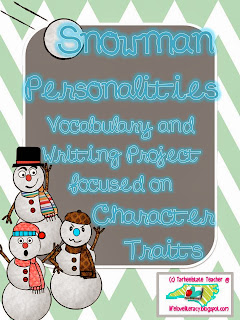
Pumpkin Personalities Pictures AND Snowman Personalities!

http://www.teacherspayteachers.com/Product/Pumpkin-Personalities-Vocabulary-and-Writing-Project30-Words-909745 
My students' pumpkins turned out super cute! This post is super-duper late in sharing, but you can celebrate with pumpkins all FALL long, right? I shared a little bit about this vocabulary and creative writing project here.
http://www.teacherspayteachers.com/Product/Pumpkin-Personalities-Vocabulary-and-Writing-Project30-Words-909745
This project provided us a nice break from essay writing (which we are cycling through all quarter). I had so much fun with my students' stories and word exploration, that I decided we are going to do the same project again with SNOWMAN PERSONALITIES!

Here's a peak at some of the materials:

http://www.teacherspayteachers.com/Product/Snowman-Personalities-Vocabulary-and-Writing-Project30-Words-968165

http://www.teacherspayteachers.com/Product/Snowman-Personalities-Vocabulary-and-Writing-Project30-Words-968165

We are going to make our 3D snowmen out of paper plates. If you want to go all out, you can get styrofoam balls in different sizes and have them decorate that way. For our pumpkin personalities projects, I think I rushed things a lot because I was trying to juggle our first essay cycle at the same time. Students did a lot of the work of writing their story for homework. For our snowman writing projects, I plan to set aside two weeks and focus more of our time on deeply understanding the word before they develop a story.

PS: If you want to do both, the 30 Words for each creative writing set are different, so your students will be exposed to new words!

Happy creativity in the classroom!

Tuesday, October 29, 2013

Weather and Climate: Meteorology Handbook

http://www.teacherspayteachers.com/Product/Student-Illustrated-Weather-and-Climate-Meteorology-Handbook-46-Words-951147
I just completed another "labor of love." You know when I say that, I really mean "It was a heck of a lot of work to put this together and finalize it." Alas though, we are in the midst of launching our weather unit and I thought since my Human Body Systems Encyclopedia and my Force and Motion Illustrated Dictionary are such a hit with students, why not put all of our Weather and Climate vocabulary into one handbook. I know students will love the opportunity to create illustrations.

The download includes 10 Handbook pages and the nifty coverpage. What concepts are included? Glad you asked :)

Pg 3: Coverpage
Pg 4: Left intentionally blank
Pg 5: Meteorologist Photograph (students can draw themselves as a meteorologist)
Pg 6: “Introduction to Weather” vocabulary words
Pg 7: “Weather Tools”
Pg 8: “The water Cycle”
Pg 9: “Types of Clouds”
Pg 10: “Introduction to Climate”
Pg 11: “Global wind Patterns”
Pg 12: “Weather Phenomena”
Pg 13: “Types of Fronts”
Pg 14: “Describing Weather”
Pg 15: “Reading a Weather Map”
  

I hope to check in later this week to share a few more {free}weather resources and ideas with you. Happy teaching!


Tuesday, October 15, 2013

Social Studies through FREEDOM and OPPRESSION

Are you capitalizing on every opportunity to teach your students about theme? Could conceptual lenses raise the level of the work your students do in social studies and help you meet some of your literacy goals? What is the purpose of a conceptual lens?

A CONCEPTUAL LENS NARROWS THE SCOPE AND PROVIDES DEEPER FOCUSES FOR CURRICULUM. It provides a reciprocal relationship between CONTENT learning and CONCEPTUAL levels of thinking. Conceptual lenses provide direction for the kinds of thinking that will be accomplished during a unit of study.

I got super-excited this year as I began teaching THEMES through my social studies instruction. Teaching through a conceptual lens has been the biggest shift in my social studies instruction this year and I believe it has made a huge difference. As students think about historical events through different lenses, they are learning to recognize patterns and make connections that transfer beyond social studies and that specific time period. In addition, this helps me FOCUS the materials I choose to use during the unit. 

One of the beauties of a theme or lens is that these "big ideas" can also be found as important themes in literature. Therefore, by teaching through a focused lens in social studies, you are providing students with opportunities to access literacy concepts and skills across the curriculum.

To begin my instruction with conceptual lenses, I decided that US History (and surely every other history) boils down to FREEDOM and OPPRESSION, and within that, a struggle for power. I decided that freedom and oppression would be my overarching themes for social studies this year.
These posters are currently hanging on a bulletin board in my classroom to remind students of these themes. 

Here's a basic outline of how I launched our yearlong theme and goal for social studies --thinking through FREEDOM and OPPRESSION:
 
Another option would be to use a book like Encounter by Jane Yolen and chart examples of freedom and oppression from both the point of view of the Spaniards and the natives.

I decided to think through the larger chunks of US History and come up with themes that are threaded through those time periods that could be used as conceptual lenses. Here's a peak at some of the other themes/conceptual lenses I came up with: 


Not only did I make these theme definitions for bulletin boards or to pull up on smartboards, I also created student journal definition pages. These are 4 to a page, so you can easily copy them and have students glue them into their notebooks. We put our freedom/oppression definitions on the first page so that we could continue to look back and reflect on how our current study relates to freedom and oppression.

I got so excited about conceptual lenses that I decided to also make fold-ables to go with the themes. 


(My conceptual lenses include: freedom, power, oppression, change, causes, effects, compromise, propaganda, conflict, perceptions, relationships, assimilation, revolution, independence, government, democracy, ideals, beliefs, advancement, division, discord, movement, equality, injustice, influence, prosperity, crisis, being responsible, wants, needs, educated decision, innovation, interconnectedness, globalization) You can find both of these products on TPT. 


Monday, October 14, 2013

~October Currently~Pumpkin Personalities!~

Yes, it is October...actually, we are almost 1/2 way through October. Where did this month go? Anywhoo--I love love love fall. Something about the leaves and the air and all of the pumpkins, but I don't enjoy the lack of daylight or the yucky weather we have been having this past week. We started our 2nd week back from Fall Break today and it has been nothing but wet and dreary. I believe we have had 1 day where we were able to go out for recess. Boo!

I wanted to do currently a couple of times this month, but I never sat down to get to it! Alas!


Listening: I'm sure you have heard this song, but if not:
This song makes me happy! "Even if the sky is falling down, I know that we'll be safe and sound!"

LOOOOOOVING: I broke up with my personal trainer. I had to cut the cord (it's waaaayyyy too expensive.) Last week, I joined the local gym--$27 a month. I can handle that. It's been a struggle to get my butt in the gym and kick my own tail...Today, I got dressed for the gym at school and subconsciously drove RIGHT PAST the road that the gym is on. I was really mad at myself for staying too late at school and not feeling the gym...and then passing it on by. Well, I decided I would punish myself with a run around the neighborhood and made it through a 45 minute run! Success today...

Thinking: I have been wanting to tell you about my amazing Fall Break vacations. I took two Carolina beach  trips, one to Charleston, SC and one to Nags Head, NC. I had the best company in the world (sweet bf <3) and we had perfect everything--weather, food, moods, sight-seeing, relaxation, no-work-just-enjoying-life. I got to visit Fort Sumter for the first time (pre-govt shutdown) and enjoyed a few art museums. Best of all, 1st vacation together, 4 days alone, no fights. :)


Wanting: shower (stinky from run), dinner (see "hangry" below :), shopping (new season throwing me off), weekend (self-explanatory :)

Needing: This weekend, I decided that the only things I needed in life were 1) food (I eat every 2.5 hours, and if I don't, I start to get a little "hangry."), 2) affection (I love love right now:) 3) sleep. I was feeling a little philosophical, but I think this list prioritizes life pretty well (throw in a little money, and life is good). In addition, more hours in the day would be great. I would love to have MORE time to "fill my potential" AND just be a lazy bum sometimes that floats around enjoying life!
 Trick or Treat: This would be a great treat for your students. Recently, I put together my "Pumpkin Personalities" Character Traits product for TPT. I've done a fun "Pumpkin Personalities" unit in my classroom since my first year. Here's the basic process you go through:


Unfortunately, I can't find any great pictures of our pumpkins, but I was able to find a few that give you an idea of what the project is like.


Happy October everyone! 
I wish you all tons of food, affection, and sleep :) 
 

Thursday, October 3, 2013

My Article was Published on a National Blog!!! Resiliency in the Classroom!

Wow! I am so super busy, but I wanted to share with you some exciting news. Recently, my principal asked me if I would like to write an article on resiliency for ASCD. ASCD promotes "whole child" education. The organization believes that "Each child, in each school, in each of our communities deserves to be healthy, safe, engaged, supported, and challenged. That's what a whole child approach to learning, teaching, and community engagement really is."

I hope you will head over to ASCD to read my article titled "Why Resilience is Critical in a Learning Environment." Right now, it is at the top of the main blog page! I just had to pinch myself!

Wednesday, October 2, 2013

Word Study Routine and Tips~Words their Way

Words Their Way, check out the foundational text by the same name. To see an example of the developmental spelling inventory, check out this tutorial from Pearsontraining.

In the past few years, I have tried different things, but worked to simplify the process of having too many groups, word lists, and activities for students to complete. I have also worked to find routine activities that remind students of the purpose of word study~that the spelling learning should transfer into our actual writing! I have found that students' spelling deteriorates when word study is dropped from the classroom (maybe students think you don't think spelling is important at that point?) and that if I can get my routines together, students actually have a lot of fun during word study.

Keep in mind that the routines and ideas I describe below are from the upper elementary perspective. Of course, modifications and scaffolding may be necessary for lower grades and weaker spellers.

Tip # 1: Stop planning Mon, Tues, Wed, Thurs, Fri routines and think of your word study activities as a cycle. Students cycle through all activities for each word list. This shift in thinking helped me tons--our schedule gets interrupted, so teaching students "This is what we do on Monday, Tuesday, Wednesday," was really always an issue. Now, I have a seven day cycle of activities for students, including a few whole group days where we work together. How do I keep up with where we are? I have a chart showing each groups' assignment for the day. We move a sticky note that says "We are Here!" each day. This also gives us the freedom to have "off" days where we do something else with our word study time.

Although we might take a week and a half to cycle through the activities for one word list, we value word study more because we know ALL of the routines are going to happen for that word list. When we are almost at the end of a quarter or a long break, I start staggering groups out of word study.

Here's my current word study cycle of activities (and it feels "successful" most of the time):
Day 1} Complete "Blind" Word Search and try to deduce current word sort rule or pattern. If you are familiar with Words Their Way, then you know that a "blind sort" is an activity where students sort the words into categories (and write them down) as they hear them called out. It's called BLIND because they are not looking at the words. By doing this "blind searching" through a word search, students have a fun way of figuring out their word pattern focus for the word study cycle. The word search WORD searching is an engaging, fun way for students to discover some of their words and sharpen their ability to recognize words that are spelled correctly (a major key to spelling improvement). Students also demonstrate their understanding of sorting by sound and/or look when they record the words they have found into categories. (Students have the word searches glued into their notebooks and MUST record the words as they find them by SORTING the words into categories)

Tip # 2: Once you assess students and decide which lists they will start with, make copies of the word searches they will need for the quarter and spend a session helping students glue the word searches into their notebooks. I save 2-3 pages between each word search for word work and for "Meet with the Teacher." Remind students to keep the word searches in order as they glue them!

Tip # 3: You can work with your lower group before they do Word Search day. This gives them exposure to the word patterns they will be working with and hopefully a boost of confidence as they search for their words. If you have younger students and want them to have a copy of the words, just give them the word list from the Word Study books, but I strongly encourage you to consider giving them a few words to get them started and then have them search for the patterns, rather than spoon-feeding them the whole list.

Day 2} Meet with the Teacher (includes sorting words, discussing word patterns/rules and word meanings, etc.)With average/higher groups, I ask what words they found in their word search and we sort them into categories on a white board. Sometimes I will provide them with other words they should have found, but hearing what their group members found gives them clues about what else to look for.


Tip # 4: The lower groups just need practice, practice, practice, and immediate feedback. When these kiddos meet with the teacher, I give them a white board, marker, and eraser and fire off words at them from the list they are on and from previous lists. We often have to focus on short sounds vs long sounds, words with double vowel patterns, and making sure we have represented all of the sounds found in the words.

Tip # 5: For your struggling spellers, try using compound words that still fit the patterns they are studying. This allows them to practice DOUBLE the words and will allow them to feel like they are working on words just as large as other groups in the class.

Wednesday, September 25, 2013

DIVISION w UNIT FRACTIONS~ Multi-Step Word Problems Around the USA theme

This....
          set....
                 of....
                       task...
                              cards...
                                     is

                                                            ~ FINALLY FINISHED!!!~
Sorry, had to take some breaths there. I had no idea what I was getting into with this brain child. I wanted to make some task cards to connect unit fractions with division (to help students go ahead and make that leap in their understanding and make connections more easily once we get to our fractions unit); simpler cards like those are probably on the way eventually because I know we will need the practice, but I also wanted to take my student work on task cards to a higher level this go round. Hence, I decided to make one paged task cards like my Multi-step Word Problems School Supply Themed Task Cards. Needless to say, I have put in the HOURS on this product, but I am loving it!

Although the inspiration for this set of word problems was division, you will see many common core concepts embedded in the questions. Because I want my students to have to think on their toes and continue using previously learned concepts in meaningful ways. For this set of "Around the USA" task cards I used data for the land area of different states and regions and the length of coastlines. Students will end up adding, subtracting, multiplying, and dividing while having to use their mastery of different number forms to interpret the numbers they are working with (word form, base-10 expanded form, expanded form, etc).

Here's a sample task card:
These cards will not be the kind of task cards that students can ~zip~ZIP~zip~ through (like mine are used to with other task cards we have worked on this year). I think these will be a good change of pace and I would expect that the average student only completes one of the ten task cards in a 20 minute station rotations. I plan to launch these in a whole group lesson (using one of the cards as a model), then to set aside at least one day for students to get a good grasp on working through the task cards. Next, the cards will move into one of my math stations and small groups for students who need extra assistance.

Here's the nifty Student Recording Booklet and the Teacher Answer Key:
Rather than kicking back and relaxing, I am off to put together my free Student/Parent Led Conferences freebie for you guys and work on some social studies ideas.

Friday, September 20, 2013

Student/Parent/Teacher Conferences and FREEBIE


Since we just wrapped up our quarter, we also had report card conferences. Have you ever implemented Student Led Conferences? I have done a number of conferences where I ask that students are present where we also set 1-2 goals. I'm a big fan of making sure that all involved parties (student, parent, and teacher) are on the same page, having the same conversations when appropriate, but this year I had a totally crazy idea!

What if students and parents led the conference? {I have to admit, part of this idea was PURE selfishness. Conferences take up a ridiculous amount of time, including many late evenings. This idea quickly started to evolve into a way that I could have multiple conferences happening at the same time and potentially finish them in less days and less long afternoons.} I had other great reasons too, including the positive experiences I have had with leading goal setting sessions with students and parents and having students attend their report card conferences.

How did I go about setting this up?
1) I chose 4 evenings that I would block off (over the course of 3 weeks) from 3-6 for parents/students to sign up. (I ended up doing this in only 3 evenings because I was sick one of the days and had to cancel all of those conferences.) I then sent an email to parents explaining how I wanted to do conferences this year.
Click the image to Go to the GoogleDoc version that you can copy and modify for yourself

2) Students completed a reflection on all subject areas during class prior to the start of conferences. (**I want to share this with you, but my best version is on my school computer. I will upload it later.)
3) I prepared a list of guiding questions for parents. (This matches the same order as the student reflection)
4) I decided what materials students would need in order to successfully discuss their learning. These items included:
* Readers Workshop Notebook
* Math Workshop Stations Folder and Math Notebook
* Writing Draft Folder
* Social Studies Assignments, including a nonfiction reading assignment

On the day of each round of conferences, I pulled the scheduled students together and asked them to sticky note two places in their reading journal that showed their best thinking. (One had to be a write about reading entry, but the other could be from minilesson and read aloud). Then students pulled all of the materials they would need and placed them in a basket.

Benefits:
* Students are in charge. Students are responsible for sharing what they have learned this year, including classroom routines and procedures.
* College and Career Readiness {baby}: Don't we all have to undergo annual reviews where we explain the work we have done so far this year, explain what we are working on, goals we have achieved, and things we would like to do better? This is such a great, real-world, career-related experience for students!
* I felt that parents received MORE infromation about what goes on in our classroom. Rather than presenting a report card and explaining 2's, 3's, and 4's in each area, they really could get a sense of what their child is accomplishing this year.

Wow! I didn't realize how rewarding this would truly be. First, just taking a look at students' reflections and seeing (in their own words, without any influence from me) how much they were loving 5th grade, how they were capable of recognizing the improvements they have already made, and how they were able to come up with ways to improve themselves was huge.

Second, it was AMAYahzing to hear students tell their parents what we were learning in class. I could not believe how everyone was able to spout off lessons I had taught...HELLoooo! They are listening!

What did I learn?
1) 3 sets of parents/students in the room at the same time is probably ideal. At one point, I had 4 in the room and I was concerned that parents might not have felt they were getting enough attention from me (although I don't think they felt this way, I was a little anxious for criticism of this new way of doing things).
2) Having a set of parents/student scheduled for a time slot ALONE was not ideal. It changed the feel of the conference. Since they were the only ones in the room, I was all to available for them and probably did too much leading of their conversation. These conferences also tended to go on for an hour because there was no pressure to finish or understanding that other groups of parents/students were moving along faster.
3) Some students were able to "blow smoke" when talking to their parents. I allowed the child to explain things from his/her perspective, but I was hoping the parents would probe more. When they didn't, I may have asked a probing question or let it go. In the end, the report card demonstrates a more accurate picture.

All in all, I think this was a great success and will do it again next year. For 2nd and 3rd quarters, I plan to have students complete the same type of reflection and invite parents in to do a check-in on what their child has accomplished with his/her goals that they set during 1st quarter conferences. I will probably offer two evening sessions for this and let it be solely parent/student led.

I've uploaded an editable version of the student reflection and conference questions to TPT. Of course, you will want to modify the questions and directions to fit your needs. If you use these materials or ideas, I would love to hear how it goes!
Are you following my facebook page and instagram? I'd love to have you join me on social media!

LinkWithin

Related Posts Plugin for WordPress, Blogger...