Monday, October 1, 2012

Monday's Minilesson Magic: Connecting to the Character's World

Welcome back for another "Monday's Minilesson Magic." I imagine it's that time of the year where you are working on fiction and thinking about characters in the story. Last year, my students and I learned from the Lucy Calkin's unit called "Following Character's Into Meaning." I called my unit:
The unit focuses heavily on learning about the characters world, living in their shoes, and being able to understand the character's motivations and reasons for their actions. I loved, loved, loved this unit, although we made modifications to the Lucy book along the way, I think it gave me new minilessons and I LOVE the sections on confering with readers and assessing students (not testing, but really getting at what they know or don't quite have yet).

Anyway, I think I digressed :)  From this unit,  my students and I were introduced to The Tiger Rising by Kate Dicamillo. OMG, if you have not read this book, please grab a copy now--one that you can write in if you read like me and love to underline and take notes about what you want to remember when you are reading it with your students. I am totally one of the SLOWEST readers, and I totally read this book trying to cherish every paragraph and every word, and I think I finished the book in about 2 hours. If you are not a slow reader like me, you can probably finish the book in one hour...Time well spent if a you are a lover of children's literature. This book definitely kept students wanting to listen for more!
The lesson I want to highlight today is how to help students "Walk in the Character's World." I guess what students are really doing in this lesson is comparing and contrasting the character's world to the world we live in. Here's our poster of Rob's World and Experiences VS My World and Experiences.
This poster is based on our reading of the first few (VERY SHORT) chapers of the book where we see Rob get bullied on the bus, we know it happens everyday, and we know the bus driver just ignores it.  Rob is also living in the Kentucky Star Motel with his dad because his mother died a few months ago of cancer. (OMG--can I do an it's about of The Tiger Rising? It's about grief; it's about different ways people deal with their problems--Rob stuffs his in an imaginary suitcase and Sistine lets hers explode; it's about the power of love and friendship; it's about how family doesn't always have to be blood related; it's about being new to a school/town; it's about sadness; it's about the rights of animals...) Can you tell how much we LOVE this book in my class? The story stayed with us ALL year! (and this year too!)

Okay, back to the minilesson. So, I chose these two details from the book to compare to my world. I told students that in my world, adults stand up for kids when they are getting bullied. In yellow, you can see where I pushed myself to think more about this and I said "This makes me think Rob must feel ALONE, INVISIBLE, and like noone cares."  For the living in a motel detail, I said it makes me think that a motel is not a place you stay for long, but Rob and his dad have been there for months. It's like they are stuck.

The next step to this lesson would be for students to create a chart like this to think about the world the characters in their independent books are living in. My students also continued this chart as I read aloud The Tiger Rising to push their thinking and give them a place for all of their great thoughts.

What do you think? Is this a lesson you normally teach? Have you read The Tiger Rising? Do you love it as much as my kiddos and I do?


Saturday, September 29, 2012

NEW Words Their Way Word Searches-Derivational Relations Spellers

Finally!!!

Remember about a YEAR ago when I made Word Searches for Words Their Way Syllables and Affixes Spellers and Within Word Pattern Spellers and promised to get the Derviational Relations Spellers word searches ready soon? (Ok, I just checked the post and it wasn't a whole year, just 9 months, so I shouldn't beat myself up so much :) Finally, I have them finished. I was highly motivated last night to get them finished because a TPT teacher/buyer asked if I had them finished yesterday AND because my collegue and I had just spent part of the day planning a word study schedule to group our kids together and share responsibility for the groups. Super excited about this! And of course we have a group in the blue book, so it will be SO NICE to already have the word searches ready to go for that group.
If you have these books, you probably call them like I do, "the red, the yellow, the green, the blue"--if you don't know about these books and need some help to de-stress word study OMG, run now to amazon.com and check them out. I HIGHLY recommend the Words Their Way Sort Books. Before these books, I dreaded planning for word study and coming up with appropriate lists on my own, and usually gave up before the year was over. Now, I just assess the kids, identify their levels, group them into 4-5 groups, and grab the appropriate word sort book for them. To make my word study life much better, I also make copies of the word sorts kids will need for the nine weeks. (Of course, we might decide to move kids around, but it's so nice to go to the copier once and not have to think about word study every single week). The books also contain teacher directions for each lesson, example sorts, and anything the kids need to know about meaning or etymology.

If you are unfamiliar with Words Their Way, check out the foundational text by the same name. To see an example of the developmental spelling inventory, check out this tutorial from Pearsontraining

What do you get if you purchase the Word Searches? 
* You get two choices for word searches: 1/2 pages (you can have students glue into their word study notebooks) or 1 pg sheets that provide a 1/2 page students to record the words they find and sort them).
* a sample word study schedule (explaining how I do staggered groups/rotations and the activities that kids are doing each day)
* binder cover (like you see above)
* personal words recording sheet (for words missed on the weekly assessment)
* other word study tips


For more info, check the word searches out at my TPT store. I have got RAVE reviews in the comments sections, especially about being a huge time saver! :)

Happy weekend! I'm off to enjoy crock pot spaghetti and a 5 layered cookie dessert with the family! (It's an eating cheat day for me!!! :) Yay)

Tuesday, September 25, 2012

Common Core Math Must Haves

Today I am sharing with you resources I have found helpful for implementing the Common Core Math Standards. Lots of the materials below are freebies and the non-freebies are still cheap and well worth the money spent. I'm not usually one to save a PDF that's already online to my computer, but I thought many of these were so great that I had to put them in my Common Core math file so that  I don't forget about them and can use them for planning.

Standards for Mathematical Practice Rubric for Teachers: Check out this rubric to see where you are on the continuum as you teach and implement the CC through the 8 Standards for Mathematical Practice.

Flipbooks for K-12 from the KATM (Kansas Assoc of Teachers of Mathematics): These flipbooks are documents designed to help teachers understand the standards and includes instructional strategies and examples. It looks like each flipbook contains somewhere between 50-70 pages. (This is a download AND print resource for me :) 

Math Journals/Notebook Questions: 90 Questions aligned to CC. The sheets are made to print on labels so that students can stick the questions in their math journals. I LOVE these questions and how they often lead us to higher levels of thinking. We often modify these questions for our math assessments. Currently, these are available for K-5. These will run you ~10, but also poke around the site for lots of free activities and ideas. 

Utah Education Network: I have loved this site for YEARS, but now even more because their common core resources for math are awesome. Click on a grade and standard and you get a set of instructional strategies, assessment questions, games, and all sorts of ideas. We refer to these documents often during our PLCs to help us design lessons and assessments. 

Jennifer Findley's TeachersPayTeachers Resouces I am using Jennifer's task cards in my Concept Station and for review/small group lessons. I plan to use Decimal of the Day when we return from break (this will be spiral review since we have already learned about decimals) and then use Fraction of the Day 3rd nine weeks (another spiral review as I am teaching fractions 2nd 9 weeks.)

I have been working hard to understand the Standards for Mathematical Practice. The SfMP are important because they "describe the varieties of expertise that mathematics educators at all levels should be developing" in our students. While we have specific standards in each domain, we should be embedding the standards for mathematical practice in all that we do. I have created a free resource that summarizes the Standards for Mathematical Practice. (I needed this resource for myself to help me wrap my brain around the Standards for Mathematical Practice so I hope it is helpful to you too!) 

What special resources have you found for unwrapping Math in the Common Core? Let us know in the comments below :)


Monday, September 24, 2012

Monday's Minilesson Magic: Thinking about Theme Strategy

Drumroll please...Today I am announcing my new weekly blog post topic: Monday's Minilesson Magic!!!!! I really want to dedicate myself to posting about something each week and I think minilessons will be such a useful topic for other teachers, for me to document what I am doing and reflect on how it went, and to push me to seek out new ideas---I hope you think so too and will plan to tune in every Monday to catch the newest Minilesson Magic focus and grab some ideas.

I have been horrible at my weekly poetry post (uh-hem, please forgive me!). I can't seem to get the writing/idea/creative teacher muse inspired on my Love of Language Post so I thought trying something more general might work better: MINILESSONS :) I teach those everyday right? So, surely I can work up some magic once a week to come up with good ideas to share with you for Monday's Minilesson Magic.

I thought for my first post, I would focus on a new strategy I used this year for thinking about theme. I am always, always, always trying to push students' thinking about reading and trying to give them ways to push themselves that are tangible. I came up with the "It's About..." strategy. When I say "It's about" now my students know what I'm talking about.

I first introduced the "It's About" strategy in our first reading unit that I call "Coaching Your Own Reading Life." For this unit, I chose Pictures of Hollis Woods by Patricia Reilly Giff as our main read aloud. Before this lesson, I brainstormed my own ideas for "It's About" and chose to model for students the ideas I came up with instead of letting them share their own. I wanted to ensure that they understood what I meant by "It's About" and I explained that I wanted us to get at what the book is really about. I wouldn't say "It's about a girl named Hollis Woods who is a foster child that always runs away from the families she is assigned to." This is a summary statement, and I want to get at what the book is REALLY about. (During this discussion, I never mentioned that I was talking about THEME because I wanted our thinking to be unlimited. I introduced these students to theme last year and did not want us to only be thinking about themes the way we had before.) This strategy also gets at author's message, what the author might be noticing in the world and trying to make a statement about, and lessons we could learn. Here's what I came up with:
As I continued this lesson, I told students "I keep having to stop myself from explaining why I think it's about this or that." I think holding myself back from discussing why I put it on the poster made students really eager to think about why that would be on the list. My next step in the lesson was to ask students to choose one of the it's about from my poster, list it on the top of their next clean Reader Response page, and start explain why they think it's about that idea. Of course, we closed the lesson by sharing some of our writing.

How did we take this brainstorm to the next level? In the next lesson, we discussed how we could use this to push our thinking and I modeled for students how I could plan for my written response by thinking about the examples and evidence from the text that make us think "It's About..." The "It's about" that stood out to me the most that I really wanted students to write and think about was "It's about Wishes and Wants." I modeled how we could list this idea at the top of our page and list the reasons/examples from the book that make us think it's about that. I also told them that my list could include some of my own thinking, like "Every child wants/needs a family." I told them this is my thought because this is what I know and think is true about the world.
This strategy has already started to spiral through our reading curriculum and I know it was so easy and tangible for students that I will continue to use it throughout the year. Recently, I posted about our Holocaust book clubs (our second reading unit was "Coaching Ourselves Through Historical Fiction.") We used the "It's About..." strategy to brainstorm ideas for what themes show up in our Holocaust books. Here's my "It's About" model for Rose Blanche (Roberto Innocenti) and Irena's Jar of Secrets (Marcia Vaughan), two picturebook read alouds I used during the Holocaust unit.
Sorry this chart is messy! Once we got going with our ideas, I quickly realized I should not have separated the chart for the two books because most of the themes/It's About ideas we had fit for both books. The beauty of this "It's About" chart and lesson was that I was really giving students ideas for their holocaust book club books because most of the themes show up in other books about the Holocaust. For active engagement, students began to brainstorm an "It's About" for their book club books and then used this in their book club discussions.

I hope you can use "It's About" in your classroom (although now that I have said "It's about" about a thousand times in this post...you can choose to call it something else :)

Oh and, second drumroll please! :) My Monday Minilesson Magic will always include a list of Common Core Connections at the end that correlates the lesson ideas with the common core standards for those of you who are teaching through the common core.

RL3.2 Determine the central message, lesson, or moral in the story and explain how it is conveyed through key details in the text.
RL4.1 Refer to details and examples in a text when explaining what the text says explicitly and when drawing inferences from the text.
RL4.2 Determine a theme of a story, drama, or poem from details in the text; summarize the text.
RL5.1 Quote accurately from a text when explaining what the text says explicitly and when drawing inferences from the text.
RL5.2 Determine a theme of a story, drama, or poem from details in the text.

What minilessons topics are you currently working on? What minilesson topics would you like FRESH ideas for? Let me know in the comments :)

See you again next Monday for more Minilesson Magic!
 

Sunday, September 23, 2012

Snapshots on Sunday: Overview of US History Classroom Timeline

Hi Friends! Happy Sunday :)

Today I am linking up with the clutter free classroom for "Snapshots on Sunday" with pictures from our social studies timelines. We have been developing a working understanding of time periods in United States history all year (we started in July :) through an introductory timeline activity at the beginning of the year, continuous timeline activities during our Colonization/Revolutionary War unit, and a "History is Interesting" feature article writing project to get us ready for our field trip to Washington DC.

During the first week of school, I kicked off social studies with an "Overview of US History" Timeline Activity. I printed everything for the timeline in color on cardstock. (Color because I wanted to display a pretty timeline in the classroom or hallway :) Here's what we did.

Each student received an event/time period card.

Students used their social studies books and other materials to research their time period and complete a summary sheet. (The purpose of this sheet was to represent their research.)

Next, students drew an illustration to represent their time period and recorded their summary again. (The purpose of this sheet was to create an illustration that would be displayed with the event card on our classroom timeline).
Now, I must confess that what I intended for us to do next (Jigsaw) got pushed to the side because it was the first week of school and because the actual research took us longer (2-3 days) than I thought it would. But, this was a great assessment activity for me to see how students' responded to our 5th grade social studies book, their understanding of history, how adept they were at identify what information was important, and whether or not they could write a clear summary.

So, since we didn't have time for students to share their history research at the beginning of the year, I decided to save the jigsawing to kickoff our "History is Interesting" Feature Article research projects. To set up, each student placed their event/era card, summary sheet, and illustration on their desk. We used my favorite jigsaw strategy:

1. Students move from desk to desk to take a look at their classmates' work. (I always have some students place their work in other places around the room to space my little worker-bees out around the room a little more).
2. Only one student can be at a desk at a time.
3. No talking, only reading and working. (Is this why I love the strategy so much? :)

Students are so engaged during this time and love looking at each others' work. It also eliminates the boredom of listening to 25 kids tell about their topic AND allows for students who can accomplish more/work faster to move through the assignment at their own pace.

So what did students do while they were moving around the room? Students recorded the time periods they learned about during the jigsaw in their Student Timeline Booklets. When students record an event on their timeline, they are required to write a summary and a simple symbol or illustration of the event.
 The final step was to display all of the students' work on our classroom timeline in the hallway.
If you are lucky enough to have a lot of wallspace for your timeline (I AM NOT :( :(!) I would suggest spacing out the events as much as you can to allot for the time periods you study in your social studies curriculum. I would love to have enough space to do a student illustrated activity for each era we student to show more specific events from each time period. Maybe I can figure out a way, but for now, this is what I have the space for in my hallway.


Today and Tomorrow only, you can get the Timeline Materials as a FREEBIE! After Monday, the timeline materials are $2.00. (Figuring out the dates for this timeline was a MASSIVE undertaking this summer--I never realized stamping down eras and the dates of time periods was so complicated, but I could not find a consistent list anywhere, so had to come up with this all on my own. I hope you can benefit from this work!) :)

Can't wait to see SNAPSHOTS from you classroom! Tune in tomorrow for a special announcement! :)

Friday, September 21, 2012

The Comprehension "Stoplight"

Freebie Fridays

Hi Everyone! I posted this NEW freebie on Thursday, but am linking up for Freebie Friday with www.teachingblogaddict.com. :) So exciting! I hope you can use this comprehension stoplight immediately in your classroom :)

 Ready? Set, Go! and Slow down, then Stop and Think :) In my classroom, I introduce students to the comprehension stoplight to help them think about different levels of thinking that we do before, during, and after reading. We talk about how readers should push (or "coach") themselves to think on all levels and as I teach minilessons, we discuss where that kind of thinking would fall on the comprehension stoplight. 

As readers move from learning to read actual words to interpreting what the words mean, the expectations for their thinking increase. Typically in 4th and 5th grades, students know that reading words is about getting the literal meaning of the text and that they should be understanding what they read, but often, we have to teach to and push them to describe their interpretive comprehension, and encourage, lead, and BEG them to engage in the "extension" types of thinking. (By beg, I mean I specifically set minilesson time aside where we talk about theme, generalizing lessons, author's message, text-text connections, etc. and then students apply this to their own books or a book we have been reading.) As readers move up in higher levels of books---as books get more complex--author’s expect us to think on deeper levels and connect with the meaning of the texts. Here are my basic definitions of each level of the stoplight along with a few questions that students might focus on at that level.


literal: (green--go--this is the most basic level of comprehension)
Who did what? What was the problem in the story? Who were the characters? How was the problem solved? What was the setting?

interpretation: (yellow) Thoughts that fall under interpretation use the text as evidence for the more profound thoughts we have. We usually have to slow down to catch ourselves having these thoughts or slow ourselves down to think more interpretively about the book.
How would you describe the character? Why? Why did the character behave the way they did? The author wrote the book that way because… I think the author’s message was…because…

extension: (red) To extend our thinking about a book beyond just that text, we usually have to stop and give ourselves time to think. (Often in my class, we use graphic organizers to help force ourselves into this kind of thinking). In this level of thinking, we are often making connections, thinking about theme, and generalizing the lessons of the story.
What was the author’s message to the world?
Have I read other books (movies, songs) with this same theme? How does the way this author has written about the theme compare to how other authors have written? 

I LOVE LOVE LOVE the comprehension stoplight because it is a concrete way to get students thinking about different levels of thinking that we should be doing while reading. (And it helps me eventually push them to better (read deeper) writing about reading.)

This year, when I introduced the comprehension stoplight, I gave students green, red, and yellow stickers and had them divide a page in their reader response notebook into the three sections. I then modeled how to apply the levels of thinking to our classroom read aloud. 

I hope you can use the levels of thinking in your own classroom. I have uploaded a pack of helpful materials for using the stoplight in your classroom to my TPT store. It includes the two graphics you see above as well as 1/4 sized graphics that you can print to have students put into their reader response notebooks or as bookmarks to remind them of the levels of thinking. I have also included a brief list of "I can statements" for each of the levels. (Would be a great list of "starter" mini-lessons to introduce the comprehension stoplight.) The best thing about this product is it's my latest FREEBIE!
 Enjoy!

Wednesday, September 19, 2012

New and Updated SCIENCE Vocabulary Products/Ideas

Recently, I have been updating my vocabulary activities for science. This year, we have new "Essential" standards in NC for Science and Social Studies. This means that many of my vocabulary mats for NC science units needed to be updated and that some others needed to be created because we have completely new objectives this year. 

Do you strategically and habitually focus on vocabulary in your content areas? Read my "Why Vocabulary Instruction" post to see why I think it's so important.

What's a vocabulary mat? A vocabulary mat is an idea I came up with to use instead of a regular flashcard strategy for learning and studying vocabulary. Imagine students with piles and piles of science vocabulary words to study. It can get overwhelming. With vocabulary mats, the sheet of related vocabulary words stays intact (preferably copied on card stock). Students place the definitions over the top of the correct vocabulary word. You could do this the opposite way (definition sheet stays intact and the vocabulary words are placed by students), but I thought about which way would force students to engage more with the definitions and decided that they were more likely to read the definitions if those were the cards they cut apart and held in their hands. You can use the vocabulary mats right at the beginning of a unit to assess students' knowledge of the important vocabulary words/concepts for the unit.

Here's a quick list of the new-or newly updated-vocabulary mat products. While I was focused on the NC Essential Standards, I am sure these vocabulary strategies would be useful for anyone teaching units focused on these topics.
         
The updated ecosystems mat includes one mat for ecosystems related words (producer, consumer, decomposer, food web, food chain, carnivore, omnivore, herbivore, etc) and another mat focused on types of Ecosystems (temperate deciduous forest, estuary, wetland, salt marsh, riparian marsh, temperate ocean, tropical ocean, tropical rain forest, coniferous forest, etc.) If you have purchased this product in the past, you can download the new update for free.
   
For Energy and Matter, I combined these vocabulary mats into one product. The vocabulary words are still on two separate mats, but I felt that many teachers might combine these concepts into one unit and would like to have both mats readily available. 

I also worked on my vocabulary activities packs for Ecosystems, Energy, and Matter. 
    

Each vocabulary pack contains the following activities: 
-Word Knowledge Continuum (full sheet, 1/2 sheet for science notebooks, and the posters below to use for a 4 corners word knowledge activity)

-Categorize and Label prior knowledge strategy (full sheet, 1/2 sheet for science notebooks)-students group words into categories that make sense to them and label. 
 *I use both of the above strategies on the first day of each science unit. It allows me to gauge students' prior knowledge while also exposing them to key words and creating excitement for our upcoming unit. For categorize and label, I allow misconceptions without correcting students. In future lessons, students go back to the categorize and label sheet and create new categories based on new learning.

-Vocabulary Cards for Student Sorting these can also be used on the first day(s) of the unit or placed in a station for students to practice categorizing the words more often. (I like to have students work in partners and record their sorts. Later, they can turn their sorts into concept maps). I also like to copy these onto cardstock.
-Simple Word Wall cards/vocabulary cards to display in room. I like to copy these on cardstock (a different color for each unit) and place magnetic tape on the back. As part of our science workshop debrief, we create a classroom "Categories and Labels" visual. We turn it into a concept map later by making it more detailed. (I will try to get you all a picture of what we have done for our ecosystems unit as an example :))
-Give 1, Get 1 Vocabulary/Unit review game In Give 1, Get 1, students prepare their sheet by filling out 4 blocks. They then move around the room trading with classmates until their card is full. (More detailed explanation is included with the vocabulary packs).

 I have vocabulary mats for other topics, including:

I hope you found ideas here that you can use in your own science (or other content area) instruction. It's so important to continuously expose students to vocabulary so that they become "owners" of those vocabulary words.

Happy Teaching!
 

Monday, September 3, 2012

Quick Freebie: Historical Fiction: Holocaust Parent Letter

Hi Friends!

Happy Labor Day!

Have you upper grades teachers been brave enough to embark on a study of the Holocaust? This year, we decided to use the Holocaust as our topic for our Historical Fiction reading unit, which includes student book clubs.

Here are the books we chose to use:


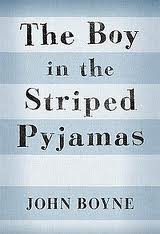
All of these books (except # the Stars were new to me). I had seen snippets of The Boy in the Striped Pajamas movie, but had not read the book. Of course, we were concerned about age appropriateness. Although I don't think I would embark on this study with lower than 5th graders, I felt all of the books were very appropriate and held students attention the whole time.

I love Jerry Spinelli and was so pulled into Milkweed (and Jerry's poetic, rich way of writing) that I had to run to Barnes and Noble to buy my own copy so that I could mark it up with underlines, stars, and comments. Yellow Star was the perfect book for my readers who need to build stamina. Jennifer Roy writes the story of her aunt Syvia (who was taken to Lodz ghetto with her family at the age of 4) and crafts the scenes of the story in short, easy to read poems. I also love this book for the historical fiction unit (although of course it isn't fiction) because each historical change or transition that happened in Lodz ghetto is written about through a nonfiction introduction before each section of the story. So, we hear about what was happening in a direct, historical summary sort of way, and then we read about it through Syvia's young eyes.  

The Boy in the Striped Pajamas was an easy read. If you have not read it, Bruno and his family move from Berlin to Auschwitz because Bruno's father is a high-ranking general. They live right outside of the concentration camp, and through exploration, Bruno meets Shmuel (a young Jewish boy, ironically born on the same exact day as Bruno) who lives on the other side of the fence. Throughout reading this novel, we have to pick up clues about how the Jews were treated, who Bruno's father is, and deal with the naivety of Bruno who complains about having to leave his 5 story house in Berlin as Shmuel is wasting away in the concentration camp.

In this unit, we have created double-timelines (using the top half for what is happening in the character's life and the bottom half to record the historical information we learn from the book). Students launched their book clubs by creating club names and club norms that they hold themselves accountable for following. My goal is that students read two books from the unit in their book clubs so that we can focus on making rich text-text connections and compare and contrast the characters, setting, and the author's handling of the material.

I thought you might like a copy of our parent letter that we sent home prior to the unit to give families a chance to talk about the topic, preview their child's book if desired, and ask questions about the unit. This has been one of my most favorite units as it has allowed us to talk about human behavior and to question history.

I have uploaded the letter to my teacherspayteachers store as a freebie. It is a word doc so that you can modify it however you like for your own use. 

I hope to have more time to write about this unit and share some of our minilessons. As for now, it's off to work on report cards...fortunately, we only have 9 more school days until our FALL BREAK!!! :) 

Sunday, August 12, 2012

Love of Language: Figurative Lang and Context Clue Examples

 
This year, I have decided to create a Love of Language in my classroom--not just with read alouds, but strategically and routinely through weekly lessons.


To prepare for my Love of Language Fridays, I pay attention to my read alouds throughout the week. I am on the lookout for examples of figurative language and unknown/new words that might allow us to practice developing our context clue skills. I pull examples of sentences and paragraphs that students would benefit from revisiting and analyzing. While a word may not be "unknown" to everyone (or I may have given a quick synonym for during the actual read aloud), I can still revisit the word to expose students to how to think about figuring out unknown words. Also, I choose examples from my read alouds because I like for the examples to be familiar to students when we discuss the figurative language/poetic devices and practice using context clues to figure out the meaning.

Friday's reading minilesson focuses on those examples of figurative language and unknown words in context. (After teaching these lessons a few weeks now, I have found that we only have time for working with figurative language or context clue examples if I have a lot of examples to share. I'm sure if I would keep it to one example of each, we could do both in one lesson.) To prepare for Friday, I type up the examples in cute font and print them on large sized paper (11x17).

Here are my examples for my first Love of Language lesson.

The figurative language example comes from Bedhead by Margie Palatini and the context clue example comes from Pictures of Hollis Woods by Patricia Reilly Giff. We used Bedhead as a writing mentor this week and we are reading Pictures of Hollis Woods for read aloud.
What do students do with these examples? Students have a Love of Language binder with 5 sections: 
–Word of the Week (WOW)
 –Nifty Thrifty Fifty (NFT)/Content Vocab 
–Context Clues 
–Figurative Language 
–Poems

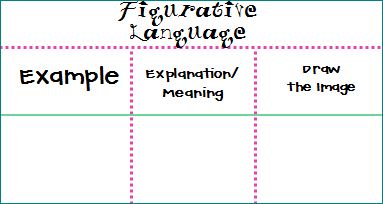
In the Figurative Language Section, students have a graphic organizer that looks like this: 
 
Through our discussion, students noted that in "spilled, spit, and sputtered" the author used alliteration. "Two-toast Toasties did triple back-flips onto the breakfast table" also contained alliteration but was an example of personification, too. Students recorded this example under the example column, then explained what the excerpt meant. Next, they drew a picture that represented the image.

In the context clues section, students complete a graphic organizer that looks like this:
 
Students record the example ("We lumbered up the main street of Hancock, passing a row of houses and a movie theater, and came to a stop in front of a diner."), we discuss the possible clues given--we decided that lumbered was a verb and that it must have described some sort of movement, maybe slowly or maybe they were walking up hill or maybe they were tired as they traveled through the town. Then, students record the meaning of the unknown word and the type of context clues we used to help us decide on the meaning. In this case, we decided that the placement of the word in the sentence let us know it was a verb/movement and the context helped us with the mood of the word.

Are you ready to start a love of language? Click here to read more or here to preview my teacherspayteachers love of language product.


Saturday, August 11, 2012

Back to School SALE! SALE! SALE! (2012-2013)

It's that time of year again! TPT will be holding a Back to School sale tomorrow, August 12 thru Monday August 13. You can get everything on the site 10% off. This is in addition to the sales that many sellers are also holding. The TPT code is BTS12. In addition to the TPT discount, all items in my store will be 10 % off.

I was already thinking about recommending items for BACK TO SCHOOL, so now I can recommend items AND you can get them on SALE! :) Here goes:

Reading:

Love of Language Program: Aligned with Common Core in Mind (includes graphic organizers for word learning, vocabulary in context, nifty thrifty fifty, and more; the program is explained so that you can implement it immediately. Check out my L<3L classroom bulletin boards and learn more about the program here. 

Nonfiction Informational Reading Strategies and Graphic Organizers(perfect for Common Core Reading Information strands)
Character Trait Definition Cards, Powerpoint, and Activity Graphic Organizers (one of my best sellers!)


Word Study: Words Their Way Word Searches
Within Word Pattern Spellers Word Searches

Syllables and Affixes Spellers Word Searches
(These products also includes a structure for word study and extra goodies).

Social Studies:
US History Student Timeline Booklets (These will be a measly 2.43 with my sale and the coupon!)
My students have loved using the Timeline booklets this year. Often, I use it as a tool to jigsaw the events we have learned about during our 2-3 days of research. I will also be pulling them into our reader's workshop when we study historical fiction. The possibilities are endless!

Be sure to peruse the other items in my store. Happy Back to School! I hope your new year starts off as smoothly and wonderfully as mine has (with my looping kiddos :)).

Thursday, August 2, 2012

Back to School 2012-2013 Social Studies Workshop Part 2

In this post, I hope to get into the nuts and bolts of my social studies workshop. How do I plan for each component of the workshop and the flow of the week?

Well, first I have to explain my change in thinking  about how to plan for social studies.

I used to think "Okay, I'm teaching Colonization/Revolutionary War for 4 weeks and we will get as far as we get before it's time to move on to Science." Depending on the how fast the group of children works, we may get through activities and assignments at a good pace, but inevitably, I have to cut some of my activities and learning plans.

By planning through the workshop model, I figured out that it makes sense to break the concept down into smaller topics and plan to spend just a week on those concepts. I chose to break our Colonization/Revolutionary War unit into the following 4 topics: Week 1: The Thirteen Colonies, Week 2: The Colonies Rebel, Week 3: Important People of the Revolution, Week 4: Important Battles of the Revolution. This will nicely set the foundation for our 2nd nine weeks' social studies unit, Government.

Okay, let's get to planning. Here's my social studies planning template again:
 
1st, I gather many different kinds of resources and decide on my minilesson plans. Will I use a read aloud, poem, video clip, interactive smartboard activity, or a question and quick write to launch a discussion? Is there an important person or event that students won't learn about through their work stations that I can teach them about in minilesson?

Next, I pull materials for small groups. We have guided reading materials that came with our social studies textbook. These are good for my below-grade level and average readers. For my higher readers, I plan to use the Joy Hakim series entitled A History of US. I could also choose to use historical fiction and make the small groups more like a book club. (I may do this later in the year for another unit, but for our first unit, I chose to focus on nonfiction reading skills.) We have a great book room that we have worked hard over the years to make sure provides us with materials that connect to the content areas. With social studies workshop, now we can definitely utilize them even if we are studying fiction in readers' workshop. Sometimes it might even make sense for me to pull a chapter from the social studies book to utilize during small groups--the possibilities are truly endless, but  I want to make sure I am supporting students' learning of literacy skills and deepening their understanding of the time period.

Next, I think about what stations or tasks I want to have. With stations being Tues, Wed, and Thurs, students will have two stations and one day that they meet with me during the work time portion of our workshop. What materials and activities have I used in the past that I want to use in stations? For this first go-round, one of my stations will be computer-based so that students can use technology to learn and one of my stations will be a research station that allows us to share our learning through a jigsaw or carousel activity on Fridays.

Now that I am ready, I group my students and think about which day would be best to meet with each group. Might one group of my students need me to teach them research strategies in their small group before they go to the research station? (Of course!). I also think about which students would benefit from a partner at the computer station and research station and try to organize my groups so that they have the support they need while I am working with small groups.

One last thing I have to plan for is fast-finishers. Now, with this structure, I feel like I will rarely have fast finishers, but I still need to plan for them given that one of my purposes for social studies workshop was that some students could accomplish more learning during social studies time. I decided to begin with three simple choices for our first unit: pull a book from the Colonial/Revolutionary War book bin, read, and represent your learning in your knowledge notebook; choose one of the RAFT writing ideas and write a piece in your knowledge notebook; work on your timeline booklet, adding more events from this time period.

I may change this structure as the year goes on, but these are my plans for using a workshop model in our first social studies unit. I'm super excited to see how it goes.

How is your social studies instruction going? Am I just a slow-learner or are these the things you tweak as you gain more experience?

LinkWithin

Related Posts Plugin for WordPress, Blogger...